A clean submission is not a file with a lot of documents. It is a file that tells one consistent, supportable story.
Most underwriting emergencies do not begin in underwriting. They begin earlier—with a number that was never reconciled, a deposit nobody asked about, a debt that did not make it onto the application, or a property detail that does not fit the loan program. The goal of a pre-underwriting review is simple: find the question before the underwriter has to ask it.
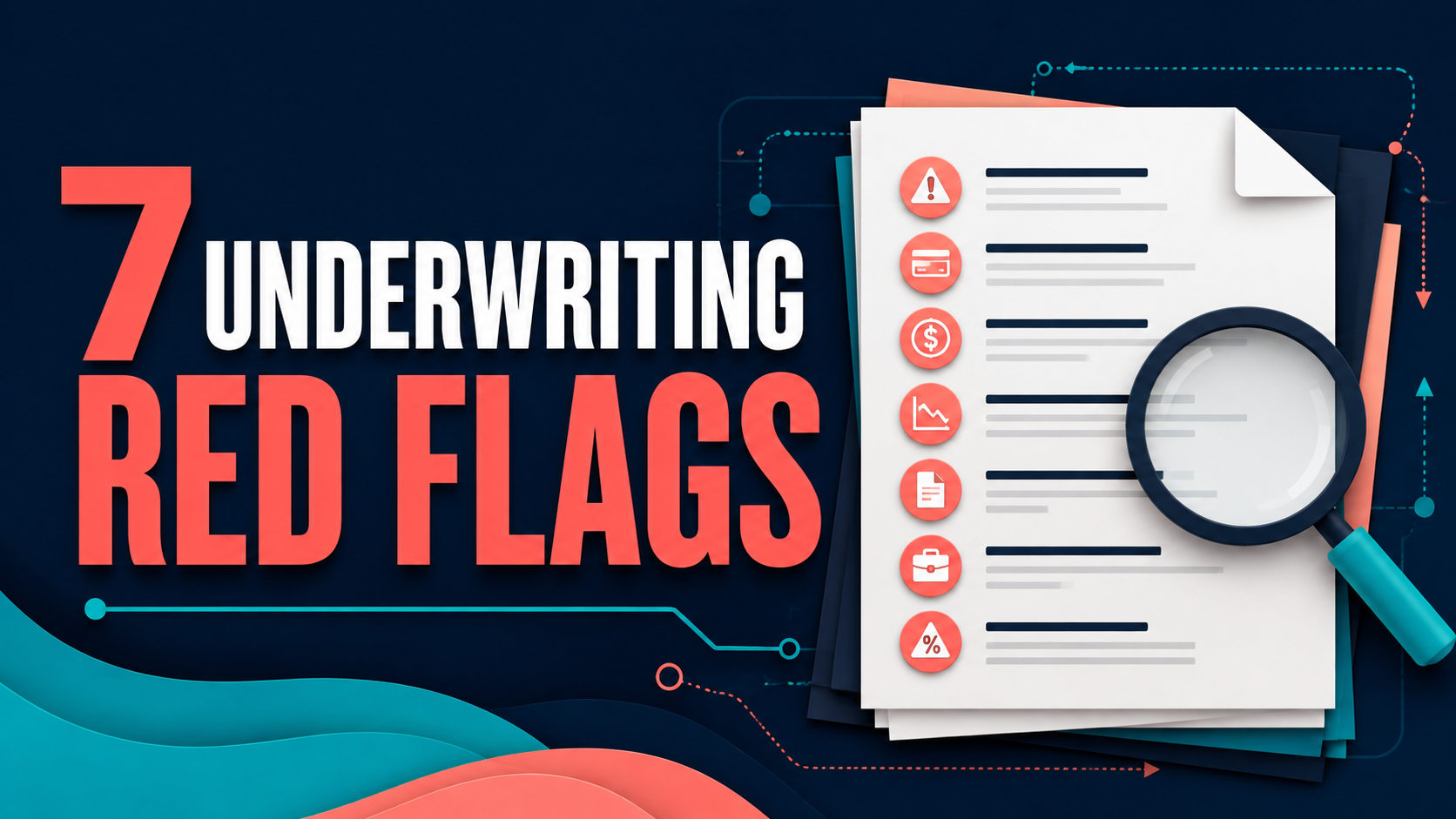
Find it. Learn it. Put it to work. Use these seven red flags as a repeatable audit before every file leaves origination.
1. The income documents do not agree
Compare the application, paystubs, W-2s, tax returns, written or electronic verifications, and your income calculation. Look for different employers, job titles, start dates, pay rates, hours, year-to-date totals, or pay frequencies. A small difference may have an easy explanation. An unexplained difference creates a condition—and sometimes changes qualifying income.
- Recalculate base pay from the actual pay frequency.
- Compare year-to-date earnings with the expected pace for the year.
- Separate base income from overtime, bonus, commission, shift differential, per diem, and reimbursements.
- Document employment gaps, recent raises, leave, or a change in position before submission.
Ask: “If I knew nothing about this borrower, would these documents lead me to the same monthly income shown in the file?” Fannie Mae’s current guidance requires employment income used for qualification to be verified and applies the same documentation standards whether a file is processed through automated or manual underwriting. Review Fannie Mae’s employment and income documentation standards.
2. Variable income is being treated like guaranteed income
Overtime, bonus, commission, fluctuating hours, seasonal earnings, and other variable income require more than a current paystub. The file should explain the history, calculation, trend, and likelihood of continuance required by the applicable program and investor.
- Do not annualize one unusually strong pay period.
- Compare the current year with prior years and investigate a downward trend.
- Confirm whether the income is recurring or tied to a one-time event.
- Keep your written calculation in the file so the processor and underwriter can follow it.
Quick note template: “Income used is $____ per month, based on ____. The history reviewed covers ____. The current trend is ____. The following variance was investigated: ____.”
3. The money is present—but the source is not clear
A bank balance is not the same thing as verified eligible funds. Review every account being used for earnest money, down payment, closing costs, reserves, or debt payoff. Identify transfers between accounts, recent deposits, cash deposits, gift activity, business funds, retirement withdrawals, and borrowed funds.
- Trace transfers from the source account through the receiving account.
- Match earnest-money evidence to the contract and cleared transaction.
- Collect gift documentation in the correct sequence for the program.
- Ask about business cash-flow impact before using business assets.
- Do not assume a large deposit can simply be ignored; document why it is or is not needed.
Freddie Mac’s guide includes specific requirements for borrower funds and for documenting certain deposits, while the CFPB reminds consumers that lenders typically must document the source of funds brought to closing. See Freddie Mac Guide Section 5307.1 and the CFPB Loan Estimate explainer.
4. The application does not include every liability
Credit reports do not tell the whole story. Ask directly about child support, alimony, payment plans, buy-now-pay-later accounts, co-signed debts, business debts paid personally, loans against assets, undisclosed mortgages, student loans, tax obligations, and debts opened after the initial credit pull.
- Compare credit inquiries with the borrower’s explanation.
- Reconcile monthly statements to debts shown on the application.
- Review real-estate-owned schedules against credit, taxes, insurance, and mortgage statements.
- Document any debt you propose to omit and the exact guideline supporting that treatment.
Fannie Mae states that the risk analysis must include liabilities that affect the borrower’s ability to meet the mortgage obligation. Review Fannie Mae’s general liability guidance and its current monthly-debt guidance.
5. The borrower’s credit profile changed after preapproval
A preapproval is a snapshot. Before submission, ask whether the borrower has opened an account, increased balances, missed a payment, financed furniture, co-signed, disputed an account, changed an authorized-user relationship, or received a new collection. Then compare the answer with available credit updates and account documents.
Borrower script: “Before we send your file to underwriting, I need one last financial checkup. Since we reviewed your credit, have you opened, closed, financed, co-signed, disputed, or paid late on anything—even if the payment has not appeared on your credit report yet?”
6. The property, occupancy, and loan program do not fit together
Underwriting is evaluating both the borrower and the transaction. Review the contract, MLS details, application, appraisal status, title information, property type, occupancy, number of units, HOA or condo status, manufactured-home characteristics, mixed use, repairs, concessions, interested-party contributions, and planned use of the property.
- Confirm the address, sales price, seller credits, earnest money, and closing date match across documents.
- Ask whether the borrower plans to occupy the home, rent part of it, or use it for business.
- Identify property types that require additional eligibility review before appraisal or underwriting.
- Confirm that concessions and financing structure fit the selected program.
A strong file does not hide a complication. It names the complication and shows the proposed path through it.
7. The file tells conflicting stories
Look for inconsistencies in names, Social Security numbers, marital status, addresses, dependents, employment dates, ownership interests, housing history, military status, and real estate owned. One mismatch can lead to several more questions because the underwriter must determine which version is accurate.
- Compare the application with identification, credit, tax returns, pay records, bank statements, the contract, and title.
- Correct data-entry errors before running final findings when possible.
- Add a concise note explaining any legitimate inconsistency.
- Never use a letter of explanation as a substitute for missing third-party evidence.
The 15-minute pre-underwriting audit
- Minutes 1–3: Application. Scan identity, addresses, employment, income, assets, liabilities, real estate owned, occupancy, and declarations.
- Minutes 4–6: Income. Reconcile calculations with every supporting document and flag trends or gaps.
- Minutes 7–9: Assets. Confirm enough eligible funds, trace transfers, and explain deposits.
- Minutes 10–11: Credit and debts. Resolve inquiries, undisclosed obligations, disputes, late payments, and payment discrepancies.
- Minutes 12–13: Property and contract. Match transaction terms and identify eligibility concerns.
- Minutes 14–15: Findings and narrative. Confirm the file matches the latest AUS findings and leave clear processor notes for every exception.
Use a three-part fix for every red flag
- Identify: State the inconsistency in one sentence.
- Verify: Collect the document or third-party evidence that establishes the facts.
- Explain: Add a short, factual note connecting the evidence to the file. Do not write a novel and do not speculate.
Processor handoff example: “YTD overtime is below last year because the borrower transferred departments in March. Current base pay and overtime history were recalculated from the attached paystubs, W-2s, and VOE. Qualifying income is $____. See calculation dated ____.”
Put It to Work
Add these seven questions to your submission checklist today:
- Does every income number reconcile?
- Is variable income supported by history and trend?
- Can every needed dollar be sourced?
- Are all liabilities identified and treated correctly?
- Has the credit profile changed?
- Do the property, occupancy, contract, and program align?
- Does the entire file tell one consistent story?
Guidelines vary by loan program, automated findings, lender, and investor. Use this as a risk-screening workflow, then confirm the current requirements that apply to the specific loan.
Knowledge is power.
Leave a Reply