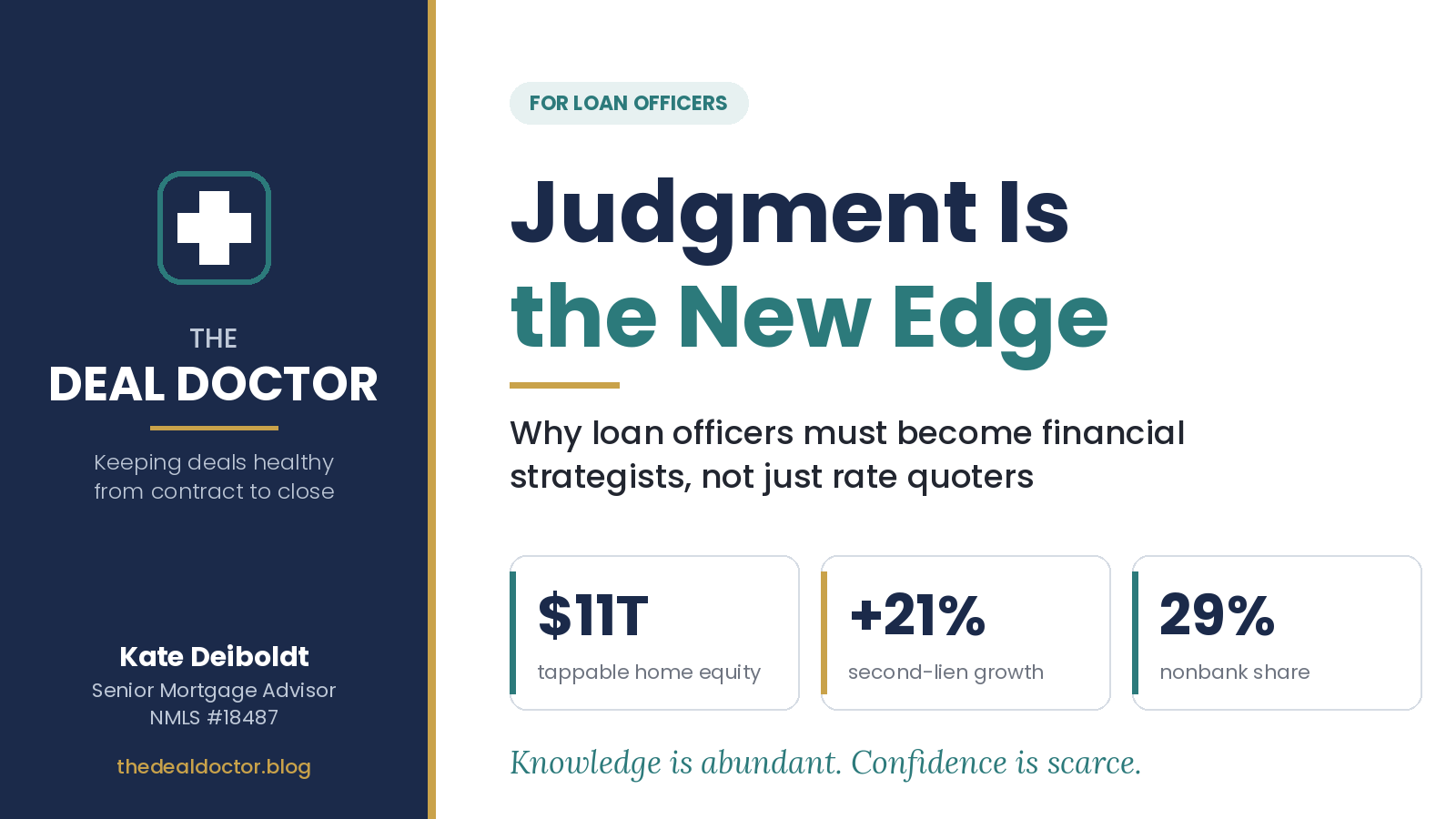
The short answer: Borrowers can now get rates, program details, and AI-generated answers in seconds. What they can’t get on their own is confidence about what those answers mean for them. That’s why the most valuable loan officers are shifting from information providers to financial strategists: people who explain tradeoffs, map out options like home equity, and help borrowers make better decisions with the information they already have.
Key takeaways
- Information used to be the loan officer’s advantage. Today it’s everywhere, and it’s free.
- Borrowers aren’t stuck because they lack data. They’re stuck because they lack confidence.
- Homeowners hold roughly $11 trillion in tappable equity, and second-lien lending grew 21 percent in one year.
- Nonbanks nearly quadrupled their share of second-lien originations since 2022. The door is open for independent loan officers.
- AI will take the busywork. Judgment, education, and trust are what’s left, and they’re worth more than ever.
Picture a borrower sitting at her kitchen table at 10 p.m. She has three browser tabs open with rate quotes. She watched two YouTube videos on HELOCs. She asked an AI chatbot whether she should refinance.
She has more information than any borrower in history.
And she still doesn’t know what to do.
I’ve been in this business for 26 years, and I have never seen that gap wider than it is right now. Rob Chrisman put words to it in his September 14 daily commentary, in a section called “LOs as Financial Strategists.” His point was simple and a little uncomfortable: the edge we used to have is gone. And the edge that replaces it is bigger.
Why isn’t information enough anymore?
For years, loan officers created value by knowing things consumers couldn’t easily find. Rates. Program guidelines. How the process worked.
That advantage has largely disappeared. Borrowers compare rates online, research programs, and get instant answers from AI. As Chrisman notes, many of them are still paralyzed. Not because they lack data, but because they lack confidence in what that data means for their own situation.
Think of it like a GPS. Anyone can get directions. But when the road is closed and there are three detours, you want someone in the passenger seat who has driven this route a thousand times.
That’s us. Or at least, it should be.
What does a financial strategist loan officer actually do differently?
A transaction manager presents options. A strategist explains the tradeoffs behind them.
It sounds like a small difference. It isn’t.
A transaction manager says, “Here are your three loan options.” A strategist says, “Here’s what each option does to your monthly budget, your cash reserves, and your plans five years from now. Let’s walk through which one fits the life you’re actually living.”
Chrisman makes the case that trust no longer comes from the fastest preapproval or answering every question on the first call. It comes from thoughtful education, clear expectations, and helping borrowers see the consequences of each decision before they make it.
I couldn’t agree more. Knowledge is power, but only when someone helps you use it.
Why does home equity make this so urgent right now?
Here’s where the strategist mindset stops being a philosophy and starts being a pipeline.
In the same commentary, PRMG’s Kevin Peranio shared numbers from a Q3 2026 white paper on HELOC lending that every loan officer should sit with for a minute:
- Total owners’ equity in residential real estate hit $34.9 trillion in the first quarter of 2026.
- Mortgage borrowers hold $17.9 trillion of that, with roughly $11 trillion considered tappable. That averages out to about $310,500 per borrower.
- Subordinate-lien originations grew from $148.3 billion in 2024 to $179.3 billion in 2025. That’s a 21 percent jump in one year.
- Banks and credit unions originated 85 percent of those loans in 2022. By 2025, that fell to 66 percent, while the nonbank share nearly quadrupled from 8 percent to 29 percent.
Now layer on the rest of the picture. Chrisman also pointed out that the Federal Reserve’s data shows revolving debt at an all-time high. That same week, the 10-year Treasury climbed to nearly 5 percent and the market was bracing for a Fed hike.
So your past clients are sitting on record equity, carrying record credit card balances, and looking at a first mortgage rate they’d never want to give up.
That is a strategy conversation. Not a rate conversation.
Should they tap equity with a HELOC or a closed-end second and keep that low first mortgage? Would a cash-out refinance vs. a HELOC make more sense for their numbers? Should they touch their equity at all? A good strategist doesn’t push one answer. They lay out the tradeoffs honestly, including the risk of borrowing against your home, so the borrower can choose with clear eyes.
Will AI replace loan officers?
No. But it will replace the parts of the job that never needed us in the first place.
Chrisman’s commentary was full of agentic AI tools built to handle document collection, verifications, and file setup. That’s good news. Every hour AI takes off your desk is an hour you can spend in real consultation with a real person.
Technology should make us more human, not less. The loan officers who use AI to buy back time for advice will pull ahead. The ones who compete with AI on speed alone will lose that race.
How can loan officers start acting like financial strategists this week?
- Run an equity review on your past clients. Pull everyone you’ve closed in the last five to seven years. Estimate their equity. Then reach out with education, not a pitch: “Here’s what your home has done, and here are the options people in your spot are weighing.”
- Build a side-by-side you can explain in five minutes. HELOC, closed-end second, cash-out refi, or do nothing. Show the monthly payment, total cost, and the risk of each. Simple beats impressive.
- Ask better discovery questions. Before you quote anything, ask what they’re trying to accomplish, what keeps them up at night, and what their next five years look like.
- Talk in payments and plans, not just rates. A rate is a number. A payment is a life. Help people see how each choice lands in their real budget.
- Let AI handle the chase. Automate document requests and status updates so your time goes to the conversations only you can have.
- Stay compliant and suitable. Strategy means recommending what fits the borrower, not what’s easiest to close. When debt consolidation is on the table, make sure the long-term cost is crystal clear.
The bottom line
Rates change. Technology changes. Markets change.
People don’t.
They still want someone they trust to help them make a big decision. Chrisman closed his section with a line I’m going to borrow for my own team: when knowledge is abundant, judgment becomes the real competitive advantage.
Trust is still the greatest competitive advantage. Judgment is how you earn it.
So here’s my challenge. Pick five past clients this week. Call them. Don’t sell. Just help them understand where they stand and what their options are. You’ll be surprised how many of them have been waiting for someone to explain it.
Source: “Sep. 14: Verification, Non-QM, Processing, Agentic AI Tools; LOs as Financial Strategists; Equity Study” by Rob Chrisman, Chrisman Commentary, September 14, 2026. Equity figures cited by Kevin Peranio of PRMG from the Scaling Bank HELOC Lending white paper.
Connect with Kate
Have a file that needs a second opinion, or a past client with equity questions? Just call Kate. Visit JustCallKate.info, follow along on Facebook @katematties, email Kate@VanDykMortgage.com, or call (931) 980-9764.
About the author
Kate Deiboldt is a Senior Mortgage Advisor at VanDyk Mortgage Corporation serving Clarksville, TN and Fort Campbell, KY. With 26 years of local mortgage experience, she specializes in VA, FHA, THDA down payment assistance, reverse mortgages, self-employed borrowers, and complex files. As The Deal Doctor, she helps Realtors and loan officers keep deals healthy from contract to closing.
Kate Deiboldt, Senior Mortgage Advisor, NMLS #18487. VanDyk Mortgage Corporation, NMLS #3035. Licensed in TN, KY, AL, FL, GA, TX, IL. Equal Housing Lender. This article is for educational purposes and is not a commitment to lend. Tapping home equity puts your home up as collateral; review all costs and risks before borrowing.
Frequently Asked Questions
1. What does it mean for a loan officer to be a financial strategist?
It means going beyond quoting rates and collecting documents. A financial strategist helps borrowers understand the tradeoffs behind each option and how each choice affects their budget, savings, and long-term goals.
2. Why isn’t access to information enough for borrowers anymore?
Borrowers can find rates and program details online in seconds, but many still feel stuck. The challenge isn’t finding information. It’s knowing what that information means for their specific situation.
3. How much home equity do American homeowners have?
Total owners’ equity in residential real estate reached $34.9 trillion in the first quarter of 2026. Mortgage borrowers hold $17.9 trillion of it, with roughly $11 trillion considered tappable, or about $310,500 per borrower on average.
4. How fast is second-lien lending growing?
Subordinate-lien originations grew about 21 percent in one year, from $148.3 billion in 2024 to $179.3 billion in 2025.
5. Are banks still the main source of HELOCs?
Less than before. Banks and credit unions originated 85 percent of second-lien loans in 2022 but 66 percent in 2025. Over the same period, the nonbank share grew from 8 percent to 29 percent.
6. Will AI replace mortgage loan officers?
AI is taking over repetitive tasks like document collection, verifications, and file setup. That frees loan officers for consultation and planning, which is where human judgment matters most.
7. Should a homeowner use a HELOC or a cash-out refinance?
It depends on their current rate, how much they need, how long they need it, and their comfort with a variable payment. Many homeowners with low first mortgage rates look at a HELOC or closed-end second to avoid giving up that rate. A loan officer should compare total costs and risks side by side.
8. How can loan officers build trust with borrowers?
Through clear education, honest expectations, and helping borrowers see the real consequences of each decision. Trust comes from understanding, not from speed alone.
9. What is an equity review for past clients?
It’s a proactive check-in where a loan officer estimates a past client’s current equity and explains their options, such as a HELOC, a closed-end second, a cash-out refinance, or leaving their equity untouched.
10. What’s the first step toward becoming a strategist instead of a rate quoter?
Start with better questions. Before quoting anything, ask what the borrower wants to accomplish and what their next five years look like. Then build your recommendation around their answers.
Leave a Reply