The Quick Answer
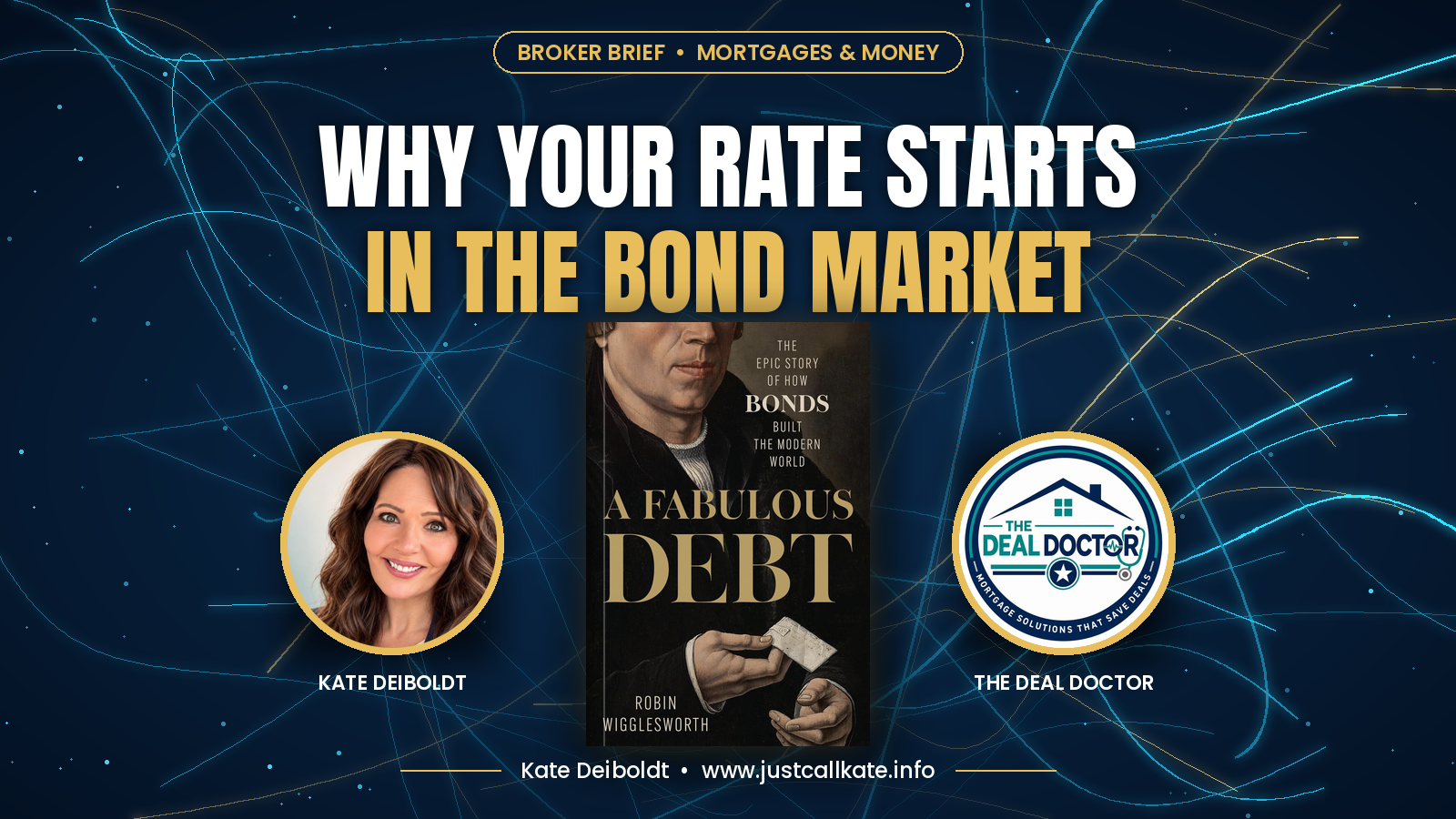
A Fabulous Debt by Financial Times journalist Robin Wigglesworth tells the 900 year story of the bond market, from medieval Venice to modern Wall Street. For homebuyers and real estate pros, the lesson is practical: mortgage rates are shaped largely by investors in the bond market, not set by the Fed or your lender on a whim. Understanding that one idea makes rate conversations calmer, clearer, and a lot less scary.
Book: A Fabulous Debt: The Epic Story of How Bonds Built the Modern World by Robin Wigglesworth (2026). Audience: homebuyers, real estate agents, and loan officers.
A buyer asked me last month, “Kate, why did my rate go up? The Fed didn’t do anything.”
It’s one of the most common questions I hear. And it’s a great question, because the answer surprises almost everyone.
Your mortgage rate doesn’t really start with the Fed. It doesn’t start with your lender either. It starts in a place most people never think about.
The bond market.
That’s why I couldn’t put down Robin Wigglesworth’s new book, A Fabulous Debt. Wigglesworth writes for the Financial Times and runs its markets blog, Alphaville. He also wrote Trillions, the story of index funds. This time he takes on what he calls the supposedly boring corner of finance and shows it is anything but.
The Big Idea: Bonds Quietly Run the World
Stocks get the headlines. Bonds do the heavy lifting.
Wigglesworth traces how bonds pooled money from ordinary citizens and merchants to fund wars, cities, railroads, and entire nations. He follows the story from 12th century Venice, through the dam builders of 17th century Holland, to Alexander Hamilton’s plan to put a brand new United States on solid financial footing. Today, the global debt market is measured in the hundreds of trillions of dollars.
My favorite way to picture it: a bond is simply a promise. You lend money today. Someone promises to pay you back over time, with interest.
Sound familiar? It should. That’s a mortgage.
A Story Worth Knowing
Here’s one of my favorite bond facts, and it ties right back to those Dutch dam builders. A Dutch water board issued a bond back in 1648 to pay for dike repairs. That bond still exists, and it still pays a little interest today. Yale University owns it.
Think about that. A promise made almost 400 years ago is still being kept.
That’s the whole point. Bonds work because people trust the promise. When trust is high, borrowing is cheaper. When trust slips, borrowing gets expensive. The same is true for countries, companies, and you and me.
Why This Matters for Your Mortgage
Here’s the part I want every buyer and every agent to understand.
When you get a mortgage, your loan usually doesn’t stay in one place. Most loans are bundled together with thousands of others into mortgage-backed securities. Those securities are sold to investors around the world. Pension funds. Insurance companies. Banks. Even central banks.
Those investors decide what return they need to buy those bonds. That return heavily influences the rate you’re offered.
So when investors get nervous about inflation, they demand more return. Rates go up. When investors get nervous about the economy and look for safety, they often buy bonds. Rates can come down.
That’s why mortgage rates tend to move with the 10 year Treasury yield far more than with the Fed’s headline rate. The Fed sets a short term rate for banks. The bond market prices long term money. A 30 year mortgage is long term money.
So when my buyer asked why rates went up when the Fed did nothing, the answer was simple. The Fed didn’t move. The bond market did.
What Agents and Loan Officers Can Do With This
Knowledge is power. And this knowledge calms people down.
Explain it in one sentence.
“Mortgage rates are set mostly by investors buying mortgage bonds, so they can move daily even when the Fed is quiet.” That one line can stop a lot of panic.
Stop chasing headlines.
When the news says “Fed cuts rates,” buyers expect mortgage rates to drop overnight. Sometimes they don’t. Set that expectation early so nobody feels misled.
Talk about locking before it’s urgent.
Because rates move with the market, a rate lock is a tool, not a formality. Talk with your buyers about when to lock and why before they’re under contract, not the morning a big economic report comes out.
Focus on the payment, not the prediction.
Nobody can reliably predict where rates are headed. Not me. Not the TV experts. What we can do is make sure the payment fits today, with a plan for tomorrow.
A Note for Homebuyers
If you’re buying a home, here’s what I want you to take away.
You don’t control the bond market. Nobody does. But you do control your preparation.
Keep your credit healthy. Keep your documents ready. Get fully pre-approved so you can move when the right home appears. And ask your loan officer to walk you through how rate locks work before you start shopping.
Waiting for the “perfect” rate is a lot like waiting for the perfect weather to plan a wedding. You might get it. You might not. Plan for the life you want, and make sure the numbers work.
If rates do come down later, refinancing may be an option worth reviewing. It isn’t guaranteed, and it has costs, so it should be a conversation, not a promise.
The Bottom Line
Bonds have funded cathedrals, canals, countries, and the home you’re sitting in right now. They aren’t boring. They’re the quiet engine underneath every closing.
Understand the engine and you stop being scared of the noise.
My challenge: the next time a client asks why rates moved, don’t just say “the market.” Explain the bond market in one simple sentence. Watch their shoulders drop. That’s trust being built in real time.
If you’re ready to talk through your options, you can start your application here, or reach me anytime at JustCallKate.info.
Frequently Asked Questions About A Fabulous Debt
What is A Fabulous Debt about?
It’s Robin Wigglesworth’s history of the bond market, showing how bonds evolved from medieval Venice to modern Wall Street and helped finance much of the modern world.
Who is Robin Wigglesworth?
He is a Financial Times journalist who edits the paper’s Alphaville finance blog and wrote Trillions, a history of index funds.
Does the Fed set mortgage rates?
Not directly. The Fed sets a short term rate for banks. Long term mortgage rates are shaped mostly by investors in the bond market, especially demand for mortgage-backed securities.
Why do mortgage rates follow the 10 year Treasury?
Investors compare mortgage bonds to Treasuries when deciding where to put their money, so the two tend to move in the same direction, with mortgage rates usually sitting above Treasury yields.
Should I wait for rates to drop before buying a home?
Nobody can reliably predict rates. A better approach is to make sure the payment fits your budget today, talk with your loan officer about rate locks, and review refinancing later only if it makes sense.
Source: This Broker Brief summarizes and comments on ideas from A Fabulous Debt: The Epic Story of How Bonds Built the Modern World by Robin Wigglesworth (2026). All ideas from the book belong to its author; the commentary and mortgage and real estate applications are my own. I highly recommend reading the full book. Rates and market conditions change daily; contact a licensed loan officer for current pricing.
Kate Deiboldt | Senior Mortgage Advisor | VanDyk Mortgage Corporation | NMLS #18487 | Company NMLS #3035
Kate@VanDykMortgage.com | (931) 980-9764 | JustCallKate.info
Licensed in TN, KY, AL, FL, GA, TX, and IL. Equal Housing Lender. This article is for educational purposes only and is not a commitment to lend. All loans subject to credit approval and program guidelines.
Leave a Reply