You know the one.
It’s the call that’s been sitting on your list since Monday. The seller who needs to hear the price is too high. The borrower whose credit report came back rougher than they expected. The past client you keep meaning to check in with. You move it to tomorrow. Then tomorrow. And somehow it gets heavier every single day.
Brian Tracy has a name for that task. He calls it your frog. And his advice is simple: eat it first.
Where “Eat That Frog” Comes From
Brian Tracy’s book, Eat That Frog! 21 Great Ways to Stop Procrastinating and Get More Done in Less Time, has sold millions of copies for one reason. It takes a big, messy problem and makes it simple.
The idea borrows from an old saying often credited to Mark Twain. If you had to eat a live frog every morning, you’d want to get it over with first thing. Then nothing else that day could be worse. And if you had two frogs? Eat the ugly one first.
Tracy’s point is that your “frog” is the biggest, most important task on your list. The one you’re most likely to put off. And it’s usually the one that would make the biggest difference if you just did it.
After 26 years in this business, I can tell you this: real estate and mortgage are frog-heavy careers.
Your Frog Has a Name
For a real estate agent, the frog might be the price reduction conversation. The hour of prospecting calls. The expired listing you know you could help. The open house follow-ups that are getting colder by the day.
For a loan officer, it might be calling the borrower who was just declined somewhere else. Telling an agent their buyer’s appraisal came in low. Working through a stack of conditions. Picking up the phone to introduce yourself to a top producer who has never heard of you.
Notice something? Almost every frog in our world is a conversation. And almost every conversation we avoid is one that moves a deal forward.
Why Waiting Feels Safer (But Isn’t)
Here’s the thing about putting off a hard task. It feels like you’re protecting yourself. You avoid the awkward moment, the bad news, the possible “no.”
But the frog doesn’t shrink while it waits. It grows.
That low appraisal doesn’t get easier to discuss on day four. It gets harder, because now the clock is tighter and everyone is more stressed. That seller doesn’t get more open to a price adjustment after another quiet weekend. They get more frustrated. And that Realtor you meant to call? Someone else called them first.
In our business, inaction is never neutral. Silence costs deals. Delay costs trust. And trust is still the greatest competitive advantage.
The deeper principle is this. The dread is almost always bigger than the task. The call you’ve avoided for three days usually takes eight minutes. The relief afterward lasts all day.
Five Ways to Eat Your Frog Before 9 a.m.
Tracy lays out 21 techniques in the book. These are the five I’ve seen make the biggest difference for agents and loan officers.
1. Name your frog the night before. Before you close your laptop, write down tomorrow’s one most important task. Not a list of twenty. One. When you wake up, the decision is already made.
2. Eat the ugliest one first. If you have two hard calls, make the harder one first. Your energy and courage are highest early. Spend them where they matter most.
3. Make the call before you open your inbox. Email is where good mornings go to disappear. Thirty messages later, you’re reacting to everyone else’s priorities instead of moving your own business forward.
4. Block the time and protect it. Put your frog on the calendar like a closing. Prospecting from 8:00 to 9:00 is an appointment. Treat it like one.
5. Finish what you start. Tracy calls this single handling. Once you start the hard task, stay with it until it’s done. Half-eaten frogs still sit on your plate.
What This Looks Like on a Real Deal
Picture this. A VA appraisal comes back under contract price late in the afternoon. The loan officer has two choices.
Option one: wait until tomorrow, think about how to say it, maybe send an email. Option two: call both agents first thing in the morning with the number, the options, and a plan. A reconsideration of value. A price conversation. A look at what the buyer can bring.
The second loan officer is the one agents remember. Not because the news was good, but because the response was fast, calm, and clear. That’s what saves deals. Not perfect news. Prompt action.
The same is true for agents. The listing agent who calls the seller on Monday morning with fresh showing feedback and a strategy keeps the listing. The one who waits for the seller to call them often doesn’t.
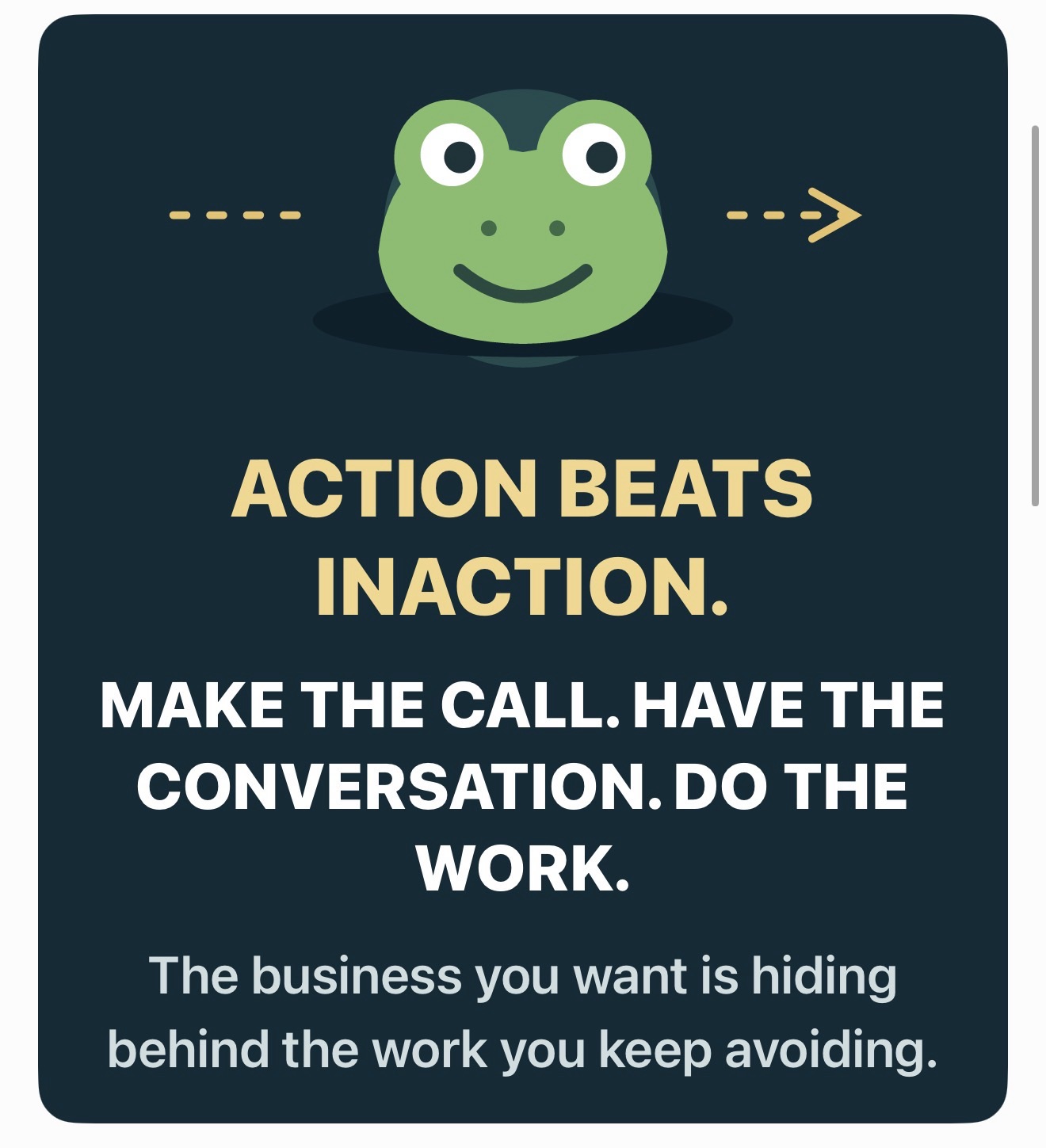
Action Beats Inaction. Every Time.
You don’t need a perfect plan. You don’t need to feel ready. You just need to start.
Motivation rarely shows up before action. It shows up after. Make one hard call and watch how the rest of your day changes. You’ll feel lighter. More confident. Ready for the next one.
So here’s my challenge for you. Tonight, write down your frog. Just one. Tomorrow morning, before email, before social media, before coffee number two, eat it.
And if your frog is a tough file, a stale listing, or a buyer who’s been told no somewhere else? That’s exactly what I do. Bring it to me. We’ll eat it together.
Frequently Asked Questions
1. What does “eat that frog” mean?
It means doing your most important, most dreaded task first, before anything else. Once it’s done, the rest of the day feels easier.
2. Who wrote Eat That Frog?
Brian Tracy, a well-known author and speaker on productivity and personal development. The book was first published in 2001 by Berrett-Koehler and has been updated in later editions.
3. How do I know which task is my frog?
Ask yourself which one task, if finished today, would have the biggest positive impact on your business. It’s usually the one you least want to do.
4. What are common frogs for real estate agents?
Prospecting calls, price reduction conversations, following up on open house leads, calling expired listings, and asking past clients for referrals.
5. What are common frogs for loan officers?
Delivering hard news on a file, calling Realtors you don’t know yet, clearing tough conditions, following up on stalled preapprovals, and reaching out to borrowers who were declined elsewhere.
6. Why is the morning the best time to eat my frog?
Your focus and energy are highest early, and the day hasn’t filled up with other people’s urgent requests yet.
7. What if my frog is too big to finish in one sitting?
Break it into smaller pieces and finish the first piece completely. Progress builds momentum.
8. Does this help my clients too?
Absolutely. Fast, clear communication on hard issues lowers stress for buyers and sellers and keeps closings on track.
9. How do agents and loan officers eat frogs together?
Agree to share problems early. When an appraisal, credit, or inspection issue pops up, a same-day call between agent and lender saves far more deals than waiting.
10. What’s the one habit to start tomorrow?
Write down one frog tonight and do it first thing tomorrow, before you check email.
Source: This post is inspired by and adapts ideas from Brian Tracy’s book Eat That Frog! 21 Great Ways to Stop Procrastinating and Get More Done in Less Time (Berrett-Koehler Publishers). All credit for the original concepts goes to the author. Learn more at briantracy.com.
Kate Deiboldt, Senior Mortgage Advisor, VanDyk Mortgage Corporation | NMLS #18487 | Company NMLS #3035 | www.nmlsconsumeraccess.org | Kate@VanDykMortgage.com | (931) 980-9764 | www.justcallkate.info | Licensed in TN, KY, AL, FL, GA, TX and IL. Equal Housing Lender. This content is for educational purposes only and is not a commitment to lend. All loans subject to credit approval, underwriting guidelines and property eligibility.
Leave a Reply