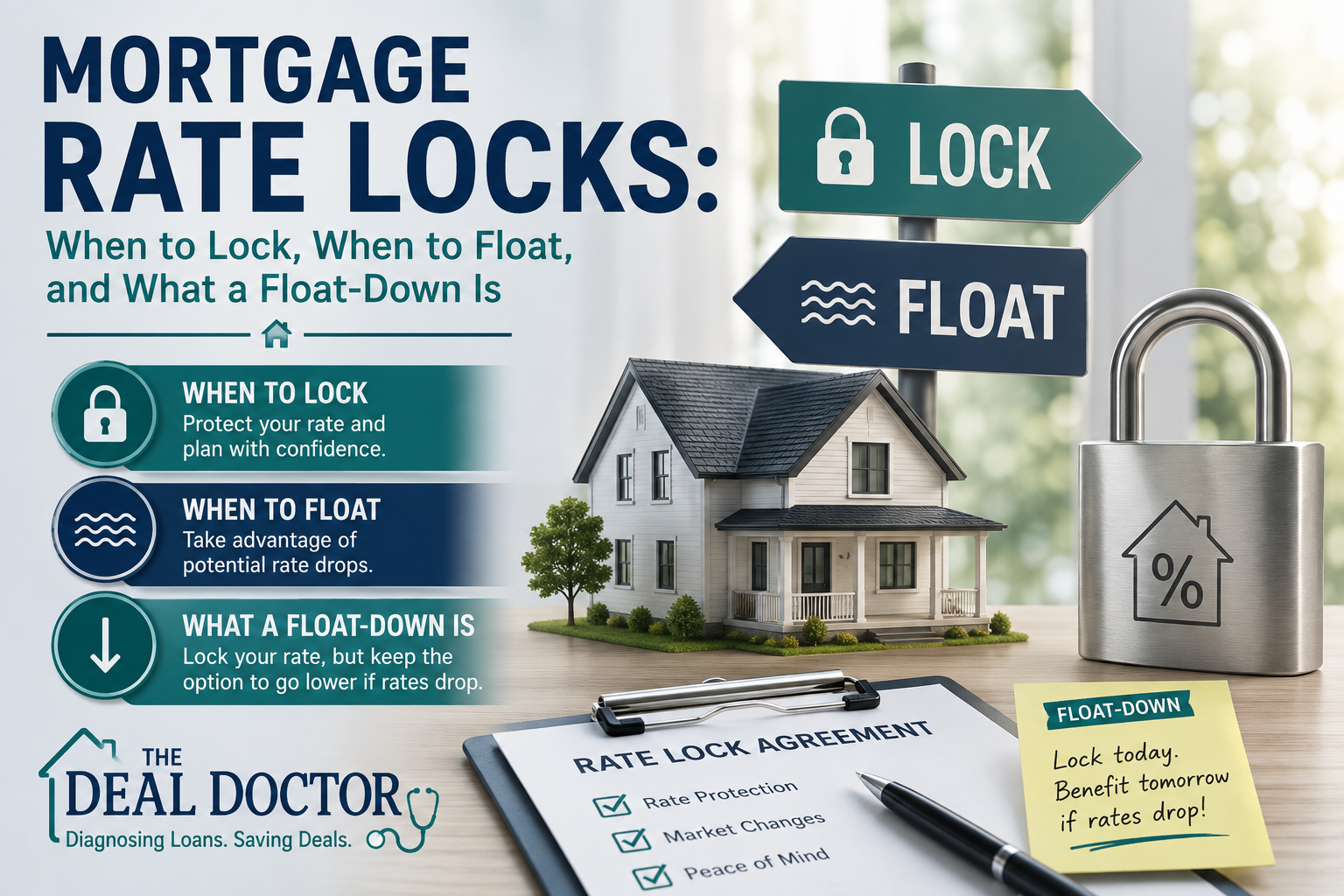
Mortgage Rate Locks: When to Lock, When to Float, and What a Float-Down Is
If you’re buying a home, a mortgage rate lock is the tool that keeps your interest rate from changing while your loan is being processed. In plain English: a rate lock is an agreement that holds your rate for a specific time window so market swings don’t wreck your payment right before closing. The best time to lock is when the payment works for your budget and your lock window safely covers your closing timeline.
TL;DR — Key Takeaways
- A mortgage rate lock is a lender commitment to hold your rate (and usually your points/credits) for a set period while you close.
- Lock when the payment fits your plan, not when you “guess” the market will drop.
- Choose a lock length that covers your contract date plus a small cushion for appraisal/underwriting delays.
- A float-down is a feature (not automatic) that may let you capture a lower rate after you lock—ask early.
- In Middle Tennessee, timing matters: new construction and VA/FHA files can need longer locks depending on the builder and paperwork.
A mortgage rate lock is a time-limited promise. A float is the opposite—your rate can move day to day. And a float-down is an optional feature that may allow a one-time adjustment if rates improve after you lock.
1) What a mortgage rate lock actually locks (it’s more than a number)
Homebuyers in Clarksville and around Fort Campbell often hear “your rate is 6.6%” and assume that’s the whole story. In reality, your quote is a pricing package. A rate lock is the agreement that holds your interest rate for a set period of time—and in many cases it also holds the pricing tied to it (discount points or lender credits) as long as you close before it expires.
That’s why two lenders can show the “same rate” but very different cash-to-close. When you lock, you’re usually locking the package you agreed to—so you can budget confidently for closing day in Montgomery County.
2) When to lock vs. when to float (a simple decision rule)
Rule of thumb for Clarksville TN buyers: lock when the payment works and you’re inside your closing window. Floating is choosing uncertainty.
- Lock if today’s payment fits your budget and you’d be stressed if rates tick up.
- Float if you have time, payment flexibility, and a clear plan for what you’ll do if rates rise.
Even in the Nashville metro and broader Middle Tennessee market, rates can move quickly around big economic news. If you’re already under contract and you’re happy with the numbers, locking can protect your buying power.
3) How long do rate locks last?
Lock periods vary by lender and timeline. Bankrate notes that “the typical initial rate lock lasts 30 to 60 days, though some lenders do 90-day initial locks” (Bankrate (2026)).
Practical guidance for our area:
| Lock length | When it often fits | Common risk if it’s too short |
|---|---|---|
| 30 days | Clean file + fast appraisal + tight contract timeline | Extension fees if appraisal or underwriting runs long |
| 45 days | Very common “safe default” for many purchase contracts | Usually small, but still can expire with delays |
| 60 days | More buffer (busy seasons, complex income, VA paperwork) | May price slightly worse than a shorter lock |
| 90+ days | New construction, long builder timelines, extended closings | Costs/premium can increase; terms vary by lender |
4) What can change your locked rate (and what can’t)
Locking protects you from market movement, but pricing can change if your loan scenario changes—like a different program, loan amount/down payment, credit score shift, or an appraisal issue that changes loan-to-value. Keep your finances steady until closing so the lock holds.
5) What a float-down is (and the questions to ask)
A float-down is a lender feature that may let you take a lower rate after you lock if market pricing improves before closing. Not every lender offers it, and the rules vary. Some allow one adjustment; others require a minimum rate improvement; some charge a fee; some bake the cost into the pricing upfront.
When you’re house hunting in Clarksville, near Fort Campbell, or even commuting toward Nashville, float-downs can feel like “best of both worlds.” Just remember: it’s a policy, not a promise. Ask for the float-down terms in writing so you’re not guessing.
6) Local timeline realities in Clarksville, Fort Campbell, and Middle Tennessee
Around Clarksville and Fort Campbell, contract timelines can stretch if appraisal, underwriting, repairs, or VA paperwork add days. Build in a cushion: a lock that expires right before closing is not a bargain—it’s a planned extension fee.
7) A quick 2026 reality check
Rates can swing while you’re in escrow. For context, Freddie Mac’s Primary Mortgage Market Survey reported the average 30-year fixed-rate mortgage at 6.58% as of July 23, 2026 (Freddie Mac PMMS (2026)). Your personal rate depends on credit, down payment, and loan type—so focus on the payment that works for your plan.
[INTERNAL LINK: How Much House Can I Really Afford in Clarksville TN? (The Real Math)]
[INTERNAL LINK: Buying Down Your Mortgage Rate: When Discount Points Are Worth It]
Frequently Asked Questions
1) Should I lock my rate as soon as I get pre-approved?
Usually, you can’t lock a final rate until you have a property and contract details, because the address, price, and loan structure affect pricing. Once you’re under contract, we’ll decide whether to lock based on timeline and comfort level.
2) What’s the difference between locking and floating?
Locking means your lender commits to a rate for a set time while you close. Floating means you’re not committed yet, so your rate can change daily. Floating can work if you have time and flexibility, but it adds uncertainty to your payment.
3) How long should my rate lock be?
Your lock should cover your expected closing date plus a cushion. Many purchase closings target 30–45 days, but appraisal and underwriting delays happen. Bankrate notes a typical initial lock lasts 30–60 days, and some lenders offer 90 days (Bankrate (2026)).
4) Can my rate change after I lock it?
A lock protects you from market movement, but pricing can change if your loan scenario changes. Examples: switching loan programs, changing down payment, a credit score shift, or an appraisal issue that changes loan-to-value. The best way to protect the lock is to keep your file steady until closing.
5) Do rate locks cost money?
Sometimes there’s a specific fee, but often the “cost” is built into the pricing—longer locks can be slightly more expensive than shorter locks. Ask your lender to compare a 30-day vs. 45-day vs. 60-day lock so you can see the trade-offs.
6) What happens if my closing is delayed and my lock expires?
If your lock expires before the loan closes, you typically need an extension or you may be re-priced at current market rates. Extensions can cost money, so choose a lock window that matches your contract timeline—plus a buffer.
7) What is a float-down option?
A float-down is an option that may let you take a lower rate after you’ve already locked, if market rates drop before closing. Rules vary—some allow one adjustment, some require a minimum improvement, and some charge a fee. Always ask for the float-down terms in writing.
8) Should I lock if rates seem like they might drop?
If the payment works today and a rate increase would hurt your budget, locking can be the safer move. Floating is a bet, and it can pay off—but it can also backfire. I like to set a clear plan: “We’ll float until X date or until the rate hits Y,” so you’re not guessing day to day.
9) How does new construction affect rate locks in Middle Tennessee?
New construction timelines can change, so a standard 30–60 day lock might not cover the full build. Some lenders offer extended locks (90+ days) or new-construction lock programs. The key is matching the lock to the builder’s realistic completion date and understanding how extensions or float-downs work if the timeline shifts.
10) What should I ask my lender before I lock?
Ask: What exactly is being locked (rate plus points/credits)? When does it expire? What does an extension cost? Is a float-down available? And what changes to my application could re-price the loan? These questions protect your Clarksville homebuying plan.
Author: Kate Matties-Deiboldt, NMLS #18487, VanDyk Mortgage
Your Clear Guide Through the Mortgage Process
Whatever your questions, concerns, or hesitations about mortgage rate locks, I can be your clear guide through the mortgage process. The first step is a quick, no-obligation analysis of your current situation and a professional plan of action to put you in the best position to purchase or refinance a home when you’re ready.
📞 Call or text: (931) 980-9764
✉️ Email: Kate@JustCallKate.com
Kate Matties-Deiboldt — NMLS #18487, VanDyk Mortgage
Clarksville TN mortgage lender · Fort Campbell VA loan specialist
Leave a Reply