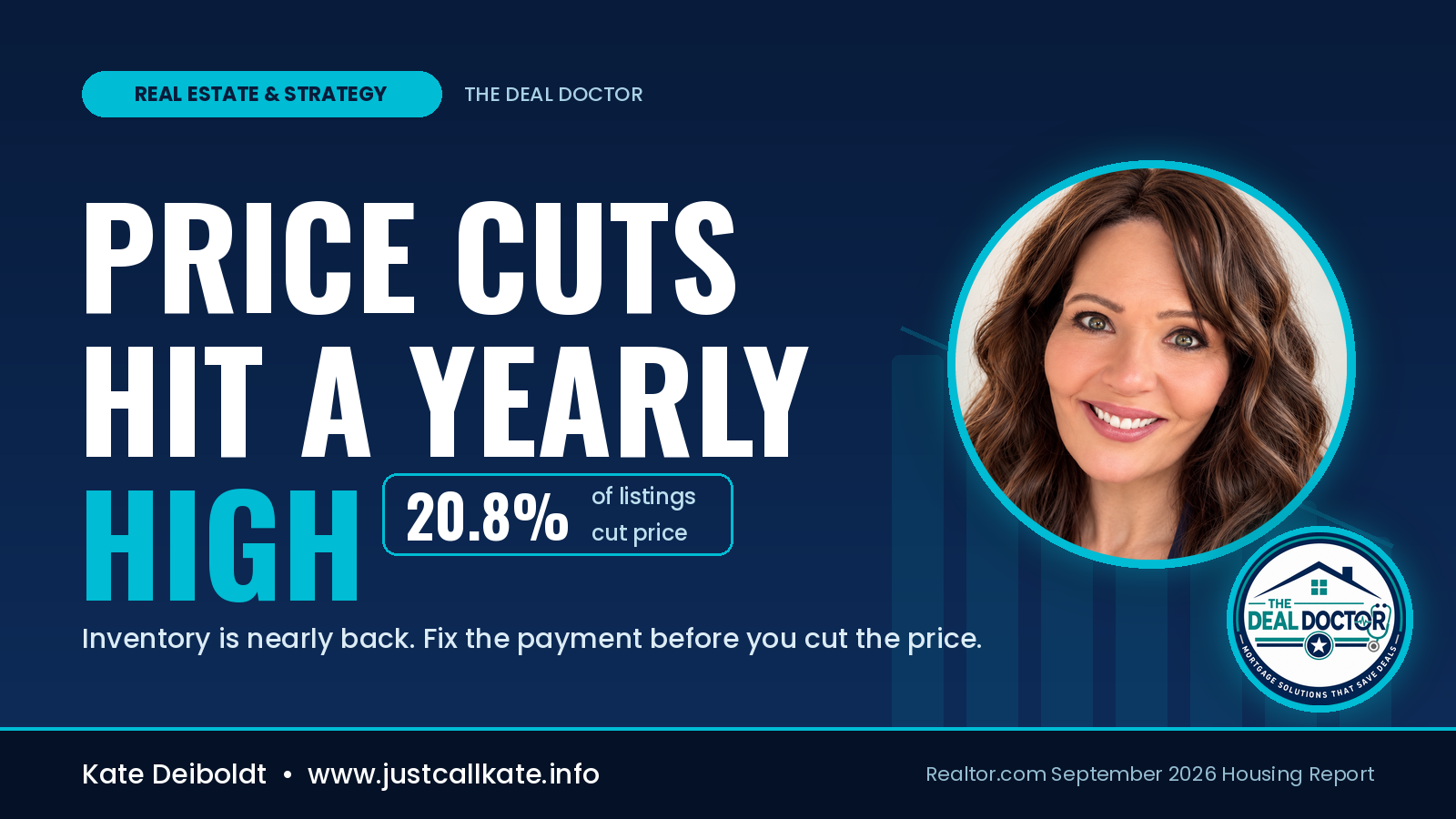
One in five.
That’s how many homes for sale across the country took a price cut in September. According to the Realtor.com September 2026 Housing Report, 20.8% of active listings had a price reduction. That’s the highest share of the year.
And if you’ve been in the field lately, you didn’t need a report to tell you. You’ve felt it. The showing that turns into a “we’ll think about it.” The listing that sat one weekend too long. The seller who calls asking, “What are we doing wrong?”
Let’s talk about what this data really says, and more importantly, what we do with it.
The Numbers Worth Knowing
Here’s the national snapshot from September:
- Active listings: 1,161,615, up 5.4% from a year ago
- Median listing price: $419,250, down 1.4% year over year
- Price per square foot: $223, down 1.7% year over year
- Median days on market: 61 days
- Homes under contract: down 4.1% year over year
- New listings: down 0.7% year over year
Now here’s the headline inside the headline. Inventory is now just 9.1% below pre-pandemic levels. That’s the first time the gap has dropped below 10%.
Think about that for a second. For years, the story was “there’s nothing to buy.” That story is fading. Jake Krimmel, Senior Economist at Realtor.com, put it simply: “More homes are available than they were a year ago, and the inventory gap with the pre-pandemic market is closing.”
Buyers Have Leverage. They Just Can’t Use All of It.
This is the part I want every agent and loan officer to slow down and hear.
Danielle Hale, Chief Economist at Realtor.com, said it best: “September’s housing data shows that buyers are gaining leverage, but higher mortgage rates are limiting how much of that opportunity they can use.”
Picture a store running a big sale. The shelves are full. The prices are marked down. But the customers are standing at the door checking their wallets. That’s today’s market. More choice. Softer prices. And buyers who are still doing math on the monthly payment.
So the deeper principle is this: Buyers don’t buy prices. They buy payments.
That one idea changes how we should handle almost every stale listing out there.
It’s Not the Same Market Everywhere
Krimmel also noted that buyers are gaining negotiating power, “but that does not look the same everywhere.” The regional numbers prove it.
- West: 22.8% of listings had a price cut
- South: 21.6%
- Midwest: 20.7%
- Northeast: 15.2%
Salt Lake City led the big metros at 33.6%, followed by Denver at 32.1% and Portland at 31.6%. New York sat at the other end at just 10.3%.
Closer to home, the South saw active listings rise 2.6% while the median list price slipped 2.4%. And just up the road, Louisville posted one of the biggest inventory jumps in the country, up 27.1% year over year. Here in the Clarksville and Fort Campbell area, that tells me one thing. National headlines are a starting point. Your local numbers are the diagnosis.
The Deal Doctor Prescription: Fix the Payment Before You Cut the Price
When a listing goes stale, the reflex is to cut the price. Sometimes that’s the right move. But it’s not the only move, and it’s often not the most powerful one.
Here’s a simple example. Say a buyer is borrowing $400,000 at 7%. A $10,000 price cut lowers the loan amount and saves that buyer roughly $67 a month in principal and interest. Now take that same $10,000 and offer it as a seller credit toward a permanent rate buydown. Depending on pricing that day, it might lower the rate by around half a point. At 6.5%, that same buyer saves roughly $133 a month.
Same $10,000 from the seller. About twice the payment relief for the buyer.
That’s not a trick. That’s just knowing where the money works hardest. Knowledge is power.
What Realtors and Loan Officers Can Do This Week
- Market the payment, not just the price. Put a sample monthly payment right in your listing remarks and flyers, built with your lender so it’s accurate and compliant. Buyers scroll past prices. They stop for payments they can picture.
- Offer concessions with a purpose. A seller credit toward a temporary or permanent buydown can keep a deal together better than another price drop. Concession limits vary by loan type, so run the numbers first.
- Get ahead of the second cut. If a listing has passed the 30-day mark with steady showings and no offers, the feedback is in. Have the pricing and payment conversation now, before the market has it for you.
- Know your local data cold. Days on market, price-cut share, and list-to-sale ratios in your zip codes. When your seller hears a national headline, you want to be the one with the local truth.
- Bring your lender into the listing appointment. Sellers trust a plan. A lender who can show three payment scenarios in five minutes makes your pricing advice land with confidence instead of pressure.
If you’ve got a listing that’s been sitting, this is exactly what my Deal Doctor Listing Analysis is built for. I’ll look at the price, the payment, and the buyer pool, then give you a few financing strategies you can market right away. Trust is still the greatest competitive advantage, and showing up with a real plan builds it fast.
What This Means for Homebuyers
If you’re buying, this is a better moment than it’s been in a while. You have more homes to choose from, more room to negotiate, and sellers who are listening. Don’t just ask for a lower price. Ask what a seller credit could do for your rate and your monthly payment. And get fully pre-approved first, so you can move with confidence when the right home shows up.
The Bottom Line
The market is shifting toward balance. That’s not bad news. It’s a return to a market where skill matters again. Where pricing strategy, financing strategy, and real advice make the difference.
So here’s my challenge. Pick one listing that’s been sitting too long. Before you call the seller about another price cut, call your lender and ask, “What would this payment look like with a buydown instead?” Then bring that answer to your seller.
I’d love to be that call. And if you have buyers ready to get started, send them here: katedeiboldt.vandyk-pos.com.
Frequently Asked Questions
1. What share of homes had price cuts in September 2026?
According to Realtor.com, 20.8% of active listings had a price reduction in September 2026. That’s the highest share of the year and up 0.9 percentage points from a year earlier.
2. Is housing inventory back to pre-pandemic levels?
Almost. National inventory is now 9.1% below pre-pandemic levels, the first time that gap has dropped below 10%. Active listings totaled 1,161,615, up 5.4% from a year ago.
3. Are home prices falling?
Slightly, on a national level. The median listing price was $419,250, down 1.4% from a year ago, and price per square foot fell 1.7%. Local markets vary widely, so check the numbers in your area.
4. Is it a buyer’s market now?
Buyers are gaining leverage in many places, but it depends on the market. Realtor.com noted that higher mortgage rates are limiting how much of that leverage buyers can actually use.
5. Which areas are seeing the most price cuts?
The West led the regions at 22.8%, followed by the South at 21.6%. Among large metros, Salt Lake City, Denver, and Portland had the highest share of listings with price reductions.
6. Is a price cut or a seller concession better for buyers?
It depends on the buyer’s goals, but a seller concession used toward a rate buydown can often lower the monthly payment more than an equal price cut. Your lender can compare both side by side.
7. What is a rate buydown?
It’s prepaid interest that lowers the buyer’s mortgage rate. A permanent buydown lowers the rate for the life of the loan. A temporary buydown, such as a 2-1 buydown, lowers it for the first year or two.
8. How long are homes sitting on the market?
The national median was 61 days in September 2026, one day more than August and one day less than a year earlier.
9. When should a seller consider a price reduction?
If a home has had steady showings but no offers after a few weeks, the market is giving feedback. Talk with your agent and lender about price and payment strategies before making a second cut.
10. How can a lender help a listing that isn’t selling?
A lender can build payment scenarios, suggest concession structures, and identify loan programs that fit the likely buyer pool. That gives agents something new to market besides a lower price.
Source: This post adapts and comments on the Realtor.com September 2026 Housing Report, released September 30, 2026 via PR Newswire. All national, regional, and metro statistics and quotes are from that report.
Payment examples are hypothetical and for illustration only. They reflect principal and interest on a $400,000, 30-year fixed-rate loan at 7% and 6.5%, and do not include taxes, insurance, mortgage insurance, or HOA dues. Actual buydown pricing varies daily and by loan program. This is not a quote, rate offer, or commitment to lend. Rates and programs are subject to change without notice. All loans subject to credit approval, underwriting guidelines, and property eligibility. Not all applicants will qualify.
Kate Deiboldt, Senior Mortgage Advisor | VanDyk Mortgage Corporation | NMLS #18487 | Company NMLS #3035 | Kate@VanDykMortgage.com | (931) 980-9764 | Licensed in TN, KY, AL, FL, GA, TX, and IL | Equal Housing Lender. www.nmlsconsumeraccess.org
Leave a Reply