
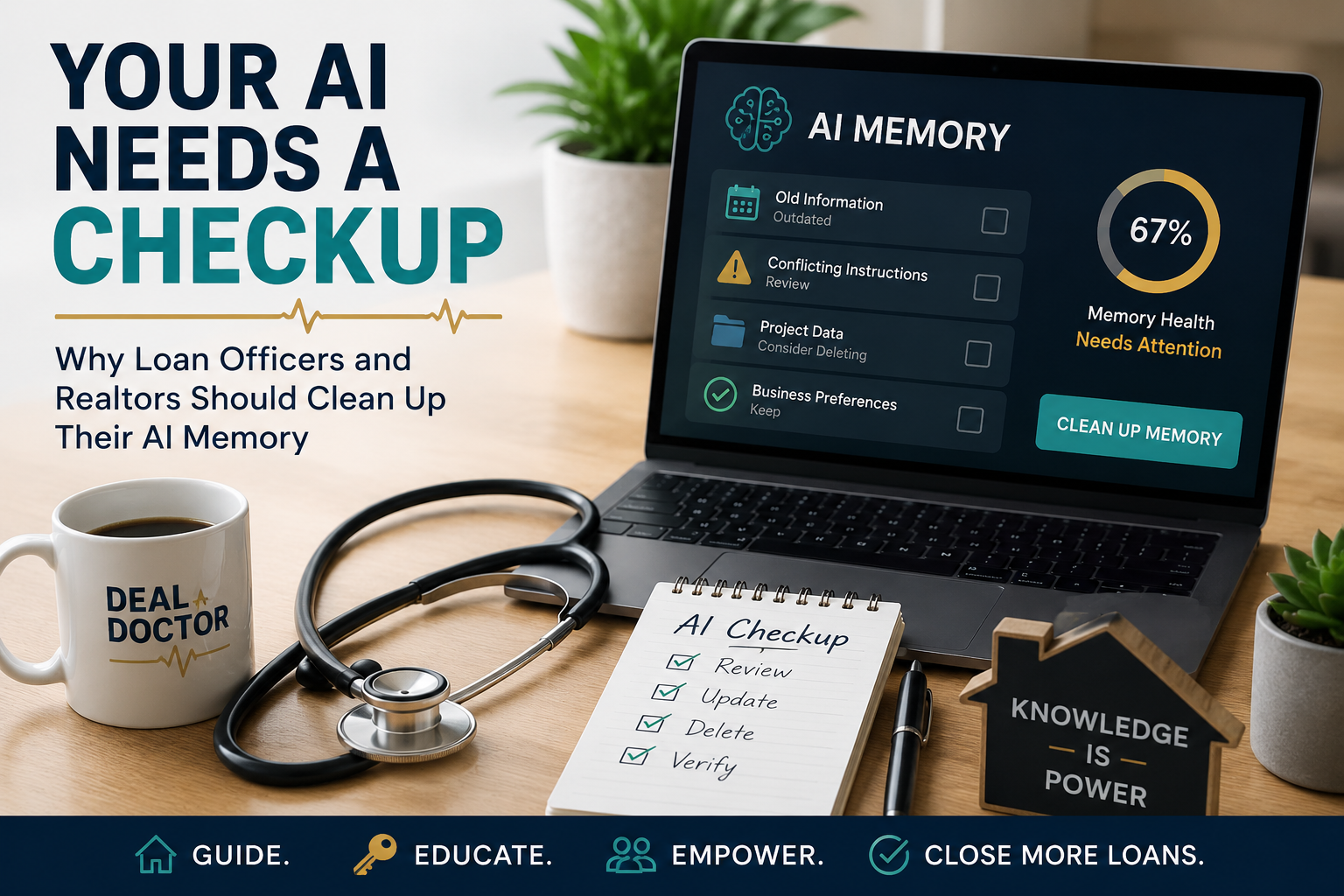
If you use ChatGPT, Claude, Gemini, or another AI assistant regularly, you’ve probably spent a lot of time teaching it about you.
Your writing style. Your business. Your clients. Your preferences. Your processes. The way you like things done.
That’s one of the best things about AI memory.
It’s also becoming one of the things we need to be careful about.
An interesting article from Android Authority recently made the case for periodically cleaning up your AI’s memory. The basic problem is simple:
AI can remember things that aren’t true anymore.
And for mortgage and real estate professionals, that matters.
AI Memory Is Not the Same as AI Knowledge
Suppose six months ago you told ChatGPT:
“My company doesn’t offer renovation loans.”
Then your company adds them.
Unless that old information gets updated, your AI assistant may continue operating under the assumption that you don’t have the product.
Now imagine the remembered information isn’t about a product.
Maybe it’s an old company procedure.
An underwriting practice.
A marketing strategy you’ve abandoned.
A Realtor relationship that’s changed.
Or—much more dangerously—an old mortgage guideline.
That’s why there’s one distinction every mortgage professional using AI needs to understand:
Memory provides context. It does not provide authority.
Your AI can remember how you like your emails written.
It should NOT be trusted to “remember” today’s FHA, VA, Fannie Mae, Freddie Mac, USDA, investor, or compliance requirements without verification.
Mortgage rules change.
AI memory doesn’t automatically turn yesterday’s information into today’s information.
Think of Your AI Like Your CRM
Imagine opening your CRM and discovering it contains:
- Old phone numbers
- Former employees
- Dead leads
- Obsolete loan programs
- Outdated Realtor relationships
- Duplicate records
- Notes that haven’t been accurate in two years
You wouldn’t say:
“Look at all this great data!”
You’d clean it up.
AI deserves the same treatment.
We’ve spent the last couple of years talking about garbage in, garbage out when discussing AI.
There’s now another version:
Stale information in, questionable answers out.
And the more you use AI, the more important that becomes.
Give Your AI a Quarterly Checkup
I recommend doing a simple 15-minute AI memory audit once every quarter.
Review what your AI remembers about you and look specifically for six things:
Wrong. Outdated. Duplicated. Temporary. Conflicting. No longer useful.
Delete what doesn’t belong.
Correct what’s wrong.
And when something changes, don’t simply give AI another instruction that conflicts with the old one.
Tell it explicitly:
“The previous information about ______ is obsolete. Replace it with ______.”
You’re maintaining a knowledge system—not accumulating a digital junk drawer.
Be Especially Careful With Mortgage Information
This is where I put on my Deal Doctor coat.
There are things AI is fantastic at remembering:
Your preferred communication style.
Your brand voice.
Recurring workflows.
How you like reports organized.
Your business goals.
The type of clients you serve.
There are other things I don’t want an AI assistant relying upon from memory:
Current mortgage guidelines.
If the answer could affect whether someone qualifies for a mortgage, verify it.
That means going back to authoritative sources such as the FHA Handbook, VA guidance and Circulars, Fannie Mae Selling Guide, Freddie Mac Guide, USDA guidance, investor guidelines, or your company’s current policies and overlays.
AI is an extraordinary research assistant.
It is not an underwriting authority.
And “ChatGPT said so” probably isn’t going to win your argument with an underwriter.
Not Every Conversation Needs to Become a Memory
There’s another good habit worth developing.
Not everything you discuss with AI needs to become part of its long-term understanding of you.
Most major AI platforms now provide some version of a temporary conversation or controls over memory.
Use them.
If you’re experimenting with an idea, researching something completely unrelated to your business, testing prompts, or discussing a one-off hypothetical situation, you may not want that information influencing future conversations.
Think of it this way:
Permanent AI context:
Your business, communication preferences, branding, recurring processes, long-term projects, and established preferences.
Temporary context:
Experiments, hypothetical scenarios, random research, one-time projects, and information that won’t matter next month.
Knowing the difference makes your AI considerably more useful.
The Better You Get at AI, the More This Matters
Most people begin using AI by learning how to write better prompts.
That’s AI 101.
But as AI becomes integrated into your actual business, the skill set changes.
You need:
Prompt hygiene.
Memory hygiene.
Data hygiene.
Source verification.
And most importantly:
Human judgment.
AI can help you research faster.
It can organize enormous amounts of information.
It can summarize documents, draft communications, analyze ideas, automate repetitive tasks, and help you retrieve knowledge you might otherwise forget.
But someone still has to decide whether the information is accurate, current, relevant, and appropriate.
That’s us.
The goal isn’t to create an AI that remembers absolutely everything you’ve ever told it.
The goal is to create one that has the right context when you need it.
So here’s your Deal Doctor prescription:
Once every quarter, give your AI a checkup.
Review what it knows.
Delete what it doesn’t need.
Correct what’s changed.
And never confuse what your AI remembers with what you’ve verified to be true.
Because whether we’re talking about mortgages, real estate, or artificial intelligence…
Knowledge is power.
But only when the knowledge is right.
Kate Deiboldt
Mortgage Professional | VanDyk Mortgage
📱 931-980-9764
🌐 http://www.justcallkate.info
Your Clear Path Home—Even If You’ve Been Told No Before.
Leave a Reply