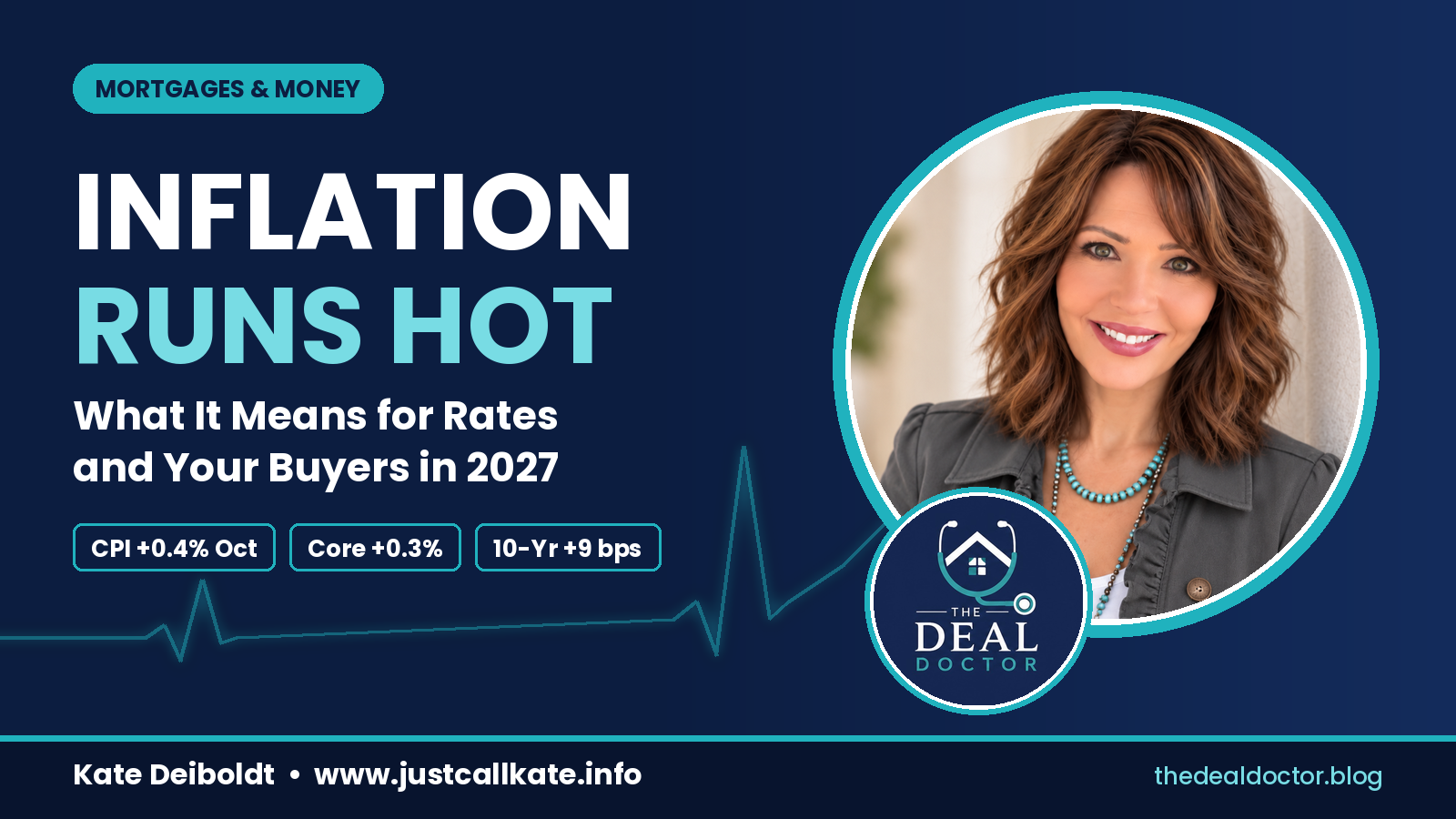
• Inflation Ran Hot in October. Here’s How to Prepare Your Buyers for Higher Rates in 2027.

    Have you noticed the grocery bill creeping up, even when you put the exact same things in the cart every week?

    That feeling showed up in the numbers last week. And it matters for every buyer in your pipeline.

    What the October Inflation Report Said

    RISMedia’s Claudia Larsen broke down the latest Consumer Price Index, and the short version is this: inflation ran hotter than the experts expected.

    Prices rose 0.4% in October. Economists were looking for 0.2% to 0.3%. That’s a step down from September’s 0.6%, but still more heat than the forecast.

    Core inflation, which strips out food and energy, rose 0.3%. That’s the third month in a row at the same pace. Not a spike. A steady simmer.

    Here’s what drove it:

    • Shelter rose 0.3% and accounted for more than 30% of the increase.
    • Food rose 0.5%.
    • Energy slowed down but still rose 0.7%.

    One quirk this month. There’s no official 12-month inflation number, because the Bureau of Labor Statistics didn’t collect October 2025 data during last year’s government shutdown. Using what is available, Navy Federal chief economist Heather Long estimated inflation at about 4% over the past year.

    Why This Hits Mortgage Rates

    The market reacted fast. Realtor.com senior economist Jake Krimmel told RISMedia that a December Fed rate hike now looks almost certain, with CME FedWatch odds jumping to 99% the morning of the report. He also said more hikes in early 2027 look increasingly possible.

    The 10-year Treasury yield climbed 9 basis points within about 25 minutes of the release. Krimmel warned that rising yields and a possible Fed hike could put “upward pressure on mortgage rates again.”

    Now let’s slow down, because this is where a lot of buyers get confused.

    The Fed doesn’t set mortgage rates. Mortgage rates tend to follow the 10-year Treasury and what investors are willing to pay for mortgage bonds. And inflation is the enemy of anyone holding a bond.

    Think about it this way. If you lend your neighbor $100 and they pay you back next year, but everything costs 4% more by then, your $100 buys less. So you’d want a little more interest to make it worth your while. Investors feel exactly the same way. When inflation runs hot, they ask for higher yields. And mortgage rates usually follow.

    Krimmel made one more point worth hearing. A lot of today’s pressure comes from energy, tariffs and global events. Those are costs the Fed has less direct control over, and they’re the ones consumers feel most. That’s why this may not cool off overnight.

    Let’s Put It in Dollars

    Your buyers don’t live in basis points. They live in monthly payments.

    Picture a $300,000, 30-year fixed loan. At 6.50%, principal and interest runs about $1,896 a month. At 6.75%, it’s about $1,946.

    That quarter point costs roughly $50 a month. Nearly $17,900 over the life of the loan.

    That’s not a reason to panic. It’s a reason to plan.

    Don’t Miss the Rent Side of the Story

    Remember that shelter drove more than 30% of October’s increase. That includes rent.

    So when a buyer says, “I’ll just keep renting until rates come down,” it’s worth a gentle conversation. Renting isn’t a pause button. Housing costs keep moving whether they own or not. The difference is who builds the equity.

    Every situation is different. Sometimes waiting is the right call. But that decision should come from clear numbers, not from a scary headline.

    Six Moves Realtors and Loan Officers Can Make Right Now

    1. Refresh every preapproval. A preapproval from 60 days ago was built on 60-day-old pricing. Rerun the numbers at today’s rates, and build in a little cushion so a small move doesn’t knock a buyer out of their price range mid-search.

    2. Talk rate lock strategy early. When rates are jumpy, timing matters. Ask about lock length, lock extension costs and whether a float-down option is available. Keep an eye on the calendar too. Inflation reports and Fed meetings are the days markets move.

    3. Put seller concessions to work. A seller credit can fund a temporary buydown, like a 2-1, that lowers the payment for the first two years. Or it can buy down the rate permanently. Have your lender show the buyer both options side by side so they can choose with clear eyes.

    4. Hunt for assumable loans. FHA and VA loans can often be assumed by a qualified buyer, with lender approval. In a market like Clarksville and Fort Campbell, where VA loans are everywhere, a listing with a low-rate assumable loan can be a real advantage. VA entitlement rules apply, so loop in your lender before you market it.

    5. Lead with the payment, not just the price. Buyers shop with their monthly budget, so show them options in monthly terms. For listings that are sitting, my Deal Doctor Listing Analysis lays out payment strategies on one page so buyers can see what’s actually possible.

    6. Buy a payment that works today. Nobody can promise where rates go next. If they fall later, refinancing may be an option, but it’s never a guarantee. The safest plan is a payment the buyer is comfortable with right now.

    The Deeper Lesson

    After 27 years in this business, here’s what I know.

    Markets change. Rates change. Inflation reports change every single month. People don’t.

    When headlines get loud, buyers get nervous. And nervous buyers usually do one of two things. They freeze, or they rush. Neither one helps them.

    What helps is a calm voice that explains what’s happening, why it matters and what to do next. That’s your role. When you’re the one who makes sense of the noise, you become the person they trust with the biggest purchase of their life.

    Knowledge is power. And trust is still the greatest competitive advantage.

    Your Challenge This Week

    Pick five buyers in your pipeline. Give each one a two-minute call: “Inflation came in hotter than expected last week. Let’s take a fresh look at your numbers so nothing surprises you.”

    That call builds more loyalty than any marketing piece you’ll send this month. And if you’d like a partner to rerun their numbers or map out a buydown strategy, just call Kate. I’ll keep you in the loop the whole way.


    Frequently Asked Questions

    1. How much did inflation rise in October 2026?
    The Consumer Price Index rose 0.4% for the month, above the 0.2% to 0.3% economists expected. Core inflation, excluding food and energy, rose 0.3%.

    2. Why is there no official yearly inflation number this month?
    The Bureau of Labor Statistics didn’t collect October 2025 data during the government shutdown, so it couldn’t calculate a 12-month change. Navy Federal’s Heather Long estimated yearly inflation at about 4%.

    3. Does the Federal Reserve set mortgage rates?
    No. The Fed sets a short-term rate. Mortgage rates tend to follow the 10-year Treasury yield and investor demand for mortgage bonds, though Fed decisions can influence both.

    4. Why does inflation push mortgage rates higher?
    Inflation shrinks what a future dollar can buy. Investors who hold mortgage bonds ask for higher yields to make up for it, and mortgage rates usually follow.

    5. Is a Fed rate hike coming?
    According to Realtor.com economist Jake Krimmel, CME FedWatch odds of a December hike reached 99% the morning of the report, and more hikes in early 2027 look more possible. Markets can shift quickly, so watch upcoming data.

    6. How much does a quarter-point rate increase cost a buyer?
    On a $300,000, 30-year fixed loan, going from 6.50% to 6.75% adds about $50 a month in principal and interest, or nearly $17,900 over 30 years. This is an illustration only.

    7. Should buyers wait for rates to come down?
    It depends on their situation. Rents are rising too, and nobody can promise where rates go next. The best decision comes from running real numbers with a trusted lender.

    8. What is a temporary buydown?
    A temporary buydown, like a 2-1, lowers the payment for the first year or two, often funded by a seller credit. The buyer still qualifies at the full note rate.

    9. Can a buyer take over a seller’s lower-rate mortgage?
    Often, yes, with FHA and VA loans. The buyer must qualify and the servicer must approve. With VA loans, entitlement rules matter, so talk with a lender first.

    10. What should buyers do when rates are volatile?
    Refresh the preapproval, understand lock options, ask about seller concessions and focus on a monthly payment they’re comfortable with today.


    Source: This post was inspired by “Inflation Hotter Than Economist Expectations, Raising Odds of 2027 Rate Hikes” by Claudia Larsen, published by RISMedia on November 10, 2026. Read the original at RISMedia. Economist comments are as reported by RISMedia. Payment examples are illustrations only, use hypothetical rates and are not a quote or loan offer.

    Kate Deiboldt, Senior Mortgage Advisor, VanDyk Mortgage Corporation | NMLS #18487 | Company NMLS #3035 | www.nmlsconsumeraccess.org | Kate@VanDykMortgage.com | (931) 980-9764 | www.justcallkate.info | Licensed in TN, KY, AL, FL, GA, TX and IL. Equal Housing Lender. This content is for educational purposes only and is not a commitment to lend. All loans subject to credit approval, underwriting guidelines and property eligibility. Rates, terms and program availability are subject to change without notice.

  • The New Appraisal Is Here. Here’s How to Read It.

    Think about the last appraisal you read. You probably didn’t read it at all. You flipped straight to the bottom of page 2, found the number, and exhaled.

    That habit just retired.

    As of yesterday, November 2, 2026, the new appraisal format is mandatory for new reports on conventional loans sold to Fannie Mae and Freddie Mac. The familiar 1004 and its cousins are being replaced by one dynamic report under the new Uniform Appraisal Dataset, UAD 3.6. And if you open one expecting the old layout, you are going to feel a little lost.

    The best visual walkthrough I have seen comes from Terra Breeden at Class Valuation, in UAD 3.6: A Complete Guide to the New Report (with Pictures). It recaps a webinar featuring Freddie Mac Chief Appraiser Scott Reuter, and it puts the old and new reports side by side. I want to translate it for the people who actually live with appraisals every day: Realtors, loan officers, and the buyers we serve.

    First, What Actually Changed on November 2

    New appraisals submitted to the GSEs’ portal now have to use UAD 3.6. The date that counts is when the report is first submitted, not when the loan application came in. A few nuances matter:

    • Some lenders are still on the old format for now. Lenders with an approved temporary exception can keep ordering legacy reports into 2027, so you may see both formats for a while. (I covered that in The $300 Appraisal Surprise.)
    • FHA, VA and USDA have not switched yet. They have said they intend to adopt the new format, but for now your VA and FHA buyers will still see the familiar forms. Here in the Fort Campbell market, that means two report styles crossing your desk at the same time.

    From a Rack of Forms to One Tailored Report

    The old system worked like buying a suit off the rack. Single family home? 1004. Condo? 1073. Two to four units? 1025. You picked the closest form and made it fit, and sometimes a property simply didn’t fit any of them.

    UAD 3.6 is the tailor. The lender orders based on what the property actually is (units, ADUs, condo or single family) and the scope of work (interior, exterior, desktop, hybrid, update or completion). The technology then builds one report from the data that applies. Class Valuation notes that separating the property from the assignment this way means more loans should be eligible for sale to Fannie and Freddie. That is good news for unusual properties.

    Start on Page One. That Is Where the Story Lives Now.

    This is the change I am most excited about. The old report scattered the important stuff. The value sat at the bottom of page 2. Property problems could hide in a comment box or a long addendum.

    The new report opens with a summary page: the opinion of value, the market value condition, and the key property facts, all in one place. It also includes a table of apparent defects, damages and deficiencies right up front.

    Realtors, read that twice. The repair conversation used to start when an underwriter dug something out of page 4. Now it starts on page 1, where everyone sees it at a glance. My advice? Walk your listings with fresh eyes before the appraiser does. A loose handrail you fix today is a line that never shows up in that table.

    A Missing Section Is Not a Missing Piece

    The old forms showed every section, every time, in the same order, whether it applied or not. The new report only shows the sections that fit the property and the assignment. Photos and comments now sit inside the section they describe instead of piling up at the back.

    So if you don’t see a condo section on a single family home, nothing is wrong. The better question is no longer “what’s on page 3?” It is “which sections should be here for this file?”

    New Words, Same Ideas

    This is where muscle memory trips people up. The concepts are the same. The labels changed. Here is your cheat sheet:

    • Arm’s length transaction is now typically motivated.
    • Location is now site influenced.
    • Age becomes year built.
    • Garage rolls up under vehicle storage.
    • GLA becomes finished above-grade area, broken out by level, with below-grade space reported separately under ANSI measurement standards.

    That last one is worth a pause. If your listing counts a finished basement or bonus room in the square footage, don’t be surprised if the appraisal breaks it out differently. A new label is not a new policy. Ask before you panic.

    Six Products, One Family

    Instead of a drawer full of form numbers, UAD 3.6 offers six core products: traditional, desktop, hybrid, exterior-only, appraisal update and completion report. The old 1004D used to handle both updates and completions. Now those are two separate products, so ask which one was ordered.

    Investors, this one is for you. The rent schedule that used to arrive as a separate 1007 now usually lives inside the report as its own section. If you are waiting on a separate rent PDF, it may already be in your hands.

    A Grid That Shows Its Work

    Under the old sales grid, an appraiser might roll several differences into one lump adjustment. Everyone downstream had to guess what drove it. The new grid gives key features their own lines and their own adjustments, and items that don’t apply are clearly dashed out.

    That transparency should mean fewer back-and-forth revision requests, because reviewers can see exactly which feature moved the number. It pairs nicely with my earlier post on how appraisers now have to show their math on market trends.

    The Deeper Principle: Clarity Builds Confidence

    Every change here points in the same direction. Put the important information first. Show the reasoning. Connect the photo to the problem it describes. That is what good communication looks like, and it is what clients have always wanted from us.

    Will it feel clunky at first? Sure. Class Valuation suggests it takes about five or six reports before you feel comfortable. That is a temporary learning curve, not a permanent problem.

    What I Would Do This Week

    • Realtors: Ask your lender which format they are ordering. Pre-walk your listings for visible defects. Give your sellers a heads-up that square footage may be reported differently.
    • Loan officers: Update your checklists to start with “which sections apply?” Tape the terminology cheat sheet to your monitor. Look for the rent schedule inside the report before you chase a 1007.
    • Buyers: Read page one of your appraisal. Value, condition and any concerns are all right there. If something doesn’t make sense, ask. That is what we are here for.

    Forms change. People don’t. Your buyer still wants to know one thing: is my home worth what I am paying, and is there anything I should worry about? The new report finally answers that on the first page.

    Knowledge is power. So here is my challenge: the next time a UAD 3.6 report lands in your inbox, don’t scroll for the number. Read page one first. And if you want someone to walk through one with you, just call Kate at (931) 980-9764.

    Frequently Asked Questions About the New UAD 3.6 Appraisal Report

    1. What is UAD 3.6?

    UAD 3.6 is the updated Uniform Appraisal Dataset from Fannie Mae and Freddie Mac. It replaces the legacy appraisal forms with a single, data-driven report called the redesigned Uniform Residential Appraisal Report (URAR).

    2. When did UAD 3.6 become mandatory?

    November 2, 2026, for new appraisal reports submitted to the GSEs on conventional loans. The mandate is based on when the report is first submitted, not when the loan application was taken.

    3. Why might I still see old-style appraisals?

    Some lenders received a temporary exception to keep ordering the legacy format into 2027. FHA, VA and USDA loans also still use the familiar forms for now, though those agencies plan to adopt the new format later.

    4. Where do I find the appraised value now?

    On the summary page at the front of the report, along with the market value condition and key property facts. You no longer need to hunt for it at the bottom of page 2.

    5. What is the defects, damages and deficiencies table?

    It is a table near the front of the report that lists apparent issues the appraiser observed. It helps underwriters, agents and buyers see potential repair items right away instead of finding them buried in comments.

    6. Does a missing section mean the appraisal is incomplete?

    Not necessarily. The new report only includes sections that apply to the property and the assignment. A condo section won’t appear on a single family home, for example.

    7. What happened to “GLA” and “arm’s length”?

    GLA is now reported as finished above-grade area by level, with below-grade space shown separately. Arm’s length is now described as “typically motivated.” The concepts are the same, only the labels changed.

    8. Could the appraisal square footage differ from my listing?

    It can, especially for finished basements and other below-grade space, since the new report follows ANSI measurement standards and separates above-grade from below-grade area. Talk with your lender before assuming the value is affected.

    9. Is the rent schedule still a separate form?

    In most cases, no. The rent schedule is now a section inside the UAD 3.6 report, and the separate 1007 is reserved for limited situations.

    10. How long does it take to get comfortable reading the new report?

    Class Valuation estimates about five or six reports. Start with the summary page, use a terminology cheat sheet, and ask your loan officer to walk through your first few with you.


    Source: Terra Breeden, “UAD 3.6: A Complete Guide to the New Report (with Pictures),” Class Valuation, August 27, 2026, recapping the Class Valuation webinar “UAD 3.6: Your Roadmap to November.” Visit the original article for side-by-side images of the old and new reports.

    This article is for educational purposes only and is not a commitment to lend. Appraisal requirements, fees, turn times and program availability vary and are subject to change. Kate Deiboldt, Senior Mortgage Advisor | VanDyk Mortgage Corporation | NMLS #18487 | Company NMLS #3035 | (931) 980-9764 | Kate@VanDykMortgage.com | Licensed in TN, KY, AL, FL, GA, TX and IL | Equal Housing Lender | www.nmlsconsumeraccess.org

  • Stronger Agents, Stronger Business: What Buffini’s Agent-First CEO Podcast Teaches Leaders and Lenders

    Walk into almost any brokerage meeting and you’ll hear the same three worries. How do we recruit? How do we keep the good ones? And why isn’t the bottom line better?

    Most leaders treat those as three different problems. Three budgets. Three strategies. Three headaches.

    Buffini thinks they’re really one problem. And after 27 years of watching teams grow (and sometimes fall apart) from the lending side of the table, I think they’re right.

    What Buffini Just Launched

    RISMedia reports that Buffini has launched The Agent-First CEO, a free weekly podcast built for brokerage owners and team leaders.

    Ethan Beute, Buffini’s Chief Ambassador, hosts the show. He’s hosted more than 500 podcast episodes, including a show for team leaders, so he knows how to get good stories out of people.

    New episodes drop every Wednesday. Most feature a team leader or brokerage owner talking about what is actually working for their agents. Some feature a leadership expert or a panel of Buffini coaches. Every episode gets its own page on buffini.com with key takeaways and a full transcript, which is a nice touch if you’d rather skim than listen.

    You can find it on YouTube, Apple Podcasts and Spotify, or at buffini.com/agentfirst.

    The Big Idea: Productivity Sits in the Middle

    The model behind the show is simple. Agent productivity sits at the center. Culture, mentoring and training feed it. Recruiting, retention and profitability flow out of it.

    Beute says most leaders he talks with are fighting recruiting, retention and profit as “three separate battles.” His point is that when you invest in your agents first, the other three get easier.

    Brian Buffini puts it another way. Too many leaders are busy managing when their agents need someone to lead. In his view, an agent-first CEO builds a culture people want to join and trains agents to get better every single year.

    Read that again. Better every single year. Not just busier.

    Why This Matters, Even If You Don’t Run a Brokerage

    Think about a garden.

    You can spend all your money buying new plants. Or you can take care of the soil. Healthy soil makes every plant grow, and it makes the next one you bring home more likely to thrive.

    Recruiting is buying plants. Retention is keeping them alive. Profit is the harvest. Agent development is the soil.

    And in a market where every transaction takes more work than it used to, the soil matters even more. You can’t afford a team where only a few people know how to get a deal to the closing table. Every agent who levels up takes pressure off you, your staff and your bottom line.

    Here’s what I’ve seen over and over. Good agents rarely leave a place where they’re growing. They leave places where they stopped getting better. And agents talk. A culture where people genuinely improve becomes your best recruiting tool, because your own agents start doing the recruiting for you.

    What Loan Officers Should Take From This

    So why is a mortgage advisor writing about a leadership podcast for brokers?

    Because the same principle applies to every loan officer who partners with agents. Agent-first isn’t just a brokerage strategy. It’s a partnership strategy.

    Picture two loan officers. The first one stops by the office with donuts and a rate sheet. The second one shows up with a short training on how to read a preapproval letter, how seller concessions can make an offer stronger, or how a hidden partial claim lien can surprise everyone at closing.

    Six months later, a deal gets messy. Which one does the agent call?

    The second one. Every time. Because she made them better at their job.

    That’s agent-first thinking from the lending side. Make your agents more capable and the relationship takes care of itself. Teach before selling. Serve before persuading. Just keep it educational, and run anything co-branded past your compliance team so it stays RESPA-friendly.

    Three Ways to Put Agent-First Thinking to Work This Week

    1. Ask before you teach. Ask your agents, or your agent partners, where deals are getting stuck right now. Then build your training around their real problems instead of your favorite talking points.

    2. Make growth visible. Set one clear expectation each quarter and celebrate progress out loud. People who can see they’re improving tend to stay.

    3. Bring a lending partner into the room. Leaders, invite a lender to teach a session on financing that helps buyers win: down payment assistance, VA loans, or payment strategies in a higher-rate market. Loan officers, offer to teach it.

    And here’s a bonus. Queue up an episode of The Agent-First CEO for your next drive. Twenty minutes of hearing how another leader solved the problem you’re stuck on can be worth more than a week of guessing.

    Your Challenge

    Technology changes. Markets change. Interest rates change. People don’t. People want to grow, and they want to be led by someone who believes they can.

    So here’s my challenge. Pick one agent on your team, or one agent you partner with, and ask a simple question: “What’s one thing that would make you better this year?”

    Then help them get it.

    Trust is still the greatest competitive advantage. And nothing builds trust faster than helping someone become more capable than they were yesterday.

    If your team would like a session on financing strategies that help stale listings move, or buyers who were told no somewhere else, reach out. That’s exactly what The Deal Doctor is here for.


    Frequently Asked Questions

    1. What is The Agent-First CEO?
    A free weekly podcast from Buffini for brokerage owners and team leaders. Each episode focuses on what is working for agents and how stronger agents build stronger businesses.

    2. Who hosts the podcast?
    Ethan Beute, Buffini’s Chief Ambassador. He has hosted more than 500 podcast episodes, including a show for team leaders.

    3. How often do new episodes come out?
    Every Wednesday.

    4. Where can I listen?
    On YouTube, Apple Podcasts and Spotify. The trailer and every episode are also at buffini.com/agentfirst, along with key takeaways and full transcripts.

    5. Who is the podcast for?
    Brokerage owners, team leaders, emerging leaders and operations staff who are moving from doing the work to leading others. Buffini Leadership Coaching Members are part of the audience too.

    6. What does “agent-first” actually mean?
    It means putting agent productivity at the center of the business. Culture, mentoring and training support that productivity, and recruiting, retention and profitability follow from it.

    7. Is the podcast the same as Buffini’s Agent-First CEO training program?
    No. The podcast is free and open to everyone. Brian Buffini’s six-module Agent-First CEO training program is a separate offering available to Leadership Coaching Members.

    8. How does an agent-first approach help with recruiting and retention?
    Agents tend to stay where they’re growing, and they tell their friends about it. When development comes first, your culture does a lot of the recruiting and retaining for you.

    9. Why should loan officers care about a brokerage leadership podcast?
    Because the same idea drives strong lender partnerships. Loan officers who help agents get better at their jobs become the partners agents call first.

    10. How can a lender support an agent-first team?
    Offer practical education on topics that help agents win, like down payment assistance, VA financing, seller concessions and payment strategies. Keep it educational, and have your compliance team review any co-marketing so it follows RESPA guidelines.


    Source: This post is based on “Buffini Launches The Agent-First CEO; a Free Podcast for Team Leaders and Brokers,” published by RISMedia on November 12, 2026. All credit for the original reporting goes to RISMedia. Read the full article at RISMedia. The Agent-First CEO is a Buffini program; this post is not affiliated with or endorsed by Buffini.

    Kate Deiboldt, Senior Mortgage Advisor, VanDyk Mortgage Corporation | NMLS #18487 | Company NMLS #3035 | www.nmlsconsumeraccess.org | Kate@VanDykMortgage.com | (931) 980-9764 | www.justcallkate.info | Licensed in TN, KY, AL, FL, GA, TX and IL. Equal Housing Lender. This content is for educational purposes only and is not a commitment to lend. All loans subject to credit approval, underwriting guidelines and property eligibility.

  • Meet the Three Percenters: Your Next Listing Is Hiding Behind a 3% Rate

    Picture the school pickup line in a quiet suburb outside Kansas City. One dad pulls up in a Porsche. A few of the other parents have quietly stopped talking to him.

    That is not a story about a car. It is a story about a mortgage rate.

    The Wall Street Journal just profiled what it calls America’s “three percenters” in They’re Lucky Enough to Have a 3% Mortgage, and Feel Like They Can Never Move by Rebecca Picciotto (November 15, 2026). These are the roughly one in five mortgage holders who locked in a rate at or below 3% during the pandemic years. With the 30-year fixed sitting around 7.1% according to the article, their payments look like they came from a different planet.

    I read it twice. Then I read it a third time with a highlighter. Because every person in that piece is someone a Realtor or loan officer should be talking to right now. And most of them aren’t hearing from anyone.

    Five People, One Feeling

    The Journal introduces five homeowners. Here is the short version.

    The Porsche driver. Andrew Radcliff refinanced at 2.82% in 2019 and pays about $1,800 a month. With three kids and three dogs, he would love a bigger house. At today’s rates his payment would more than double, so he is adding on to the house he has instead.

    The involuntary landlord. Alex Taylor inherited her mother’s home in a nicer area and moved there. She kept her 2.88% house as a rental rather than give up the rate. She doesn’t enjoy being a landlord, and she described that rate as “like one of those sticky rat traps.”

    The never-renter. Laura Allison bought her Altoona, Pennsylvania home for $74,000 at 2.74%, the day before she turned 25. Her mortgage, taxes and insurance run about $510 a month. She plans to stay forever, while her brother has been house hunting for months without success.

    The Zillow dreamer. Kenneth Tang, a software engineer near Seattle with a 2.75% rate, now caps his real estate browsing at about 30 minutes a week. He knows the math of a move, and he doesn’t want to fall in love with a house he won’t buy.

    The early retiree. Eric Miller refinanced at 2.88% and retired at 41. He told the Journal that at today’s rates he would still be working his corporate job.

    Different lives. Same feeling. They are holding something valuable, and they are afraid to set it down.

    Why This Matters More Than the Headline

    Here is what jumps off the page for me. These folks are not staying put because they love their houses. They are staying put because the math feels scary.

    Look underneath. Radcliff wants more room. Taylor wanted out of landlording. Tang is still browsing listings, just on a timer. Those are not people who are done with real estate. Those are people who are waiting.

    And that is the deeper principle. A rate can freeze a decision. It can’t freeze a life.

    Kids grow. Parents age. Jobs move. Inheritances happen, just like Taylor’s did. The need keeps building quietly in the background. The rate only delays the conversation. Whoever is there, with clear numbers and a calm voice, when the need finally outweighs the rate is the person who gets that business.

    Taylor said something else worth sitting with. Two people can live in identical houses, and the difference between them comes down to a few months of timing. That is how most homeowners experience this market. Like luck. A lottery. Our job is to turn luck into strategy.

    Rate Math vs. Life Math

    Most three percenters run one comparison: their rate against today’s rate. That comparison wins for staying every single time.

    But it is the wrong comparison.

    The better question is life math. What does the next five years look like in this house compared to that one? What is the renovation going to cost? What is the landlord stress costing? What about the commute, the bedrooms, the school district, the aging parent two states away?

    Tang ran his numbers. Today about 13% of his income goes to housing. A move could push him closer to a quarter of it. That is real, and for him staying may be exactly the right call.

    Our job is not to talk anyone out of a great rate. Our job is to make sure the decision is a decision, not a reflex.

    Five Conversations to Start This Month

    1. Keep it and buy the next one. For some homeowners, the low-rate house becomes a rental and they buy the next home. Run the numbers honestly, including vacancy, repairs and property management. Taylor’s rent covers her costs, and she still hates the job. In our Fort Campbell market, some veterans may have remaining VA entitlement that makes a second purchase possible while keeping the first home, depending on their entitlement and qualifying.

    2. Tap equity without touching the first mortgage. Radcliff chose to renovate instead of move. A home equity line or a fixed second mortgage can fund that kind of project while the 3% first mortgage stays right where it is. Show the blended cost, not just the second loan’s rate.

    3. Sell the rate, not just the house. FHA and VA loans can be assumable, with lender approval and a qualified buyer. In a military market like Clarksville, a seller with a 2-point-something VA loan may be holding a listing feature worth more than new countertops. I unpacked this in Golden Handcuffs, Not a Trap. Veteran sellers should understand how an assumption affects their entitlement before they agree to one.

    4. Talk to the dreamers. Tang still looks at listings every week. So do a lot of your past clients. Saved searches, open house sign-ins and favorited homes are signals. Don’t pressure. Offer a payment strategy review that compares options side by side, including seller credits and buydowns.

    5. Find the stuck renters in their circle. Allison’s brother has been searching for months. Nearly every three percenter knows a sibling, a grown child or a coworker who is stuck renting. Down payment assistance, FHA and VA programs can open doors that feel shut.

    The Deal Doctor’s Take

    People don’t buy rates. They buy the life the payment allows.

    The three percenters are not a frozen market. They are a patient one. And patient people reward the professional who taught them something before asking for anything.

    Technology changes. Markets change. Interest rates change. People don’t. Knowledge is power, and trust is still the greatest competitive advantage.

    Here is your challenge for this week. Pull five past clients who closed or refinanced between 2020 and 2021. Don’t call to ask if they want to sell. Call to ask how the house is fitting their life right now. Then listen. The next move is usually hiding in the answer.


    Frequently Asked Questions

    What is a “three percenter”?

    It is the nickname the Wall Street Journal gave homeowners who locked in a mortgage rate at or below 3%, mostly during the pandemic years when rates hit historic lows.

    How many homeowners have a rate at or below 3%?

    According to the Journal, about one in five mortgage holders falls into that group. That is a big slice of potential sellers and buyers who are currently sitting still.

    Why don’t homeowners with low rates want to move?

    Because replacing a sub-3% loan at today’s rates can more than double the payment on a similar loan amount. The rate becomes something they feel they would lose, so many delay moving even when the house no longer fits.

    Is it ever smart to give up a 3% mortgage?

    It can be. Life changes like a growing family, a job relocation, caring for a parent or downsizing can outweigh the payment difference. The key is comparing total life costs and goals, not just two interest rates.

    Can I keep my low-rate home as a rental and buy another home?

    Often, yes, if you qualify. Lenders look at income, reserves, any projected rental income and occupancy rules for the new home. Talk with a tax professional about rental property, and be honest about whether you want to be a landlord.

    What is an assumable mortgage?

    It is a loan a qualified buyer can take over, keeping the seller’s rate and remaining term. FHA and VA loans can be assumable with lender approval. The buyer usually needs to cover the difference between the price and the remaining loan balance.

    Can I renovate without refinancing my low-rate loan?

    Yes. A home equity line of credit or a fixed-rate second mortgage can fund improvements while your first mortgage stays untouched. Compare the blended cost of both loans to the cost of moving.

    How can Realtors find opportunities with low-rate homeowners?

    Start with past clients and sphere contacts who bought or refinanced in 2020 and 2021. Ask how the home is working for their life, and offer a side-by-side review of options like keep-and-rent, assumption or renovation.

    What should loan officers say to past clients with low rates?

    Lead with education, not a pitch. Congratulate them on a great rate, then offer to run life math: what staying, renovating, renting or moving would actually cost over the next few years.

    Where do I start if I want to run my own numbers?

    Reach out. I’m happy to build a no-pressure payment comparison so you can see your options clearly and decide on your own timeline.


    Source: Rebecca Picciotto, “They’re Lucky Enough to Have a 3% Mortgage, and Feel Like They Can Never Move,” The Wall Street Journal, November 15, 2026. Homeowner details and figures above are as reported in that article. Commentary and strategies are my own.


    Kate Deiboldt
    Senior Mortgage Advisor, VanDyk Mortgage Corporation
    NMLS #18487 | Company NMLS #3035
    Kate@VanDykMortgage.com | (931) 980-9764
    www.justcallkate.info | Facebook: @katematties
    Licensed in TN, KY, AL, FL, GA, TX and IL

    This article is for educational purposes only and is not a commitment to lend or an offer of credit. All loans are subject to credit approval, underwriting guidelines and property eligibility. Rates, terms and programs are subject to change without notice. Loan assumptions require lender approval and buyer qualification; VA entitlement rules vary by borrower. Consult a tax professional regarding rental property. Kate Deiboldt, NMLS #18487. VanDyk Mortgage Corporation, Company NMLS #3035. Verify licensing at www.nmlsconsumeraccess.org. Equal Housing Lender.

  • 4-Pillar Realtor Content Strategy: Clarksville Guide

    4-Pillar Realtor Content Strategy: Clarksville Guide

    A realtor content strategy built on four pillars — Authority, Proof, Personality, and Conversion — is the clearest path from random posting to a pipeline that fills itself. Each pillar serves a distinct job: one builds credibility, one supplies evidence, one creates human connection, and one drives action. Without all four, most Clarksville TN realtors end up overloaded on one type and starved for the others.

    According to the NAR 2025 Technology Survey, 75% of REALTORS® now use social media to connect with clients online — yet most still post without a framework, leaving reach and referrals on the table. If you are a Clarksville real estate agent or Fort Campbell VA loan specialist, structuring your content around these four pillars will separate your feed from the noise in Montgomery County and across Middle Tennessee.

    TL;DR — Key Takeaways

    • Four pillars, one strategy: Authority, Proof, Personality, and Conversion each serve a specific role in moving a stranger to a signed client.
    • Balanced monthly mix matters: Aim for roughly 30% Authority, 25% Proof, 25% Personality, and 20% Conversion posts each month.
    • Video dominates in 2026: 91% of businesses use video as a marketing tool (Wyzowl 2026); a 60/40 video-to-static ratio is the new floor for Clarksville TN realtors.
    • NAR data backs social investment: 64% of REALTORS® adopt new technology to enhance the client experience (NAR 2025), and content strategy is the highest-leverage tech investment.
    • Conversion content needs a clear CTA: Every conversion post must ask for one action — a call, a form fill, or a DM — not three.
    • Military relocation Clarksville context is a content superpower: Fort Campbell PCS cycles create predictable seasonal demand you can map to your calendar months in advance.

    What Are the 4 Pillars of a Realtor Content Strategy?

    Authority content is any post that demonstrates your expertise in the local market, loan products, or the homebuying process — market stats, rate updates, and explainer videos all fall here. Proof content is social evidence that you deliver results — closed deal announcements, client testimonials, and five-star review screenshots. Personality content is the behind-the-scenes, human-side material that makes you relatable and memorable rather than interchangeable with every other Clarksville TN realtor on Instagram. Conversion content is any post with a direct call to action designed to generate a specific, measurable response from a prospective buyer or seller.

    Think of the four pillars as a funnel baked into your feed. Authority attracts the right audience. Proof removes doubt. Personality builds the “know, like, trust” factor. Conversion activates that audience into booked consultations, pre-approval applications, and referral requests. When one pillar dominates, results suffer — all conversion posts kill engagement; all Authority posts spike reach but the phone never rings.

    Pillar Comparison: Goals, Content Types, Monthly Mix, CTAs & KPIs

    Pillar Goal Content Types % of Monthly Mix Primary CTA Key KPI
    Authority Build credibility & trust; rank for local searches Market stats, rate commentary, neighborhood guides, explainer videos, blog recaps ~30% “Save this post for your next move.” Saves, shares, profile visits
    Proof Remove objections; demonstrate track record Closings, testimonials, Google/Zillow review screenshots, before-after staging photos ~25% “See what clients say — link in bio.” Comments, DMs, link clicks
    Personality Create connection; differentiate from competitors Behind-the-scenes, community spotlights, personal stories, day-in-the-life Reels ~25% “Tell me — buyer or seller? Drop it below.” Comments, shares, follower growth
    Conversion Generate direct leads and booked consultations Story polls, lead-gen carousels, “DM me X” posts, rate-check CTAs, open house promos ~20% “DM me ‘READY’ to get pre-approved today.” DMs received, form fills, booked calls

    Percentages are guides. New Clarksville agents should weight Personality and Authority higher; established accounts can push Conversion to 25–30%.

    How to Plan a Month of Realtor Content in 7 Steps

    1. Audit last month’s top-performing posts. Before opening a content calendar, pull your Instagram/Facebook insights and identify the three posts with the highest saves, shares, and profile visits. These signal what your specific audience in Clarksville, Montgomery County, or Middle Tennessee responds to — replicate the pillar and format, not just the topic.
    2. Map your pillar targets to a post count. If you plan 20 posts per month, that’s roughly 6 Authority, 5 Proof, 5 Personality, and 4 Conversion posts. Write the numbers in your calendar before you fill in topics so the distribution doesn’t drift toward whatever is easiest to create.
    3. Anchor to local events and military relocation Clarksville cycles. Fort Campbell PCS orders typically release in January, April, and July. Build Authority and Conversion content around those windows — VA loan eligibility, mortgage pre-approval Clarksville, and homes for sale near Fort Campbell posts perform best when timed to PCS season.
    4. Assign a video-to-static ratio. Wyzowl’s 2026 State of Video Marketing data shows 91% of businesses use video and 82% of marketers report strong ROI from it. For Clarksville TN realtors, a workable target is 60% video (Reels, Stories, YouTube Shorts) and 40% static or carousel. This ratio feeds the Instagram algorithm, which currently rewards Reels with the broadest organic reach among real estate accounts per Hootsuite’s 2025 benchmark data.
    5. Write captions and hooks in one session — batching saves 3–4 hours per week. Draft all 20 captions in a single two-hour block. Use your Authority posts to drop real Nashville real estate market stats, your Proof posts to tell the story behind a recent closing, and your Personality posts to share a genuine moment from your week in Clarksville or Fort Campbell.
    6. Schedule and cross-post strategically. Publish to Instagram first, then adapt captions (more professional tone) for Facebook, shorter clips for YouTube Shorts, and link to your full blog post on thedealdoctor.blog. This repurposing approach — one piece of content, three to four placements — is the standard operating procedure for high-output Clarksville real estate agents who produce content without a full team.
    7. Review metrics at day 7 and day 30. Check saves and shares on Authority posts at day 7 (these are early signals of organic growth). Measure DMs and link clicks on Conversion posts at day 30. Track follower growth on Personality posts month over month. Adjust the following month’s pillar balance based on what the data tells you — not what you feel like posting.

    Sample Monthly Content Calendar for a Clarksville Realtor

    The calendar below maps four weeks of content for a Clarksville TN realtor posting five times per week across Instagram and Facebook, with two Reels per week. Adjust topics to current Nashville real estate market conditions and Fort Campbell activity.

    Week Mon Tue Wed Thu Fri
    Week 1 Authority: Clarksville housing market stats (Reel) Proof: Testimonial from a PCS buyer Personality: Behind-the-scenes open house setup Authority: VA loan eligibility explainer carousel Conversion: “DM me READY for a free pre-approval consult”
    Week 2 Authority: Montgomery County median price update Personality: Community spotlight — local Clarksville business Proof: Closing photo + client quote (Reel) Authority: Mortgage rate watch post Conversion: Story poll — “Buying or renting in 2026?”
    Week 3 Personality: Day-in-the-life Reel — showing homes near Fort Campbell Authority: First-time homebuyer Clarksville guide carousel Proof: Before/after staging transformation Conversion: Open house promo with address + time Authority: Nashville vs. Clarksville market comparison
    Week 4 Proof: Five-star Google review screenshot Personality: Personal story — why I love helping military families in Middle Tennessee Authority: USDA/THDA loan options for Tennessee buyers (Reel) Conversion: Lead magnet — “Download my Clarksville Home Buyer Checklist” Personality: Monthly wrap-up — wins and lessons from the field

    FAQ — Realtor Content Strategy Pillars

    How often should a Clarksville real estate agent post on social media?

    Three to five times per week is the sweet spot for most Clarksville TN realtors without a dedicated team. Consistency beats volume — posting four times per week for six months outperforms a daily burst that burns out in two weeks. Use Stories daily for low-effort visibility, particularly for polls and swipe-up links to your pre-approval form.

    Which of the four content pillars gets the most organic reach on Instagram?

    Authority and Personality posts consistently generate the most organic reach because they earn saves and shares, which are the two signals Instagram’s algorithm weighs most heavily. According to Hootsuite’s 2025 engagement benchmark report, the average Instagram engagement rate for real estate and professional services accounts is 3.7% per post — well above the platform average. Proof and Conversion posts generate lower reach but higher-intent responses (DMs, link clicks, booked calls), making them valuable even when their numbers look smaller.

    What is a good text-to-video ratio for a realtor content strategy in 2026?

    A 60/40 split favoring video (Reels, Stories, YouTube Shorts) over static or text-based posts is the practical standard for real estate agents in 2026. Wyzowl’s 2026 State of Video Marketing report found that 91% of businesses use video as a marketing tool, and 84% of consumers say they want to see more video from brands. For Fort Campbell VA loan specialist content and military relocation Clarksville topics specifically, short-form explainer videos (30–90 seconds) outperform static carousels for reach among PCS audiences who are researching quickly from their phones.

    Do I need to be on every social media platform as a Clarksville realtor?

    No. Two to three platforms done well will outperform five platforms done poorly. For most Clarksville TN realtors, Instagram and Facebook are the core — they share the same Meta ad infrastructure, target overlapping audiences, and allow content repurposing with minimal extra effort. Add YouTube if you can commit to one video per week; add LinkedIn if you pursue relocation referrals from corporate or military HR contacts. TikTok is worth testing for agents targeting first-time homebuyers under 35, but it is not a requirement for building a sustainable Clarksville housing market presence in 2026.

    How do I measure whether my conversion content is actually working?

    Track three metrics for conversion content: (1) DMs received directly attributable to a post CTA, (2) link clicks from your bio link or Stories swipe-up to your pre-approval form or contact page, and (3) booked consultations that originate from social. Most Clarksville real estate agents skip step three — actually asking new inquiry calls “how did you find me?” — which means they never close the attribution loop. Set a 30-day conversion benchmark at the start of each month: for example, 5 qualified DMs and 2 booked calls from conversion content. If you miss it, adjust the CTA copy or the pillar mix before the next cycle.


    Written by Kate Matties-Deiboldt at The Blue Note Home — NMLS #18487, VanDyk Mortgage. Kate is a Clarksville TN mortgage lender and Fort Campbell VA loan specialist serving Montgomery County, Clarksville, Fort Campbell, Nashville, and Middle Tennessee.

  • Conventional vs. FHA vs. VA: Which Loan Is Right for Your Clarksville Home?

    If you’re buying a home in Clarksville or near Fort Campbell, the “right” mortgage usually comes down to three options: Conventional, FHA, or VA. The best fit depends on your down payment, credit profile, and whether you have VA eligibility—not just the interest rate you see online.

    In plain terms: VA loans can be the most powerful option for eligible service members and veterans, FHA loans are often the most forgiving for credit and down payment, and conventional loans can be ideal when your credit and cash position are strong.

    TL;DR — Key Takeaways

    • Conventional is best when your credit, income, and down payment are solid—it can be cost-effective with no upfront mortgage insurance.
    • FHA is designed for flexibility with smaller down payments and more forgiving credit guidelines.
    • VA is a major advantage for Fort Campbell buyers: often no down payment and no monthly mortgage insurance.
    • Don’t pick a loan by rate alone—compare cash to close, monthly payment, and long-term costs.
    • A quick pre-approval plan can show which loan fits your numbers for the Clarksville TN housing market.

    Start with the goal: the loan that gets you keys with the least stress

    Most homebuyers in Montgomery County start by asking, “What’s the lowest rate?” But the better question is: Which loan gets me approved, fits my monthly budget, and keeps my cash-to-close manageable? The right product helps you make a confident offer—especially when homes for sale near Fort Campbell move quickly.

    Cash-to-close is the total money you bring to the closing table for your down payment, closing costs, and prepaid items like homeowners insurance and taxes. Debt-to-income ratio (DTI) is the percentage of your monthly income that goes to monthly debt payments. And mortgage insurance is a fee that protects the lender when you put less money down—it shows up differently on FHA, conventional, and VA.

    Conventional vs. FHA vs. VA: the simple differences that matter

    • Conventional can be a great fit when your credit is stronger and you want mortgage insurance that can drop off later.
    • FHA is often more forgiving on down payment and credit, but it comes with upfront + monthly mortgage insurance rules.
    • VA is a major advantage for eligible Fort Campbell buyers because it’s often zero-down with no monthly mortgage insurance.

    Quick comparison table: Conventional vs. FHA vs. VA

    Feature Conventional FHA VA
    Best for Strong credit/savings Lower down payment or credit rebuild Eligible military/veterans near Fort Campbell
    Down payment Often 3%+ (program-dependent) Often 3.5%+ (program-dependent) Often 0% (eligibility-dependent)
    Mortgage insurance PMI if <20% down (can be removed) Upfront + monthly (rules vary by down payment) No monthly MI

    How to choose: 3 questions I ask Clarksville homebuyers

    1. Are you VA-eligible? If yes, we start there—it’s often the best total-cost option for homes near Fort Campbell.
    2. How much cash do you want to keep after closing? Keeping savings matters in Middle Tennessee, especially with a PCS move or job change.
    3. What’s your credit story right now? If you’re rebuilding, FHA might be the cleanest path while we plan improvement steps.

    Related reads (when you’re ready)

    • [INTERNAL LINK: FHA Loans Explained: Who Should Use One in Clarksville TN]
    • [INTERNAL LINK: VA Loans 101: A Complete Guide for Fort Campbell Service Members]
    • [INTERNAL LINK: How Much House Can I Really Afford in Clarksville TN? (The Real Math)]

    Frequently Asked Questions

    Is a conventional loan always cheaper than FHA?

    Not always. Conventional can be cheaper when your credit score is strong and PMI pricing is favorable. FHA can be cheaper in the short term if conventional PMI is high for your score. The best way to know is to compare payment and cash-to-close side by side for your Clarksville TN price range.

    Can I use FHA if I’ve had past credit issues?

    Often, yes. FHA is designed to be more flexible with credit history than many conventional guidelines. That doesn’t mean “anything goes”—you still need qualifying income and an acceptable payment history. We’ll look at your timeline and build a plan for Montgomery County TN homebuying.

    Do VA loans require a down payment?

    Many VA loans are done with zero down, which is a huge advantage for Fort Campbell buyers. Some scenarios may require a down payment, such as when the purchase price is above an appraised value and the seller won’t negotiate. We’ll map out options so you know your minimum cash needed.

    What’s the difference between PMI and FHA mortgage insurance?

    PMI is private mortgage insurance on conventional loans and it can usually be removed once you reach enough equity. FHA mortgage insurance includes an upfront premium and a monthly premium, and it may last for the life of the loan depending on down payment. This is why a payment comparison matters in Middle Tennessee.

    Does a VA loan have mortgage insurance?

    No monthly mortgage insurance. VA loans typically do have a VA funding fee, which helps keep the program running. Some borrowers have the fee waived, such as certain veterans with service-connected disability. For details, the VA outlines eligibility and benefits on VA funding fee rules (2026).

    Can I use any lender for a VA loan near Fort Campbell?

    You can choose any VA-approved lender, but experience matters. VA loans have specific appraisal and documentation requirements, and a good lender helps your offer feel strong to sellers in the Clarksville real estate market. I recommend working with someone who closes VA loans regularly and can explain the process clearly.

    Is FHA harder to buy with because of the appraisal?

    FHA appraisals pay closer attention to safety and livability items. Most homes are fine, but issues like peeling paint, missing handrails, or roof concerns can require repairs. In Clarksville, we’ll talk through the property and the contract strategy so you don’t get stuck late in the process.

    Can I switch loan types after I’m under contract?

    Sometimes, yes—but it depends on timing, appraisal type, and the seller’s expectations. Switching can impact your closing date and required documents. If you’re shopping in Nashville or Clarksville, it’s best to identify your strongest loan option before you write an offer.

    Which loan is best for a first-time homebuyer in Clarksville?

    It depends on your goals and eligibility. Many first-time buyers do well with conventional 3% down if their credit is strong. FHA can be a smart path for smaller down payments or credit rebuilds. If you’re eligible, a VA loan is often the top choice for Fort Campbell households.

    What documents do I need to get pre-approved?

    Most buyers need pay stubs, W-2s, two years of work history, bank statements, and a photo ID. If you’re self-employed, you may need business tax returns too. Getting organized early makes mortgage pre-approval in Clarksville smoother and helps you move quickly when the right home pops up.


    Byline: Kate Matties-Deiboldt, NMLS #18487, VanDyk Mortgage — Clarksville TN mortgage lender and Fort Campbell VA loan specialist serving Montgomery County and Middle Tennessee.

    Your Clear Guide Through the Mortgage Process

    Whatever your questions, concerns, or hesitations about choosing between a conventional, FHA, or VA loan, I can be your clear guide through the mortgage process. The first step is a quick, no-obligation analysis of your current situation and a professional plan of action to put you in the best position to purchase or refinance a home when you’re ready.

    📞 Call or text: (931) 980-9764
    ✉️ Email: Kate@JustCallKate.com
    Kate Matties-Deiboldt — NMLS #18487, VanDyk Mortgage
    Clarksville TN mortgage lender · Fort Campbell VA loan specialist

  • The Flood Behind the Dam: What Tighter FHA Partial Claim Rules Mean for Realtors and Loan Officers

    Here’s something I keep seeing on title commitments lately.

    A homeowner calls a listing agent. Nice house. Decent equity, at least on paper. Then the title work comes back with a second lien nobody mentioned. It’s recorded to the Secretary of Housing and Urban Development. Zero interest. Due in full at closing.

    Nobody hid it. Most of the time the homeowner simply forgot it was there.

    That lien is an FHA partial claim. And the rules around it have changed in a way every Realtor and loan officer needs to understand, because it’s going to shape the listing pipeline for the next year or more.

    What The Wall Street Journal Laid Out

    This spring, Carol Ryan at The Wall Street Journal wrote a sharp piece on what happens now that the government has pulled back on one of the biggest foreclosure prevention tools of the pandemic era. Her headline didn’t sugarcoat it: the help is ending, and foreclosures are expected to follow.

    The early numbers she cited point the same direction. Foreclosure filings in March were up 28% from a year earlier, according to Attom. Still below 2019 levels. But climbing.

    Partial Claims in Plain English

    When an FHA borrower falls behind, HUD can pay the missed amount and bring the loan current. That money doesn’t disappear. It becomes a separate junior lien on the home. No monthly payment. No interest. It just waits quietly until the home is sold, refinanced, or the first mortgage is paid off.

    Think of it like a pause button with a receipt attached.

    During the pandemic, HUD removed the limit on how many times a borrower could use it. The only real ceiling was that total claims couldn’t go above 30% of the loan balance. For families in genuine hardship, that was a lifeline. The Journal also found borrowers who went back to the well again and again. One Massachusetts homeowner stacked up five partial claims worth $96,000 since 2021. Interest free, for the life of the loan.

    What Changed

    Starting last October, the guardrails went back up. Under the tighter rules described in the article:

    • Borrowers can use a partial claim or loan modification only once every two years.
    • They have to make three consecutive mortgage payments before they qualify for help clearing the arrears.

    The goal makes sense. Help should go to people who can actually sustain the payment. But the side effect is real too. Borrowers who can’t string together those three payments now have fewer places to land.

    Why This Matters More Than the Percentages Suggest

    FHA loans are only about one in ten mortgages nationwide. So no, this isn’t 2008.

    But FHA is where first-time buyers, young families, and moderate income households live. In a military town like Clarksville and Fort Campbell, FHA and VA loans are a big part of what we do every single day.

    John Comiskey of Reverse Engineering Finance tracks most of the FHA loans inside Ginnie Mae securities. By his count, 11.6% of those borrowers were delinquent as of March. Based on his conversations with loan servicers, he estimates up to half of the seriously delinquent borrowers may not be able to qualify under the new rules. If that happens, roughly 250,000 people could lose their homes over 12 to 18 months, through a sale, a short sale, or a foreclosure.

    His way of putting it stuck with me: “The flood behind the dam has to be released.”

    Slow down on that for a second. These aren’t new problems. They’re old problems that were on pause. And pauses end.

    The Deeper Principle: Equity Decides the Ending

    This is the part I want every agent to hear.

    Two homeowners can be in the exact same financial trouble and walk away with completely different outcomes. The difference is equity.

    Remember that Massachusetts homeowner? Once you add the partial claims, the home has more than $500,000 owed against it. But that local market is hot, and one industry expert estimates it could sell for around $625,000. That’s a homeowner who can sell, pay off everything, and still walk away with something.

    Now picture a newer home in Lee County, Florida, bought from the builder in 2022 for $394,000. It went through foreclosure and is now listed at $270,000, while a similar home nearby sold this year for $376,000. That owner lost the house. The neighbors may lose some value too.

    Same storm. Different roof.

    Here’s what that means for you. A homeowner with equity who acts early has options. A homeowner who waits for the foreclosure notice usually doesn’t. The window between “I’m behind” and “it’s too late” is exactly where a good Realtor and a good loan officer can change a family’s whole story.

    Your Playbook for the Next 18 Months

    For Realtors

    1. Check for silent liens before you list. A partial claim shows up in public records as a second mortgage in favor of HUD. Find it at the listing appointment, not at the closing table.
    2. Have the equity conversation with kindness. Some homeowners have no idea a sale could pay off everything and leave money in their pocket. Show them the math.
    3. Point them to help first. Their servicer and a HUD-approved housing counselor belong in the conversation. Sometimes keeping the home is the right answer. Our job is clarity, not pressure.
    4. Watch your comps. Distressed sales can pull down values in softer neighborhoods. Price with that in mind and be ready to explain why.

    For Loan Officers

    1. Know your FHA past clients. If they used forbearance during COVID, they may have a partial claim. Make sure they know it exists before it surprises them.
    2. Build the partial claim payoff into every refinance and sale conversation, so the net numbers are real from day one.
    3. Bring your Realtor partners in early. The sooner a listing agent knows about a homeowner who is struggling but has equity, the more options everyone has.

    The Bottom Line

    Rules change. Programs come and go. People don’t.

    The families behind these numbers aren’t statistics. They’re neighbors, soldiers, teachers, and first-time buyers who did their best through a hard few years. Many of them have more options than they realize. They just need someone to explain it clearly before the clock runs out.

    So here’s my challenge. Pick five past FHA clients or sphere contacts this week. Pull the public record. See if there’s a partial claim lien. If there is, start a conversation. Not a pitch. A check-in.

    That’s how trust gets built. And trust is still the greatest competitive advantage.

    Want a free COVID era lien check on a property before you list it? Call or text me at (931) 980-9764 or email Kate@VanDykMortgage.com.

    Knowledge is power.


    Frequently Asked Questions

    1. What is an FHA partial claim?

    It’s a tool HUD uses to help FHA borrowers who fall behind. HUD pays the past-due amount to bring the loan current, and that amount becomes a separate junior lien on the home.

    2. Does a partial claim have to be paid back?

    Yes. It carries no interest and no monthly payment, but it comes due when the home is sold, refinanced, or the first mortgage is paid off or reaches maturity.

    3. How can I tell if a homeowner has a partial claim lien?

    Look in the recorded documents for a second mortgage in favor of the Secretary of Housing and Urban Development, or ask your title company to check before you list. The homeowner may also have paperwork from their servicer.

    4. What changed in the partial claim rules?

    Under the tighter rules that began last October, borrowers can use a partial claim or loan modification only once every two years, and they need to make three consecutive mortgage payments before they qualify for help with arrears.

    5. Why should Realtors care about this?

    Because these liens surprise sellers at the closing table, and because some homeowners who can no longer get help may need to sell. An agent who understands partial claims can protect today’s closings and earn tomorrow’s listings.

    6. Will this cause home prices to crash?

    Not nationally. FHA loans are only about one in ten mortgages. The bigger risk is local, in neighborhoods where prices are already soft and distressed sales can drag down comparable values.

    7. What is “accidental equity”?

    It’s equity a homeowner built mostly because local prices rose, not because they paid the loan down. In strong markets, that equity can let a struggling owner sell and pay off everything, including the partial claim.

    8. Can a homeowner who is behind on payments still sell?

    Often, yes. If the sale price covers the first mortgage, the partial claim, and closing costs, a regular sale is usually possible. If not, a short sale may be an option. Talk with the servicer early.

    9. What should a homeowner who is behind do first?

    Call the loan servicer right away and connect with a HUD-approved housing counselor. You can find one through HUD at 800-569-4287. Acting early keeps the most options open.

    10. How can The Deal Doctor help?

    I offer Realtors a free COVID era lien check on a property before it lists, plus payoff and net sheet math so sellers know where they stand. Call or text (931) 980-9764 or email Kate@VanDykMortgage.com.


    Source and inspiration: Carol Ryan, “A Federal Housing Handout Has Ended. Foreclosures Will Follow,” The Wall Street Journal, May 3, 2026 (print edition May 4, 2026, as “As Handouts End, Foreclosures Follow”). Foreclosure data from Attom and FHA delinquency data from Reverse Engineering Finance as reported in that article. The commentary and playbook are mine.

    Kate Deiboldt, Senior Mortgage Advisor, NMLS #18487. VanDyk Mortgage Corporation, Company NMLS #3035, 2515 Wilma Rudolph Blvd Ste 102 & 103, Clarksville, TN 37040. Licensed in TN, KY, AL, FL, GA, TX, and IL. Verify licensing at http://www.nmlsconsumeraccess.org. Equal Housing Lender. This article is for educational purposes only and is not legal or tax advice, a commitment to lend, or an offer of credit. All loans are subject to credit approval, underwriting guidelines, and property eligibility. Programs, rates, and terms are subject to change without notice. Not all applicants will qualify.

  • Rates Just Gave Back October. Here’s What Your Buyers Need to Hear.

    Have you ever watched the tide go out and thought, “Wait, didn’t the beach just get bigger yesterday?”

    That’s what last week felt like for mortgage rates.

    For five weeks, rates had been slowly, steadily improving. Buyers were starting to lean back in. Agents were getting a few more “let’s go look” texts. And then in just three days, most of that progress washed right back out.

    I want to walk you through what happened, why it happened, and how to talk about it with your buyers this week. Because there’s a lesson hiding in here that most people will miss.

    What Happened

    Matthew Graham at Mortgage News Daily reported on Friday, November 13 that the average top-tier 30-year fixed rate rose 0.32% over three days, landing at 7.50%. That run-up erased the vast majority of the improvement we’d seen over the previous five weeks. His headline said it plainly: rates have given back almost all of October’s gains.

    Friday’s increase was smaller than the jumps on Wednesday and Thursday. But it still counted.

    For context, just a week earlier, Mortgage News Daily’s index had the 30-year fixed at 7.17%. That’s a real move in a short window.

    The Part That Surprises People

    Here’s what caught my attention. On Friday, the bond market was, in Graham’s words, “reasonably steady.” No big selloff. No dramatic headline.

    So why did rates still go up?

    Timing.

    Bonds lost ground late Thursday afternoon. Too late in the day for most lenders to reprice. So lenders did what they usually do: they caught up the next morning. Thursday’s weakness showed up in Friday’s rate sheets, even though Friday itself was calm.

    Graham also pointed out something every loan officer knows and most buyers have never heard: lenders can set rates a little more conservatively on Fridays. Nobody wants to be caught exposed over a weekend when they can’t react to the market.

    The Deeper Principle: Rates Run on a Delay

    Think about thunder and lightning. You see the flash first. The boom comes a few seconds later. Same storm. Different arrival time.

    Mortgage rates work a lot like that. The bond market is the lightning. Lender rate sheets are the thunder. Most of the time they line up closely. But when bonds move late in the afternoon, the rate change often doesn’t land until the next morning.

    That’s why a buyer can read “markets were flat today” and still get a higher quote than yesterday. It’s not a trick. It’s not a lender being greedy. It’s the delay between the flash and the boom.

    After 27 years in this business, I can tell you this is one of the most misunderstood things about rates. And when buyers don’t understand it, they lose trust. They think someone is playing games with them. Our job is to explain it before it surprises them.

    What a Third of a Point Really Means

    Let’s put a real number on it. On a $350,000 loan, the principal and interest payment at 7.18% is about $2,371 a month. At 7.50%, it’s about $2,447.

    That’s roughly $76 a month.

    Is that meaningful? Yes. Is it a reason to panic or walk away from the right house? Usually not. It’s a reason to plan. And that’s the conversation your buyers need to have with someone who can show them the math, not just the headline.

    What This Means for Your Buyers

    Set a lock plan before you need one. When rates are moving fast in both directions, the worst time to decide is in the moment. Talk with your buyer early about what rate and payment work for them. When that number shows up, they lock. No second-guessing.

    Quote with context. A rate quoted Thursday afternoon may not be the rate available Friday morning. Tell buyers that up front. When they hear it from you first, a change feels like information. When they hear it after, it feels like a surprise.

    Shop the payment, not the rate. Help buyers think in monthly payment ranges instead of a single magic number. A buyer comfortable between $2,350 and $2,500 can handle a week like this one. A buyer anchored to one exact rate can’t.

    Use the tools that work in any market. Seller credits toward a temporary or permanent buydown, VA and FHA options, down payment assistance, and smart structuring all help no matter what Thursday afternoon’s bond market did.

    Be the steady voice. When rates give back a month of progress in three days, your clients will feel it. They’ll want someone calm who can explain what happened in plain English. That’s not a small thing. That’s the job. And trust is still the greatest competitive advantage.

    My Challenge to You

    This week, pick three active buyers and have the lock conversation before they ask. Show them the payment at today’s rate. Show them the payment a quarter point higher and a quarter point lower. Then ask, “What number lets you sleep at night?”

    That one question turns a scary headline into a plan.

    Rates change. Markets change. People don’t. They still want someone who tells them the truth and helps them move forward with confidence.

    Knowledge is power. Let’s use it.

    If you have a buyer who’s rattled by last week’s move, send them my way. They can get started here: start your home loan with Kate. Or just call me at (931) 980-9764.


    Frequently Asked Questions

    1. How much did mortgage rates rise last week?

    According to Mortgage News Daily, the average top-tier 30-year fixed rate rose 0.32% over three days, reaching 7.50% on Friday, November 13, 2026.

    2. What does “gave back October’s gains” mean?

    Rates had improved over roughly five weeks. The three-day rise erased most of that improvement, putting rates back near where they started.

    3. Why did rates go up on Friday if the bond market was steady?

    Bonds weakened late Thursday afternoon, too late for most lenders to reprice. Lenders adjusted the next morning, so Thursday’s move showed up in Friday’s rates.

    4. What does it mean when a lender “reprices”?

    Lenders publish rate sheets based on the bond market. When bonds move enough during the day, lenders may issue new pricing. If the move happens late, the update often waits until the next business morning.

    5. Are rates really higher on Fridays?

    Not always. But lenders can price a bit more conservatively on Fridays because they can’t react to market changes over the weekend.

    6. How much does a 0.32% rate increase change a monthly payment?

    On a $350,000 loan, moving from 7.18% to 7.50% raises principal and interest by about $76 a month. Your numbers will vary based on loan amount, taxes, insurance and loan type.

    7. Should my buyer wait for rates to come back down?

    Waiting is a guess. Rates just showed they can move quickly in either direction. A better approach is a plan that works today, with the option to refinance later if rates improve.

    8. When should a buyer lock their rate?

    It depends on their timeline and comfort with risk. Deciding ahead of time on a target rate and payment makes the lock decision clear and takes the emotion out of it.

    9. How can buyers soften a higher rate?

    Seller credits toward a temporary or permanent buydown, VA and FHA programs, down payment assistance and careful loan structuring can all lower costs or monthly payments.

    10. How should Realtors talk about rate swings with clients?

    Explain that rate quotes can change day to day, focus on payment ranges instead of a single rate, and connect clients with a lender who will walk them through a lock plan before they need it.


    Source: Matthew Graham, “Mortgage Rates Have Given Back Almost All of October’s Gains,” Mortgage News Daily, November 13, 2026.

    Kate Deiboldt, Senior Mortgage Advisor, NMLS #18487. VanDyk Mortgage Corporation, Company NMLS #3035. Kate@VanDykMortgage.com | (931) 980-9764. Licensed in TN, KY, AL, FL, GA, TX and IL. Verify licensing at www.nmlsconsumeraccess.org. Equal Housing Lender. This content is for educational purposes only and is not a commitment to lend. Rates, terms and programs are subject to change without notice and subject to credit approval and underwriting guidelines. Not all applicants will qualify. Rates referenced are market averages and not an offer of credit. Payment examples include principal and interest only and do not include taxes, insurance or mortgage insurance.

  • Your List Is the Business: What The Millionaire Real Estate Agent Teaches Agents and Loan Officers

    Quick question. If every lead source you pay for disappeared tomorrow, what would you have left?

    No portal leads. No paid ads. No algorithm doing you favors. Just you, your phone, and the people who already know your name.

    For a lot of agents and loan officers, the honest answer is a little scary. And that’s exactly why a book written more than 20 years ago still deserves a spot on your desk.

    The Book That Put the Database First

    The Millionaire Real Estate Agent, by Gary Keller with Dave Jenks and Jay Papasan, has been handed to new agents for two decades. Keller co-founded Keller Williams, and the book lays out the models top producers use to build a real business instead of a string of lucky months.

    There’s a lot in it. Economic models. Budgets. Hiring. But the section I come back to most is the lead generation model. Because underneath all the charts is one simple idea.

    Your database is your business.

    Why This Matters Right Now

    You don’t really own an ad. You don’t own a platform. You rent attention, and the rent keeps going up.

    What you own is your list. The names, phone numbers, and stories of people who have already said, “I know you. I trust you.”

    After 26 years in mortgage, I can tell you the agents and loan officers who sleep well in a slow market are almost never the ones with the biggest ad budget. They’re the ones with the best relationships with the people already in their phone.

    Rates change. Markets change. Platforms change. Your relationships are the one asset that compounds.

    Know Who’s on Your List

    Keller splits a database into two groups. Your Met list is people you actually know: past clients, friends, family, the folks from church and the ball field. Your Haven’t Met list is people you’d like to know, like a neighborhood you want to farm or a group of renters near Fort Campbell.

    Why does that matter? Because you talk to those two groups differently. You wouldn’t send your best friend a cold postcard. And you wouldn’t call a stranger to ask about their kids.

    Three Systems Worth Borrowing

    1. The 8×8 for new contacts. When someone new joins your Met list, Keller recommends eight touches over eight weeks. A thank you note. A useful article. A quick call. The goal is simple: by week eight, they remember your name and what you do.

    2. The 33 Touch for people you know. After the 8×8, contacts move into a year-long rhythm of about 33 touches. That sounds like a lot until you break it down. A monthly market note. A few calls a year. Holiday and home anniversary cards. A client appreciation event. Each one small. Together, they keep you top of mind.

    3. The 12 Direct for people you haven’t met. For your Haven’t Met list, Keller suggests mailing something useful once a month. Not a pitch. Real value. A neighborhood sales report. A guide to down payment help. Over time, the stranger becomes someone who recognizes you.

    What This Looks Like for Loan Officers

    This book was written for agents, but it fits lending perfectly.

    Picture a loan officer with 400 past clients sitting in an old spreadsheet. No one has heard from her in two years. Then she starts small. Every new preapproval gets an 8×8. Every closed client moves into a 33 Touch plan with loan anniversary cards and a quick call when rates actually move.

    Within a few months, something shifts. A past client calls about a refinance. Another mentions her sister is moving to Clarksville. A Realtor she closed with three years ago sends a buyer because “you were the one who stayed in touch.”

    Nothing magic happened. She just started treating her list like the business.

    And here’s the part I love for agents and lenders working together. Share the work. Co-host a past client appreciation event. Send a joint market update to your shared clients. Two clean lists, used well, make both businesses stronger. Just keep any co-marketing within RESPA guidelines and run mailers through your compliance team before they go out.

    A List Is Only as Good as Its Last Update

    One more thing nobody likes to hear. Systems only work on clean data.

    Families move. Kids are born. Soldiers PCS. A preapproval from last spring is a whole different conversation today. If your contacts live in five places and half of them are in your head, your list isn’t working for you yet.

    Trust is still the greatest competitive advantage. A clean database is how you keep showing up for the people who gave it to you.

    Your Challenge This Month

    You don’t need a perfect CRM to start. You need a list and a reason to reach out.

    So here’s my challenge. This week, put every contact you have in one place. Next week, sort them into Met and Haven’t Met. The week after, pick your first 20 people and start an 8×8. Then keep going.

    Knowledge is power. Consistency is what turns it into closings.

    And if your list includes buyers who were told no somewhere else, or listings that need a fresh financing strategy? Send them my way. That’s exactly what the Deal Doctor is here for.


    Frequently Asked Questions

    1. Who wrote The Millionaire Real Estate Agent?
    Gary Keller, co-founder of Keller Williams, with Dave Jenks and Jay Papasan. It was published by McGraw-Hill.

    2. Is the book still relevant today?
    Yes. The tools have changed, but the core idea, staying in consistent, useful contact with the people who know you, works as well as ever.

    3. What is the difference between a Met and Haven’t Met database?
    Met contacts are people you personally know. Haven’t Met contacts are people you’d like to reach, such as a neighborhood or a target group of buyers.

    4. What is an 8×8?
    Eight touches over eight weeks for someone new to your Met list, designed to make sure they remember who you are and what you do.

    5. What is the 33 Touch plan?
    About 33 contacts a year with people you know, mixing calls, notes, emails, cards and events so you stay top of mind.

    6. What is 12 Direct?
    One useful mailing a month to your Haven’t Met list, so people start to recognize your name before they ever need you.

    7. Does this work for loan officers too?
    Absolutely. Preapprovals, past clients and Realtor partners all fit the same system, and loan anniversaries make natural touch points.

    8. Can agents and loan officers market to a shared list together?
    Yes, with care. Co-marketing must follow RESPA rules, and mortgage advertising should be reviewed by your compliance team before it goes out.

    9. What should I send to my list?
    Things people are glad to get: local market updates, home anniversary notes, down payment assistance news, and real rate updates when they matter.

    10. What’s the first step I should take this week?
    Pull every contact you have into one place. You can’t nurture a list you can’t see.


    Source: This post is inspired by and adapts ideas from The Millionaire Real Estate Agent by Gary Keller with Dave Jenks and Jay Papasan (McGraw-Hill). All credit for the original concepts, including the 8×8, 33 Touch and 12 Direct programs, goes to the authors. Learn more at McGraw-Hill.

    Kate Deiboldt, Senior Mortgage Advisor, VanDyk Mortgage Corporation | NMLS #18487 | Company NMLS #3035 | www.nmlsconsumeraccess.org | Kate@VanDykMortgage.com | (931) 980-9764 | www.justcallkate.info | Licensed in TN, KY, AL, FL, GA, TX and IL. Equal Housing Lender. This content is for educational purposes only and is not a commitment to lend. All loans subject to credit approval, underwriting guidelines and property eligibility.

  • Before You Call It Quits, Call the Deal Doctor

    You know the feeling.

    It’s 8:47 at night. The appraisal came in short. Your buyer’s lender hasn’t returned a call since Tuesday. Closing is nine days out, and your stomach already knows what your head doesn’t want to say yet.

    This one might not make it.

    I’ve been originating loans in Clarksville and Fort Campbell for 26 years. And here’s what I’ve learned watching deals live and die: most deals don’t die from the problem. They die in the waiting.

    The Moment Most Deals Actually Die

    A low appraisal is fixable more often than people think. So is a credit dip. So is a self-employed borrower whose tax returns don’t tell the whole story. Even an underwriting denial isn’t always the final word.

    What kills the deal is the clock. Every day nobody makes a decision is a day of options disappearing. The rate lock gets closer to expiring. The seller gets nervous. The buyer starts scrolling other listings and wondering if this was ever meant to be.

    Think about it like a trip to the doctor. A cough you get checked in week one is a prescription. A cough you ignore for two months is a hospital stay. Same cough. Different outcome. The only variable was time.

    Sick deals work exactly the same way.

    What a Business Book Taught Me About Saving Deals

    I’ve been reading Alex Hormozi’s $100M Offers, and one idea stuck with me. He says people judge the value of any offer by four things: how big the dream outcome is, how likely they believe it is to happen, how long it takes, and how much effort it costs them.

    So I asked myself a simple question. What does a Realtor with a sick deal actually want?

    • The dream outcome: the deal closes, the commission they already counted gets saved, and they look like a hero to their client.
    • Likelihood: someone who has actually seen this problem before and fixed it.
    • Time: an answer now. Not next week.
    • Effort: one phone call. That’s it.

    That became Code Blue Deal Rescue.

    How Code Blue Deal Rescue Works

    Step one is triage. You call me. We talk for about 15 minutes. Within 24 hours you get a written Deal Doctor Chart that tells you what’s broken, whether it can be saved, the path forward, and a realistic timeline.

    Step two is rescue. If the file is fixable and your buyer wants to move forward with me, I take it from there. You and your client get weekly Deal Doctor Chart updates, so nobody is sitting by the phone guessing.

    Step three is prevention. This is my favorite one. Bring me in before the offer goes in, and I’ll stress test your buyer’s pre-approval. Problems are a lot cheaper to solve before the contract clock starts ticking.

    The Symptoms Worth a Phone Call

    If your deal has any of these, don’t wait for it to get worse:

    • The appraisal came in low
    • A VA or FHA appraisal called for repairs nobody wants to make
    • Your buyer’s credit dropped mid-process
    • A job change or income change showed up late
    • Self-employed income isn’t adding up on paper
    • An underwriting denial, or conditions that never seem to end
    • The other lender stopped returning calls
    • The rate lock is about to expire and the payment no longer works
    • A surprise junior lien, like a COVID era partial claim, popped up at title

    My Four Promises to You

    I know what agents worry about when they call another lender, because you’ve told me. So here’s my answer, in writing.

    1. A straight answer. Within 24 hours you’ll know if this deal can be saved. If it can’t, I’ll tell you plainly. No dragging it out and wasting your week.

    2. Your buyer stays your buyer. Always. I never send your client to another agent. Ever.

    3. No blame. I will never trash you or the other lender in front of your client. My job is to fix the file, not to point fingers.

    4. A comeback plan. If a deal truly can’t close, your buyer leaves with a written plan to get mortgage ready. A dead deal today can be your next closing in six months.

    Notice what’s not on that list. I won’t promise you every deal closes. Nobody honest can. What I can promise is speed, honesty, and that you’ll never be blindsided.

    What It Costs You

    Nothing. The triage call and the Deal Doctor Chart are free. There is no rescue fee for your buyer. And your buyer is always free to choose any lender they want. I just want them to make that choice with clear information instead of fear.

    Free Tools for Every Agent

    These are open to any agent who asks, no strings attached:

    • 12 Warning Signs a Loan Is About to Blow Up
    • The Low Appraisal Playbook
    • The VA Repair Conversation Guide
    • A free COVID era lien check before you list
    • The Credit Comeback System for buyers who aren’t ready yet

    The Real Lesson

    Rates change. Markets change. Guidelines change every year. People don’t.

    Your buyer doesn’t remember the appraisal number. They remember how they felt when it came in, and who showed up with a plan. Trust is still the greatest competitive advantage, and nothing builds trust faster than being the calm person in the room when everything feels like it’s falling apart.

    So here’s my challenge. Save my number today, before you need it. Then the next time a deal starts coughing, call early. A second opinion costs nothing. Waiting costs everything.

    Sick deal? Call or text me at (931) 980-9764 or email Kate@VanDykMortgage.com.

    Knowledge is power.


    Frequently Asked Questions

    1. What is Code Blue Deal Rescue?
    It’s a free, fast second opinion for Realtors whose home loan deals are in trouble. You call, we talk for about 15 minutes, and within 24 hours you get a written diagnosis and a path forward.

    2. Does it cost the Realtor anything?
    No. The triage call and the written Deal Doctor Chart are free, and there’s no rescue fee for your buyer.

    3. Can you guarantee my deal will close?
    No, and you should be careful of anyone who does. Every loan is subject to credit approval, underwriting, and property eligibility. What I guarantee is a fast, honest answer.

    4. My buyer already has a lender. Is it okay to call you?
    Yes. A second opinion is just information. Your buyer always chooses their own lender. If they’d like to move the file to me and it makes sense, I’ll handle the transition professionally.

    5. Will you take my buyer to another agent?
    Never. Your buyer stays your buyer. That promise doesn’t have an asterisk.

    6. What kinds of problems can you diagnose?
    Low appraisals, VA and FHA repair requirements, credit drops, income and job changes, self-employed income, underwriting denials and condition loops, expiring rate locks, and surprise liens at title, including COVID era partial claims.

    7. How fast will I hear back?
    Within 24 hours you’ll have a straight answer on whether the deal can be saved and what it would take.

    8. What if the deal can’t be saved?
    I’ll tell you plainly, and your buyer will get a written plan to get mortgage ready, so they can come back as a stronger buyer later.

    9. When is the best time to call?
    The moment something feels off. The earlier I see a problem, the more options we have. Even better, call before the offer so I can stress test the pre-approval.

    10. What states do you serve?
    I’m licensed in Tennessee, Kentucky, Alabama, Florida, Georgia, Texas, and Illinois, with deep roots in Clarksville and Fort Campbell.


    Source and inspiration: Alex Hormozi, $100M Offers: How to Make Offers So Good People Feel Stupid Saying No (Acquisition.com, 2021). The Grand Slam Offer and value equation concepts are his; the application to mortgage deal rescue is mine.

    Kate Deiboldt, Senior Mortgage Advisor, NMLS #18487. VanDyk Mortgage Corporation, NMLS #3035, 2515 Wilma Rudolph Blvd Ste 102 & 103, Clarksville, TN 37040. Licensed in TN, KY, AL, FL, GA, TX, IL. http://www.nmlsconsumeraccess.org. Not a commitment to lend. All loans are subject to credit approval, underwriting guidelines, and property eligibility. A diagnosis does not guarantee that any loan will be approved or close. Buyers may choose any lender. Rates, terms, and programs subject to change without notice. Equal Housing Lender.

  • Have you ever braced for a wave that never came?

    That’s what Friday morning felt like in the mortgage world. The November jobs report landed, and it was strong. Really strong. The kind of number that usually sends bond traders running and pushes mortgage rates higher before most of us finish our first cup of coffee.

    And then… almost nothing happened.

    I want to walk you through what happened, why it matters, and what it means for the conversations you’re having with buyers right now. Because this one is a great teaching moment.

    What the Numbers Said

    According to Matthew Graham’s morning analysis at Mortgage News Daily, the economy added 165,000 jobs, roughly 100,000 more than forecasters expected. Unemployment dropped. And it dropped even while more people re-entered the workforce, which is a sign of genuine strength, not just people giving up on looking for work.

    On paper, that’s a recipe for higher rates. A hot economy usually means investors worry about inflation, sell bonds, and push yields up. Mortgage rates tend to follow.

    Instead, bonds had a quick knee-jerk reaction and then settled right back to where they started in about eight minutes. Stocks shrugged too.

    Graham did note one caveat. About 70,000 of those new jobs came from professional and business services, a category that has averaged closer to 15,000 a month over the past year. That’s unusual. But he was clear that it doesn’t erase the strength of the report. This was a genuinely good jobs number. The market simply chose not to care.

    Why Didn’t Rates Jump?

    Here’s what I love about Graham’s take. He didn’t pretend anyone saw this coming. In fact, he joked that if anyone claims they predicted it, you should ask them to tell you ahead of time next time.

    That honesty is refreshing. And he offered a few factors that may have played a role:

    • Bonds were already weaker overnight. Some of the selling may have happened before the report even hit.
    • The Fed has been focused on inflation. The Federal Reserve recently made it clear that inflation is its main concern right now, so a strong jobs number may matter less than it would at other times.
    • AI is moving markets. Bonds have been taking many of their cues from the idea that artificial intelligence could hold prices down over time.
    • Tech stocks are shaky. After a rough stretch for tech, bond investors may not want to sell too aggressively in case that slide continues.
    • The election is still being digested. Markets are working out what recent results could mean for tech spending and data center construction, which could affect how much corporate debt hits the market.

    Notice something? None of those reasons are about jobs. They’re about everything else going on at the same time.

    The Deeper Lesson: Headlines Aren’t the Whole Story

    After 26 years in this business, this is the part I want every Realtor and loan officer to sit with for a minute.

    Rates don’t move on one piece of news. They move on the whole picture. Think of it like the weather. A cold front coming doesn’t guarantee snow. You also need moisture, the right temperature, the right timing. Markets work the same way. One data point is never the forecast.

    Our buyers don’t know that. They read a headline that says “strong jobs report” and assume rates are about to spike. Or they hear “the Fed might cut” and decide to wait. Either way, they’re making a big decision based on a small slice of information.

    That’s where we come in.

    Mortgage News Daily’s index had the average 30-year fixed at 7.17% on Thursday, after a nice drop. Rates are still elevated. But they’re also moving, and moving in both directions. Nobody can time that perfectly. Not me, not the pros on Wall Street, and definitely not a buyer scrolling the news at midnight.

    What This Means for Your Buyers

    So how do we help people make good decisions when the market won’t even behave the way the experts expect?

    Stop selling the rate. Start building the plan. A buyer who understands their payment, their budget, and their options can act with confidence whether rates tick up or down. That’s real security.

    Talk about strategy, not prediction. Seller credits, temporary buydowns, assumable loans, VA and FHA options. These are tools that work no matter what Friday’s jobs report says. A buyer with a strategy doesn’t need to guess.

    Have a lock conversation early. When rates are moving quickly, it helps to decide ahead of time what number makes sense to lock. That takes the emotion out of it.

    Be the calm voice. When the headlines say one thing and the market does another, your clients need someone who can explain it in plain English. That’s not just good service. That’s how trust gets built. And trust is still the greatest competitive advantage.

    My Challenge to You

    This week, when a client asks you where rates are headed, try a different answer. Instead of guessing, say something like, “Nobody knows for sure, and that’s exactly why we’re going to build a plan that works either way.”

    Watch what happens. People relax. They lean in. They start trusting you with the bigger questions.

    Markets change. Rates change. People don’t. They still want someone who will tell them the truth and help them move forward.

    Knowledge is power. Let’s use it to help people make better decisions.

    If you have a buyer who’s stuck waiting for the “perfect” rate, send them my way. They can get started here: start your home loan with Kate. Or just call me at (931) 980-9764.


    Frequently Asked Questions

    1. Why does a strong jobs report usually push mortgage rates higher?

    A strong job market can signal rising wages and inflation. Investors often sell bonds when they expect inflation, which pushes yields up. Mortgage rates tend to follow those yields.

    2. How strong was this jobs report?

    The economy added 165,000 jobs, about 100,000 more than expected. Unemployment fell while more people joined the workforce, which points to real strength.

    3. So why didn’t rates go up?

    Other forces seemed to matter more that day: bonds had already weakened overnight, the Fed is focused on inflation, AI is shaping market expectations, tech stocks are unsettled, and markets are still digesting election results.

    4. Was there anything unusual in the numbers?

    Yes. About 70,000 of the new jobs came from professional and business services, far above that category’s recent monthly average of around 15,000. Even so, analysts still considered the report strong overall.

    5. Does this mean rates are going to drop?

    Not necessarily. It means rates didn’t react the way many expected to one piece of news. Rates respond to many factors together, so no single report tells the whole story.

    6. Where are mortgage rates right now?

    Mortgage News Daily’s index showed the average 30-year fixed at 7.17% on November 5, 2026. Your actual rate depends on credit, loan type, down payment and other factors.

    7. Should my buyer wait for rates to fall?

    Waiting is a guess. A better approach is building a plan that works today, with options to refinance later if rates improve. A good loan officer can walk through both scenarios.

    8. What tools can help buyers in a 7% rate market?

    Seller credits, temporary buydowns, assumable loans, and VA, FHA or down payment assistance programs can all help lower costs or monthly payments.

    9. How should Realtors talk about rates with clients?

    Focus on payments and strategy instead of predictions. Be honest that no one can time the market, then point clients toward a plan and a trusted lender who can explain their options.

    10. When is the right time to lock a rate?

    It depends on your timeline and comfort with risk. Deciding ahead of time on a rate and payment that works for you makes the lock decision clearer and less emotional.


    Source: Matthew Graham, “Super Strong Jobs Report NOT Hitting Bonds Like You’d Expect,” Mortgage News Daily, November 6, 2026.

    Kate Deiboldt, Senior Mortgage Advisor, NMLS #18487. VanDyk Mortgage Corporation, Company NMLS #3035. Kate@VanDykMortgage.com | (931) 980-9764. Licensed in TN, KY, AL, FL, GA, TX and IL. Verify licensing at http://www.nmlsconsumeraccess.org. Equal Housing Lender. This content is for educational purposes only and is not a commitment to lend. Rates, terms and programs are subject to change without notice and subject to credit approval and underwriting guidelines. Not all applicants will qualify. Rates referenced are market averages and not an offer of credit.

  • ARMs Are Back: How to Talk About Adjustable Rates Now That Fixed Rates Crossed 7%

    Have you noticed it yet?

    A buyer sits down, looks at a payment quote at 7%, goes quiet for a second, and then asks the question. “What about one of those adjustable-rate loans?”

    If you haven’t heard it yet, you will. And soon.

    According to a new report from Inman, built on Intercontinental Exchange’s October Mortgage Monitor, adjustable-rate mortgages are making a real comeback. The 30-year fixed rate crossed 7% for the first time in 20 months, with ICE’s index hitting 7.31% on September 30. And borrowers are responding.

    The Numbers Tell the Story

    Here’s what the data shows:

    • ARMs made up nearly 11% of mortgage rate locks the week of September 18.
    • The ARM share of refinances hit 17.5%, the highest since 2019.
    • There are now 3.1 million active ARMs, the most in five and a half years. That’s about 5.6% of all mortgages.
    • The payment on a median-priced home with 20% down climbed to about $2,383 at a 7.2% rate, eating up 31.7% of median household income. Back in January, it was 27.6%.

    Meanwhile, purchase applications fell 8% over three weeks, and more than half of buyers in August paid at least half a point upfront to lower their rate.

    Put that together and you get a simple picture. Buyers are hunting for relief. Some will find it in a buydown. Some will find it in an ARM.

    The Other Side of the Coin

    Now here’s the part I want every agent and loan officer to slow down and read twice.

    Back in 2020, about 74,000 people took out seven-year ARMs. Their median balance is $629,000. Their median rate is 2.75%. Pretty sweet, right?

    In 2027, their fixed period ends. ICE estimates that rate jumps to 5.79% at the first reset. That’s a median payment increase of $1,066 a month. After later adjustments, it grows to $1,269 a month, a 43% increase.

    Think about that for a second. Same house. Same family. Same paycheck. Suddenly, a car payment and a half shows up every month.

    And it doesn’t stop there. About 186,000 ARMs reach the end of their fixed periods in 2027. Scheduled first resets climb to 252,000 in 2029 and 425,000 in 2032.

    Andy Walden, head of mortgage and housing market research at ICE, summed it up well: “ARMs are becoming more attractive to borrowers looking for relief from today’s higher fixed rates, but the overall market exposure to adjustable payments remains relatively limited.”

    Translation? This isn’t 2007. Today’s ARMs are fully underwritten, and roughly 90% of new ones carry a fixed rate for at least five years. About half are fixed for at least seven. But limited exposure for the market doesn’t mean limited exposure for your client.

    An ARM Is a Tool, Not a Trap

    I like to think of an ARM like a lease with a renewal clause. You get a great rate for a set term. But you’d better know what the renewal terms look like, and you’d better have a plan before you get there.

    Here’s the deeper principle. The loan isn’t the risk. The lack of a plan is the risk.

    An ARM can be a brilliant fit for the right borrower. A military family who knows they’ll PCS in three or four years. A buyer whose income is clearly on the way up. Someone planning to sell or pay down the balance before the first adjustment. For those folks, paying for 30 years of rate certainty they’ll never use can be money left on the table.

    But for the buyer who’s stretching to qualify and hoping rates fall in time to refinance? Hope is not a strategy.

    What This Means for Realtors and Loan Officers

    1. Get ahead of the question. Buyers are going to ask about ARMs. Be the one who explains it clearly before they read a scary headline or a too-good-to-be-true ad.
    2. Teach the three numbers. Every ARM conversation should cover the starting payment, the payment at first adjustment, and the worst-case payment under the caps. If a client can’t handle number three, it’s probably not their loan.
    3. Match the loan to the life plan. Ask how long they’ll realistically stay. Around Fort Campbell, PCS timelines make this conversation especially relevant.
    4. Compare it side by side. Put the ARM next to a fixed rate with a seller-paid buydown. Sometimes the buydown wins. Sometimes the ARM does. Clarity wins every time.
    5. Mine your past clients. Some of your 2019 and 2020 buyers may be holding ARMs heading toward a reset. A friendly check-in now could save them a lot of stress later.

    What This Means for Homebuyers

    1. Know your caps. Ask how much the rate can rise at the first adjustment, each one after, and over the life of the loan.
    2. Plan for the payment, not the rate. Make sure the highest possible payment still works for your budget.
    3. Don’t bank on a refinance. Rates could fall. They also might not. Choose a loan you can live with either way.

    Knowledge is power. The buyer who understands the fine print makes a decision. The buyer who doesn’t makes a guess.

    The Bottom Line

    ARMs are back because buyers need breathing room, and that’s okay. Our job isn’t to scare people away from them or push people into them. Our job is to make sure every client walks in with their eyes wide open.

    Here’s my challenge for you this week. Before you show another home or write another pre-approval, practice explaining an ARM in under two minutes. Starting payment. Reset. Caps. Plan. If you can say it simply, your clients will trust you with the big decisions.

    And if you have a buyer who wants to see an ARM and a fixed rate side by side, send them my way. They can get started right here: katedeiboldt.vandyk-pos.com. I’d love to help them find the right fit.


    Frequently Asked Questions

    1. What is an adjustable-rate mortgage (ARM)?

    An ARM is a home loan with a fixed interest rate for an initial period, often five, seven, or ten years. After that, the rate adjusts at set intervals based on a market index plus a margin, so the payment can go up or down.

    2. Why are more buyers choosing ARMs right now?

    With 30-year fixed rates crossing 7% for the first time in 20 months, an ARM’s lower initial rate can mean a lower starting payment. ICE reports ARMs made up nearly 11% of rate locks in mid-September.

    3. What does a 7/6 or 5/6 ARM mean?

    The first number is how many years the rate stays fixed. The second usually describes how often it adjusts after that. A 7/6 ARM, for example, is fixed for seven years and then adjusts every six months.

    4. What are rate caps?

    Caps limit how much your rate can rise. There’s typically a cap on the first adjustment, a cap on each adjustment after that, and a lifetime cap. Always ask your lender for all three.

    5. How much could my payment increase at reset?

    It depends on your balance, your caps, and where rates are at the time. ICE estimates 2020 seven-year ARM borrowers will see a median increase of $1,066 a month at their first reset in 2027, growing to $1,269 after later adjustments.

    6. Are today’s ARMs like the ones from the 2008 crisis?

    No. Today’s ARMs require full income and asset documentation, and borrowers are qualified with the payment adjustment in mind. About 90% of new ARMs are fixed for at least five years.

    7. Who is a good candidate for an ARM?

    Borrowers who expect to move, sell, or substantially pay down the loan before the first adjustment, or whose income is clearly rising. Military families with predictable PCS timelines are often a good example.

    8. Who should probably avoid an ARM?

    Buyers who plan to stay long term, are stretching to qualify, or couldn’t comfortably handle the highest possible payment under the caps. Peace of mind has value too.

    9. Can I refinance before my ARM adjusts?

    Often, yes, if you qualify at that time. But refinancing depends on future rates, your credit, income, and home value, so it shouldn’t be the only plan.

    10. Is an ARM better than a rate buydown?

    It depends on your timeline and goals. A seller-paid buydown on a fixed loan can lower your payment while keeping long-term certainty. Ask your lender to compare both options side by side.


    Source: This post was inspired by and adapts Homebuyers Turn to ARMs as Mortgage Rates Climb Past 7% by Jessi Healey, published by Inman on October 5, 2026. Data cited is from Intercontinental Exchange (ICE) and the Mortgage Bankers Association as reported in that article.

    This article is for educational purposes only and is not a rate quote, loan offer, or commitment to lend. Figures cited are market data from third-party sources and are not specific to any VanDyk Mortgage product. Adjustable-rate mortgage rates and payments can increase after the initial fixed period. Rates and programs are subject to change without notice. All loans subject to credit approval, underwriting guidelines, and property eligibility. Not all applicants will qualify.

    Kate Deiboldt, Senior Mortgage Advisor | VanDyk Mortgage Corporation | NMLS #18487 | Company NMLS #3035 | Kate@VanDykMortgage.com | (931) 980-9764 | Licensed in TN, KY, AL, FL, GA, TX, and IL | Equal Housing Lender. www.nmlsconsumeraccess.org

  • Stop Chasing Closings. Start Building Relationships.

    I hear it at conferences. I see it in sales trainings. Maybe you’ve even said it yourself.

    “Every transaction you close is worth $1,000,000.”

    The math sounds exciting. Close one deal, earn the repeat business, collect the referrals, add up a lifetime of value. Suddenly every file on your desk looks like a jackpot.

    Here’s my honest take. That’s the wrong way to think.

    Not because the math is wrong. Because the focus is wrong.

    The Million Dollar Mindset Has a Blind Spot

    When the transaction is the prize, the person becomes the path to the prize. And people can feel that. They can feel it in how fast you talk. In how quickly you move past their questions. In the way you go quiet once the closing is done.

    Think about a garden. If all you care about is the harvest, you’ll keep pulling up the carrots to see if they’re ready. You’ll get impatient. You’ll cut corners. And you’ll end up with less than you would have if you’d just tended the soil.

    Transactions are the harvest. Relationships are the soil.

    When we chase the harvest, we rush. We overpromise. We stop listening. And ironically, the deal we were so focused on becomes the deal most likely to fall apart.

    Here’s a Better Way to Think About It

    “Every relationship you invest in is a gateway to more and better relationships.”

    Read that one more time. Slowly.

    Gateway. Not a payout. A door that opens to the next room.

    More and better. Not just more. Better. When you serve people well, you attract people who value being served well. A client who trusts you sends you a friend who’s ready to trust you. An agent who respects how you work introduces you to other agents who work the same way.

    That’s how quality compounds. One great relationship doesn’t just pay once. It raises the caliber of everyone who comes through the door after it.

    People Don’t Care How Much You Know…

    There’s an old saying, often attributed to Theodore Roosevelt and made popular by leadership author John C. Maxwell:

    “People don’t care how much you know until they know how much you care.”

    After 26 years in this business, I can tell you that line is true every single day. I’ve watched brilliant loan officers lose clients because they led with rates and guidelines. And I’ve watched good, steady professionals build careers that last decades, simply because their clients always knew someone was in their corner.

    Our business runs on four things:

    • Trust. They believe you’ll do what you say.
    • Respect. You value their time, their money, and their goals.
    • Loyalty. You show up after closing, not just before it.
    • Understanding. You know their needs, and you know their fears.

    That last one matters more than most of us admit. A buyer is quietly asking: Will I get denied? Can I really afford this? Am I making a huge mistake? An agent is quietly asking: Will this lender close on time? Will they keep me in the loop? Will my client come back and blame me if something goes wrong?

    When you answer the fear, not just the question, people relax. And relaxed people make better decisions.

    A Great Lender Does More Than Approve Loans

    This is why I believe a great lender has to do more than approve loans. We have to protect the transaction, and we have to help protect the relationships you’ve worked so hard to build.

    Realtors, think about what’s really on the line when you refer a client to a lender. It isn’t just a commission check. It’s your name. Your reputation. Every past client who might hear about how this one went. When a loan goes sideways, your relationship takes the hit too.

    So here’s what protecting the relationship looks like in real life:

    • Communication before you have to ask. You should never have to chase your lender for a status update.
    • Solving problems before they become emergencies. That’s the heart of The Deal Doctor approach. Diagnose early. Treat early. Save the deal.
    • Honest expectations. No surprises at the closing table. Clarity beats pressure every time.
    • Respecting that your client is your client. I’m there to serve them and support you, not to take over the relationship you built.

    What This Means If You’re Buying a Home

    If you’re a homebuyer reading this, here’s the takeaway for you. You deserve a lender who explains the why, not just the what. Someone who answers the questions you’re nervous to ask. Someone who’s still picking up the phone a year after closing when you want to talk about a refinance or a second home.

    You’re not a file number. You’re the start of a relationship. Choose a team that treats you that way.

    Your Practical Takeaway This Week

    Ideas only matter when we act on them. So here are three simple things to try this week:

    1. Call one past client with zero agenda. No pitch. Just ask how the house is treating them.
    2. Ask one partner what their biggest fear is on a deal. Then listen. You’ll learn more in five minutes than in a week of trainings.
    3. Follow up 30 days after your next closing. That’s when most people disappear. Be the one who doesn’t.

    Transactions end. Relationships don’t have to.

    Markets will change. Rates will change. Technology will keep changing. People won’t. They’ll always remember how you made them feel when the stakes were high.

    Trust is still the greatest competitive advantage. So go invest in it.

    Realtors: if you want a lender who protects your deals and your reputation, let’s talk. Call or text me at (931) 980-9764 or email Kate@VanDykMortgage.com. Homebuyers: you can get started anytime at my secure application page.


    Frequently Asked Questions

    1. What’s wrong with saying every closing is worth $1,000,000?

    The math isn’t the problem. The focus is. It trains you to see people as dollar signs, and clients and partners can feel that. When you focus on the relationship instead, the business tends to follow.

    2. What does “a gateway to more and better relationships” mean?

    Every relationship you serve well opens doors to new ones. And because like attracts like, those new relationships tend to be higher quality: people who value trust, communication, and service.

    3. Who said “People don’t care how much you know until they know how much you care”?

    The quote is often attributed to Theodore Roosevelt, though its exact origin is debated. Leadership author John C. Maxwell helped make it widely known.

    4. How does a lender protect a Realtor’s relationships?

    By communicating proactively, catching problems early, setting honest expectations, and closing on time. A smooth loan experience reflects well on the agent who made the referral.

    5. What are the most common fears homebuyers have?

    Being denied, not being able to afford the payment, hidden costs at closing, and making a decision they’ll regret. A good lender addresses those fears directly instead of avoiding them.

    6. What do Realtors worry about most when choosing a lender?

    Closing on time, staying in the loop, and protecting their client relationship. If a loan falls apart, the agent’s reputation often takes the hit.

    7. What is The Deal Doctor approach?

    It’s about diagnosing problems early and finding solutions that save deals, especially complex files, credit challenges, self-employed borrowers, and transactions other lenders have struggled with.

    8. How can I build stronger relationships with past clients?

    Stay in touch without an agenda. Check in after closing, remember milestones, and be a resource when they have questions. Consistency beats intensity.

    9. Why should homebuyers care about their lender’s relationship with their agent?

    When your agent and lender trust each other and communicate well, problems get solved faster and your closing is far more likely to stay on track.

    10. How do I get started working with Kate?

    Call or text (931) 980-9764, email Kate@VanDykMortgage.com, or start your application at katedeiboldt.vandyk-pos.com.


    Source: This post is an original reflection by Kate Deiboldt. The quote “People don’t care how much you know until they know how much you care” is commonly attributed to Theodore Roosevelt and popularized by John C. Maxwell.

    Kate Deiboldt, Senior Mortgage Advisor, VanDyk Mortgage Corporation. NMLS #18487. Company NMLS #3035. Kate@VanDykMortgage.com | (931) 980-9764. Licensed in TN, KY, AL, FL, GA, TX and IL. Verify licensing at www.nmlsconsumeraccess.org. Equal Housing Lender. This is not a commitment to lend. All loans are subject to credit approval, underwriting guidelines and property eligibility. Programs, rates, terms and conditions are subject to change without notice. Information is for educational purposes only.

  • When Every Lender Sounds Smart, Trust Wins

    I read Rob Chrisman’s latest industry roundup this week, and one thing jumped off the page.

    Almost every item was about technology. AI underwriting. AI governance. AI that builds loan presentations. Dashboards that watch the models that value homes.

    And right next to all of that? A long list of in-person events running well into 2027.

    That pairing tells you everything about where our business is headed.

    The tools are getting smarter. The people still want to shake hands.

    The tools are getting very, very good

    Let’s start with what’s actually being built, because it matters for every Realtor and loan officer reading this.

    According to Chrisman’s October 22 report on Mortgage News Daily, here’s a sample of what lenders are being offered right now:

    • AI underwriting that shows its work. Black Lake Digital is promoting a tool called Decider that it says logs every decision for audits, avoids the “made up answer” problem AI is known for, and costs far less than the big general-purpose models.
    • Guardrails for AI itself. Crittora is offering a system that checks whether an AI is authorized before it acts and keeps a record afterward. ACES released a free guide on getting AI governance exam-ready for federal regulators, Fannie, Freddie and state examiners.
    • Watching the home value robots. ICE launched a self-service dashboard so lenders can monitor the automated valuation models they rely on, about a year after new quality control standards for AVMs took effect.
    • Presentations that make every LO look like a pro. MortgageCoach, now tied to TrustEngine, uses AI to build loan presentations right inside Encompass, with pricing pulled in automatically.
    • More product options. Newrez Correspondent highlighted interest-only loans, temporary buydowns, ARMs and VantageScore. MCT is building out Non-QM pricing and investor matching.

    That’s a lot of horsepower.

    So here’s the question I want you to sit with for a second.

    If every lender can produce a beautiful presentation, a fast underwriting decision and a clean audit trail… what makes your client choose one over another?

    Why governance is the quiet headline

    Most people will skim right past the AI governance pieces. I’d encourage you not to.

    Here’s why it matters. When a lender uses AI to touch a loan decision, someone eventually has to explain that decision. To a regulator. To an investor. Sometimes to a borrower who was told no.

    “The computer said so” is not an answer anyone accepts.

    Think about it like a GPS. It’s a fantastic tool. But if it sends you down a closed road, you’re still the one driving the car.

    That’s exactly the shift these governance tools represent. The industry is admitting something important: AI is powerful, and power needs accountability.

    For loan officers, that means your judgment isn’t going away. It’s becoming more valuable. Someone has to know when the tool is right and when it isn’t.

    For Realtors, it means asking your lending partners a new kind of question. Not just “how fast can you close?” but “who’s actually looking at my buyer’s file?”

    Meanwhile, the market is testing everyone

    None of this is happening in a calm market.

    Chrisman noted the 10-year Treasury yield sitting around 5 percent, with rates elevated and mortgage applications slipping. Homebuilder confidence is at its lowest point since 2012. Both Fannie Mae and the MBA trimmed their origination forecasts for 2027.

    There’s also reporting that the White House may be preparing an executive order aimed at housing costs, including simpler PMI cancellation, lower VA and USDA fees and reduced GSE refinance fees. Nothing is final, so I’d treat that as “watch this space,” not a plan.

    Here’s what a tough market really does. It exposes who was coasting.

    When deals are plentiful, almost anyone can look good. When deals get hard, buyers and agents need someone who can actually solve problems. A temporary buydown to ease the first couple of years. An ARM structure that fits someone’s real timeline. A non-QM option for the self-employed buyer whose tax returns don’t tell the whole story.

    The tools can surface those options. A person still has to know which one fits the family sitting across the table.

    The deeper principle: technology raises the floor, people raise the ceiling

    Here’s what I believe after 26 years in this business.

    Technology raises the floor. It makes the average experience better, faster and more consistent. That’s a good thing. I use AI every day, and I’m a big fan.

    But people raise the ceiling.

    The ceiling is the moment a buyer is scared because their rate changed. The moment a listing has been sitting for 90 days and the seller is losing hope. The moment an agent needs a lender who will pick up the phone at 7 p.m. and say, “I’ve got an idea.”

    No dashboard does that.

    Technology should make us more human, not less.

    And notice what the industry itself is doing. Look at that event calendar: the MBA Independent Mortgage Bankers Conference in Tampa in January, the Optimal Blue Summit in Scottsdale in February, the Northeast Mortgage Summit, the ICE Experience in Las Vegas, MBA National Secondary in Chicago. The same companies building the smartest tools are booking ballrooms so people can meet face to face.

    They know. Relationships still close deals.

    What to do with this

    Here’s my practical take for each of you.

    Loan officers: Learn the tools. Seriously. Don’t be the person who resists them. But use the time they save to do more of what only you can do. Call your agents. Review your files personally. Explain the “why” to your borrowers. Be the human who understands the machine.

    Realtors: When you choose a lending partner, ask how they use technology and who stands behind it. A fast preapproval is nice. A lender who catches a problem before it blows up your closing is priceless.

    Everyone: Show up. Go to the events. Have the coffee. Make the call instead of sending another text. In a market full of smart software, a real relationship is a rare thing.

    Trust is still the greatest competitive advantage.

    The tools will keep getting better. That’s exciting. But the people who win the next few years won’t be the ones with the fanciest software.

    They’ll be the ones their clients trust to use it wisely.

    So here’s my challenge to you this week. Pick three people in your business you haven’t talked to in a while. Pick up the phone. Ask how they’re doing. No pitch.

    You’ll be amazed what comes back.

    Knowledge is power. Relationships are what put it to work.


    Frequently Asked Questions

    1. What is AI governance in the mortgage industry?

    It’s the set of rules, oversight and record-keeping a lender uses to make sure AI tools are used responsibly. It covers who can use the tool, what it’s allowed to decide, and how decisions get documented and reviewed.

    2. Why are regulators paying attention to AI in lending?

    Because AI can influence who gets approved, what rate they get and how a home is valued. Regulators want lenders to be able to explain those outcomes and show they’re fair and accurate.

    3. Will AI replace loan officers?

    I don’t believe so. AI is great at speed and consistency. It’s not great at reading a nervous buyer, structuring a creative solution or building a relationship with an agent. Those skills are becoming more valuable, not less.

    4. What is an AVM and why does it matter?

    An automated valuation model estimates a home’s value using data instead of an in-person appraisal. Lenders use them in some loan decisions, so new quality control standards require lenders to make sure those estimates are reliable.

    5. What is a temporary buydown?

    It’s a way to lower the interest rate for the first year or two of a loan, often paid for by the seller or builder. It can make the early payments more manageable while buyers settle in or wait to see if rates improve.

    6. Are ARMs a good idea right now?

    For the right buyer, they can be. If someone expects to move or refinance within a few years, an adjustable-rate mortgage may offer a lower starting rate. It’s all about matching the loan to the buyer’s real plans and comfort with risk.

    7. What is a Non-QM loan?

    A non-qualified mortgage is a loan that doesn’t follow standard agency guidelines. It can help self-employed buyers, investors or people with unique income documentation who don’t fit the usual box.

    8. How should Realtors evaluate a lending partner in an AI-driven market?

    Ask how quickly they communicate, how they handle problems, and who personally reviews the file. Technology should support the lender, not replace the attention your buyer deserves.

    9. What does the possible White House housing executive order include?

    Reports suggest it may address simpler PMI cancellation, lower VA and USDA fees and reduced GSE refinance fees. Nothing has been finalized, so it’s best to wait for official details before planning around it.

    10. How can loan officers stand out when everyone has the same tools?

    Be the expert who explains things clearly, the partner who answers the phone and the professional who shows up in person. When everyone sounds smart, trust is what makes you memorable.


    Kate Deiboldt | Senior Mortgage Advisor | The Deal Doctor
    VanDyk Mortgage Corporation | NMLS #18487 | Company NMLS #3035
    Kate@VanDykMortgage.com | (931) 980-9764 | www.justcallkate.info
    Licensed in TN, KY, AL, FL, GA, TX and IL. Equal Housing Lender. www.nmlsconsumeraccess.org

    This article is for educational purposes only and is not a commitment to lend. Programs, rates and terms are subject to change and borrower qualification. Not all applicants will qualify.

    Source: Rob Chrisman, “LO Performance, AI Governance, ARM, Non-QM Execution, U/W Tools; In-Person Events Into 2027,” Mortgage News Daily, October 22, 2026. Read the original article.

  • Rates Went Up. Options Did Too. Your October Mortgage Market Checkup

    Every agent I talk to right now is asking the same question.

    Fair question. September was not kind to the mortgage market. But here’s what I want you to hear before anything else: rates went up, and options went up too. Both of those things are true at the same time. And the agents who understand the second half of that sentence are the ones who will keep closing deals this fall.

    “Kate, what is going on with rates?”

    So let’s do a quick checkup. Five things happened in the industry this week. I’ll translate each one into plain English and tell you what it means for the buyers sitting across your desk.

    1. The Rate Picture: A Rough Month With a Strange Twist

    Here’s the strange part. Inflation actually came in softer than expected last week. Normally, that’s good news for rates. Normally, rates drift down.

    They didn’t.

    The 10-year Treasury, which is the closest cousin to mortgage rates, finished September around 5.30%. That’s more than half a percent higher than where the month started. Mortgage News Daily’s 30-year fixed index is sitting around 7.60%.

    Why? According to the market commentary, a lot of it was traders selling because other traders were selling. Think of it like a traffic jam with no accident. Nobody can point to the crash. Everybody just hit the brakes at once.

    What it means for your buyers: Rates are reacting to mood as much as to data right now. That cuts both ways. A market that can move up fast on mood can move down fast on mood too. The next big thing to watch is the jobs report. Your buyers don’t need to predict the market. They need a lender who is watching it for them.

    2. One Price Chart, Two Credit Scores

    This one is big, and it’s going to keep coming up.

    Fannie Mae and Freddie Mac are moving to a single pricing grid. VantageScore is joining the existing FICO Classic grid. In plain terms: a lender can use either score, and the borrower gets priced off the same chart.

    For decades, FICO was the only game in town for conventional loans. This is a real shift. VantageScore is often able to score people with thinner credit files, the young buyer with one credit card and a car payment, or the service member who has been deployed and hasn’t built much history.

    What it means for your buyers: More people may be able to get a usable score, and a fair price, without waiting a year to build credit. The details on how each lender rolls this out are still settling, so don’t promise anything yet. But if you have a buyer who was told “your credit is too thin,” it’s worth a fresh conversation.

    3. The New Appraisal Format Got a Breather

    You may have heard about UAD 3.6. It’s the new, redesigned appraisal report. The deadline for lenders to deliver appraisals in the new format was November 2nd.

    Now, approved lenders can apply for a temporary exception to that deadline. This came after the Mortgage Bankers Association raised concerns that the whole appraisal world, the software, the appraisers, the review systems, wasn’t fully ready.

    Here’s how I think about it. It’s like a new highway opening before all the exit signs are up. Everyone wants the new road. Nobody wants to get lost on it.

    What it means for your buyers: November 2nd is less likely to be a hard wall that causes appraisal delays or surprises at the closing table. Fewer hiccups. Smoother timelines. That’s good news for everyone with a contract on the calendar.

    4. Big Money Is Betting on Flexible Loans

    Some people have been wondering if the boom in “non-QM” loans was starting to run out of steam. These are the loans for people who don’t fit the standard box: self-employed borrowers, investors, people who qualify with bank statements instead of tax returns.

    Then New York Life’s investment arm, which manages hundreds of billions of dollars, agreed to take majority control of the company behind Verus, one of the biggest players in that space. Verus is already having its biggest year ever, with roughly $8.9 billion in loans packaged and sold to investors so far in 2026.

    When an insurance giant buys in, that’s not a fad. That’s a foundation.

    What it means for your buyers: The small business owner who writes off everything on their taxes. The real estate investor buying their fourth rental. The contractor whose income goes up and down every season. These folks have more paths to “yes” than they did a few years ago, and that money isn’t going anywhere.

    5. The Quiet Squeeze on Smaller Loans

    This one doesn’t make headlines, but it matters a lot in our market.

    Investors who buy mortgages sometimes pay a little bonus for certain loans, especially smaller loan amounts. Why? Smaller loans tend to refinance less often, so investors keep collecting interest longer. In the industry, that bonus is called a “spec pay-up.”

    Those bonuses have been shrinking since late August, and they kept sliding through September.

    What it means for your buyers: A buyer with a smaller loan amount may see pricing get a touch worse, even on a day when the “headline rate” doesn’t move. If a quote looks different than it did two weeks ago, this could be part of the reason. It’s not anyone playing games. It’s the market behind the market.

    The Deeper Lesson

    Look at those five stories together. Rates got more expensive. But credit got more flexible. Appraisals got more breathing room. And flexible loan programs got a massive vote of confidence.

    Technology changes. Markets change. Interest rates change. People don’t.

    Your buyers still want the same thing they always have: a clear picture and someone they can trust to walk them through it. The rate is one number. The strategy is everything else.

    Your Action Step This Week

    Pull up the buyers you’ve parked. The ones who said “let’s wait,” or were told their credit was too thin, or are self-employed and got turned away somewhere else.

    Send them my way for a fresh look. Not a sales pitch. A checkup. Some of them have more options today than they did in the spring, and they’ll remember you were the one who called.

    Knowledge is power. Let’s put it to work.


    Frequently Asked Questions

    1. Why did mortgage rates go up when inflation came in lower?

    Markets don’t always follow the textbook. In September, a lot of the movement came from technical selling, meaning traders reacting to other traders and to key price levels, rather than to the economic news itself. Good data doesn’t always win the day in the short run.

    2. What does the 10-year Treasury have to do with my mortgage rate?

    Mortgage rates and the 10-year Treasury tend to move in the same direction because they compete for the same kind of long-term investor. They aren’t the same number, but when the 10-year rises sharply, mortgage rates usually follow.

    3. What is VantageScore?

    VantageScore is a credit scoring model, like FICO, created by the three major credit bureaus. It can often generate a score for people with shorter or thinner credit histories.

    4. Does the single pricing grid mean my buyer gets a better rate?

    Not automatically. It means a lender can use either score and price the loan off the same chart. For some borrowers, especially those with limited credit history, that could open the door to approval or better pricing. Every file is different, so it’s worth reviewing case by case.

    5. What is UAD 3.6?

    It’s the updated Uniform Appraisal Dataset, a redesigned format for appraisal reports used on Fannie Mae and Freddie Mac loans. It’s meant to make appraisals more consistent and data-driven.

    6. Will the appraisal deadline delay my closing?

    The new temporary exception makes that less likely. Approved lenders can apply for more time past the November 2nd deadline, which helps avoid bottlenecks while appraisers and software catch up.

    7. What is a non-QM loan?

    A non-QM, or non-qualified mortgage, is a loan that doesn’t follow the standard Fannie Mae, Freddie Mac, FHA, or VA guidelines. Examples include bank statement loans for self-employed borrowers and DSCR loans for investors who qualify based on rental income.

    8. Are non-QM loans risky?

    Today’s non-QM loans are fully documented and carefully underwritten. They usually carry a higher rate than a standard loan, but they’re built for real borrowers with real income who simply don’t fit the traditional box. Large investors putting serious money behind them is a sign of how established they’ve become.

    9. What is a spec pay-up, and why should I care?

    It’s a bonus investors pay for certain loans they expect to hold longer, often smaller loan amounts. When those bonuses shrink, pricing on those loans can get slightly worse, even if the headline rate doesn’t change.

    10. Should my buyers wait for rates to come down?

    Nobody can time the market perfectly, and I won’t pretend to. The better question is whether the home and the payment make sense today. If they do, buy the right house now and keep an eye on refinance opportunities later. If they don’t, let’s build a plan so they’re ready when the timing is right.


    Source: Rob Chrisman, Mortgage News Daily, October 1, 2026. Market figures reflect conditions at the time of writing and change daily. This article is for educational purposes only and is not a commitment to lend.

    Kate Deiboldt, Senior Mortgage Advisor, VanDyk Mortgage Corporation
    NMLS #18487 | Company NMLS #3035
    Kate@VanDykMortgage.com | (931) 980-9764
    Licensed in TN, KY, AL, FL, GA, TX, IL | Equal Housing Lender

  • Are House Prices in Trouble? What The Economist’s “New Mortgage Shock” Means for Your Next Deal

    Last week a headline stopped me mid-scroll. The Economist ran a lead editorial titled “Why house prices may be in trouble”, filed under a label that should get every agent and loan officer’s attention: The new mortgage shock.

    Their summary line promised a big serving of bad news with a few crumbs of comfort. I want to talk about both. Because headlines like this one land in your clients’ feeds too. And when they do, your buyers and sellers will look to you for what it actually means.

    So let’s slow down. Let’s make sense of it. And let’s leave with a plan.

    The tension nobody can wish away

    The Economist opens with a political observation. Back in January, President Trump told his cabinet he wanted to make homes more affordable, and also wanted “to drive housing prices up for people that own their homes.” The editorial’s point is simple: in the real world, you can’t fully have both at the same time.

    I’m not here to talk politics. But I will tell you this. That exact tension sits at every closing table I’ve ever worked. The seller wants the highest price. The buyer wants a payment they can live with. Our job has always been to find the place where both can say yes.

    What’s changed is how narrow that place just got.

    What makes this a “shock”

    Here’s the number that matters. According to the Freddie Mac Primary Mortgage Market Survey, the average 30-year fixed rate climbed from roughly 6.5% in July to just over 7% for the week ending September 24, 2026. That’s the first reading above 7% since January 2025.

    Half a point doesn’t sound like much. So let me put it in grocery-store terms.

    Imagine you walk in with the same budget you had in July. Same cart. Same list. But everything on the shelf quietly got more expensive. You still leave with groceries. You just leave with fewer of them.

    That’s what happened to buying power this summer. For the same monthly principal and interest budget, that move in rates trims what a buyer can borrow by about 5%. A buyer who was shopping at $300,000 in July is now shopping closer to $285,000. Nobody sent them a memo. Their budget just shrank.

    The deeper principle: prices follow payments

    This is the part I want every agent and loan officer to really sit with.

    Buyers don’t buy prices. They buy payments.

    When the payment on a home goes up and incomes don’t, something has to give. Usually it’s one of three things: the price comes down, fewer homes sell, or homes sit longer. Most of the time, it’s a little of all three.

    That’s why The Economist is asking whether prices are in trouble. And it’s why you may already be seeing it in your own pipeline. More price reductions. More listings crossing 60 days. More buyers who were preapproved in the spring and now need a fresh look at their numbers.

    None of that is a crisis. It’s a recalibration. And recalibrations reward the people who explain them clearly.

    The crumbs of comfort (from my desk)

    The Economist promised crumbs of comfort. Here are the ones I see after 26 years of helping families through every kind of market.

    Softer prices can be good news for buyers. A market where sellers are willing to negotiate is a market where a buyer can ask for concessions, repairs, or help with closing costs. Those conversations were nearly impossible two years ago.

    Most homeowners are sitting on real equity. Years of appreciation built a cushion. A slower market is uncomfortable for sellers, but for most of them it’s not dangerous.

    There are tools built for exactly this moment. Seller concessions, temporary buydowns, VA and FHA financing, and down payment assistance programs can all help close the gap between what a seller needs and what a buyer can afford. The right structure depends on the buyer and the loan program, so this is a conversation to have with a loan officer before you write the offer, not after.

    Markets move. I won’t predict where rates go next. Nobody can do that honestly. But I can tell you that the families who make good decisions in uncertain markets are the ones who understood their numbers before they signed.

    What to do this week

    Realtors: Pull every active listing over 45 days and ask one question. Is this a price problem or a payment problem? If buyers like the house but can’t make the monthly number work, a concession aimed at the payment may do more than a price cut of the same size. That’s exactly what a Deal Doctor Listing Analysis is built to show.

    Loan officers: Call every buyer you preapproved before August. Don’t wait for them to find out at the offer stage that their number moved. A five-minute call today builds more trust than a perfect rate sheet ever will.

    Homebuyers: Don’t let a headline make your decision for you. Get your numbers refreshed. Know your comfortable payment, not just your maximum approval. Then shop with confidence instead of fear.

    The bottom line

    Rates change. Markets change. Headlines change every single week.

    People don’t. They still want a home that feels safe. They still want someone who will tell them the truth. And they still remember who helped them understand what was happening when everyone else was just repeating the headline.

    Knowledge is power. Trust is still the greatest competitive advantage. So here’s my challenge: pick three clients this week and walk them through what this “mortgage shock” really means for them. Clearly. Calmly. With real numbers.

    That’s how we heal deals in a tough market.

    Have a buyer who needs a fresh look at their numbers? Send them to my secure application page: katedeiboldt.vandyk-pos.com/create-account, or just call me at (931) 980-9764.


    Frequently Asked Questions

    1. What is the “new mortgage shock” The Economist is talking about?

    It refers to the recent jump in mortgage rates and the pressure that puts on home prices. When borrowing gets more expensive, buyers can afford less, and prices feel that pressure.

    2. How high did mortgage rates go?

    Freddie Mac’s weekly survey showed the average 30-year fixed rate just above 7% for the week ending September 24, 2026, up from about 6.5% in July. Your own rate depends on your credit, down payment, loan type, and other factors.

    3. Does this mean home prices are going to crash?

    Not necessarily. Higher rates usually show up as slower sales, longer days on market, and price reductions rather than a sudden collapse. Local conditions matter a lot, so national headlines don’t tell the whole story for your market.

    4. How much buying power does a half-point rate increase cost?

    As a rule of thumb, the move from about 6.5% to about 7% reduces what a buyer can borrow by roughly 5% for the same principal and interest budget. Taxes, insurance, and mortgage insurance can change the picture, so get your own numbers run.

    5. Should I wait to buy until rates come down?

    Nobody can promise where rates will go. The better question is whether the payment fits your budget today and whether the home fits your life. A softer market can also give buyers more room to negotiate.

    6. What can sellers do if their home isn’t selling?

    Figure out whether it’s a price problem or a payment problem. Sometimes a concession that lowers the buyer’s payment or covers closing costs does more than a straight price cut. Your agent and loan officer can model both.

    7. What is a temporary buydown?

    It’s a funded arrangement, often paid by the seller, that lowers the borrower’s payment for the first year or two of the loan. Eligibility and limits depend on the loan program, so talk with a loan officer before writing it into an offer.

    8. If I was preapproved this spring, is my preapproval still good?

    It may need an update. Preapprovals typically have an expiration window, and rate changes can affect how much you qualify for. A quick refresh keeps surprises out of your offer.

    9. Are VA and FHA loans still good options right now?

    They can be. Each program has its own guidelines, costs, and benefits, and the best fit depends on your situation. A loan officer can compare them side by side for you.

    10. How should Realtors talk to clients about this headline?

    Calmly and with real numbers. Explain that payments drive prices, show what the rate move means for their specific budget, and focus on the options available today. Clarity builds more confidence than urgency ever will.


    Source: “Why house prices may be in trouble,” The Economist, Leaders section, September 24, 2026. Rate data from the Freddie Mac Primary Mortgage Market Survey. Commentary and takeaways are Kate Deiboldt’s own.

    Kate Deiboldt, Senior Mortgage Advisor | VanDyk Mortgage Corporation | NMLS #18487 | Company NMLS #3035 | Kate@VanDykMortgage.com | (931) 980-9764 | Licensed in TN, KY, AL, FL, GA, TX, IL | Equal Housing Lender

    This article is for educational purposes only and is not a commitment to lend or an offer of credit. Rates, terms, and programs are subject to change without notice and to borrower qualification, underwriting approval, and program guidelines. Not all applicants will qualify. Market rate figures cited are national survey averages and do not represent a specific loan offer. VanDyk Mortgage Corporation is an Equal Housing Lender and does business in accordance with the Fair Housing Act and the Equal Credit Opportunity Act.

  • Rates Dipped. Buyers Didn’t. What the Latest MBA Numbers Mean for Your Next Deal

    Last week, mortgage rates did something they hadn’t done in more than two months. They went down.

    If you’re like most of the agents and loan officers I talk to, you probably expected the phone to start ringing. It didn’t.

    According to Matthew Graham’s latest report at Mortgage News Daily, the Mortgage Bankers Association’s weekly survey showed total application volume fell 5.3% for the week ending October 16. That’s the very same week the average 30-year fixed rate slipped from 7.50% to 7.41%.

    Read that again. Rates improved. Demand dropped anyway.

    That tells us something important about where buyers are right now. And if we understand it, we can do something about it.

    What the Numbers Actually Say

    • Purchase applications fell 7% for the week and are now running 18% below last year’s pace.
    • Refinance applications slipped 2% and sit 59% below a year ago.
    • Refinance share rose to 39.0% from 37.7%. Not because refis are booming, but because purchase activity fell harder.
    • ARMs held steady at 10.5% of applications, with rates nearly a full point below the 30-year fixed.

    The MBA’s Joel Kan put it plainly: higher rates “are pricing buyers out of the market.”

    Why a Small Rate Dip Didn’t Move Anyone

    Picture a store marking a $500 jacket down to $494. Technically it’s a sale. Nobody is lining up at the door.

    That’s what a nine basis point move feels like to a buyer. On a $300,000 loan, principal and interest at 7.50% is about $2,098 a month. At 7.41%, it’s about $2,079. That’s roughly $18 a month. Real money over time, sure. But it’s not life changing, and buyers know it.

    Here’s the bigger issue. Most buyers sitting on the sidelines aren’t waiting for 7.41%. They’re waiting for a number they have in their head. Usually a 5 or a 6. Until they see it, a small dip just looks like noise.

    The Deeper Principle: Buyers Don’t Buy Rates

    Buyers buy payments. And they buy confidence.

    When we lead every conversation with the rate, we hand buyers a reason to wait. When we lead with the payment, the plan, and the options, we hand them a reason to move. Rates change. Markets change. People don’t. They still want to know one thing: “Can I do this, and will I be okay?”

    Our job is to answer that question with clarity, not pressure.

    Five Moves for Realtors and Loan Officers Right Now

    1. Stop selling the rate. Start building the payment.

    Show buyers the full monthly picture side by side: different loan programs, different down payments, with and without seller help. When buyers can see the payment, the rate stops being the whole story.

    2. Point seller concessions at the payment, not just the price.

    A $9,000 price cut on a $300,000 loan at 7.41% saves a buyer about $62 a month. In many cases, that same $9,000 pointed toward a temporary or permanent rate buydown can move the payment further, especially in the early years. Run both scenarios before you write the offer or the counter. This is where a strong lender partner earns their seat at the table.

    3. Put the ARM back on the table, honestly.

    With the average 5/1 ARM at 6.46%, the principal and interest on that same $300,000 loan drops to about $1,888. That’s close to $190 a month less than the 30-year fixed. An ARM isn’t right for everyone. But for a buyer who expects to move, refinance, or grow their income in the next few years, it deserves a real conversation, with the risks explained clearly.

    4. Give waiting buyers a plan instead of a pitch.

    Call the buyers who told you they’re “waiting for rates.” Get them fully pre-approved now and show them exactly what their payment looks like at today’s rate and at the rate they’re hoping for. When the market moves, they’re ready to act in days, not weeks. Prepared buyers win.

    5. Mine your past clients.

    Refinance share climbing to 39% is a quiet signal. Somebody who bought at 8% last year may already be close to a meaningful savings. Loan officers, pull that list. Realtors, check in with your past buyers. A helpful phone call today builds the trust that brings the next referral.

    The Opportunity Hiding in a Slow Week

    Here’s what I want you to hear. Soft demand is not the same as no demand.

    When purchase applications fall, competition falls with them. Sellers become more open to concessions. Listings sit longer, and stale listings are often the best financing opportunities in the market. The buyers who are still shopping right now are serious, and they have more negotiating room than they’ve had in a long time.

    If you have a listing that’s been sitting, I’d love to run a Deal Doctor Listing Analysis on it. We can look at payment strategies, seller credit options, and financing angles that help buyers say yes without the seller giving away the house.

    Your Challenge This Week

    Pick three buyers who are waiting on the sidelines. Don’t send them a rate update. Send them a payment plan. Show them what’s possible today and what happens when rates move.

    Knowledge is power. And right now, the agents and loan officers who bring clarity instead of headlines are the ones who will keep closing.

    Have a buyer ready to get started? Send them to my secure application page, or just call me at (931) 980-9764. Let’s make great deals happen.


    Frequently Asked Questions

    1. What did the latest MBA mortgage application survey show?

    Total application volume fell 5.3% for the week ending October 16, 2026. Purchase applications dropped 7% and refinances fell 2%.

    2. Didn’t mortgage rates go down that week?

    Yes. The average 30-year fixed rate fell from 7.50% to 7.41%, the first weekly decline in more than two months. The drop simply wasn’t large enough to bring buyers back.

    3. How much does a 0.09% rate drop change a monthly payment?

    On a $300,000 loan, principal and interest goes from about $2,098 to about $2,079 a month, a difference of roughly $18. Taxes, insurance, and mortgage insurance are not included in that figure.

    4. How far behind last year are purchase applications?

    Purchase applications are running about 18% below the same week last year, according to the MBA.

    5. Why did the refinance share go up if refinances fell?

    Refinances fell 2%, but purchase applications fell 7%. Because purchase activity dropped more, refinances made up a larger slice of the total, rising to 39.0% from 37.7%.

    6. Are adjustable-rate mortgages a good option right now?

    They can be for the right buyer. The average 5/1 ARM was 6.46%, nearly a full point below the 30-year fixed. ARMs carry the risk of a higher rate after the fixed period, so they work best for buyers with a clear plan to sell, refinance, or handle a future adjustment.

    7. Is a seller credit better than a price reduction?

    Often it is, when the credit is used toward a rate buydown or closing costs. A price cut lowers the payment slightly over the whole loan. A buydown can lower it more, especially in the first few years. The right answer depends on the buyer, so run both scenarios with your lender.

    8. Should buyers wait for rates to fall further?

    Nobody can promise where rates will go. Waiting can mean more competition and higher prices if rates drop quickly. A smart approach is to get pre-approved now, buy a home that works at today’s payment, and consider refinancing later if rates improve and the numbers make sense.

    9. What should Realtors do during a slow purchase market?

    Lead with payments instead of rates, use seller concessions strategically, keep waiting buyers pre-approved and ready, reconnect with past clients, and partner with a lender who can model financing options on stale listings.

    10. How can The Deal Doctor help with a listing that isn’t moving?

    I offer a Deal Doctor Listing Analysis that looks at payment strategies, seller credit options, buydowns, and loan programs to help buyers say yes. Call Kate at (931) 980-9764 to get started.


    Source: Matthew Graham, “Mortgage Applications Aren’t Ready to Rebound Just Yet,” Mortgage News Daily, October 23, 2026, citing the Mortgage Bankers Association weekly application survey.

    Kate Deiboldt, Sr. Mortgage Advisor, NMLS #18487. VanDyk Mortgage Corporation, NMLS #3035. Equal Housing Lender. Verify licensing at www.nmlsconsumeraccess.org. Rates and payment examples are illustrative averages drawn from the cited source, show principal and interest only, and do not include taxes, insurance, or mortgage insurance. Actual rates, terms, and payments vary by borrower qualifications, property, and market conditions. This is not a commitment to lend. All loans are subject to credit approval and underwriting guidelines.

  • Eat That Frog: Why Action Beats Inaction for Agents and Loan Officers

    You know the one.

    It’s the call that’s been sitting on your list since Monday. The seller who needs to hear the price is too high. The borrower whose credit report came back rougher than they expected. The past client you keep meaning to check in with. You move it to tomorrow. Then tomorrow. And somehow it gets heavier every single day.

    Brian Tracy has a name for that task. He calls it your frog. And his advice is simple: eat it first.

    Where “Eat That Frog” Comes From

    Brian Tracy’s book, Eat That Frog! 21 Great Ways to Stop Procrastinating and Get More Done in Less Time, has sold millions of copies for one reason. It takes a big, messy problem and makes it simple.

    The idea borrows from an old saying often credited to Mark Twain. If you had to eat a live frog every morning, you’d want to get it over with first thing. Then nothing else that day could be worse. And if you had two frogs? Eat the ugly one first.

    Tracy’s point is that your “frog” is the biggest, most important task on your list. The one you’re most likely to put off. And it’s usually the one that would make the biggest difference if you just did it.

    After 26 years in this business, I can tell you this: real estate and mortgage are frog-heavy careers.

    Your Frog Has a Name

    For a real estate agent, the frog might be the price reduction conversation. The hour of prospecting calls. The expired listing you know you could help. The open house follow-ups that are getting colder by the day.

    For a loan officer, it might be calling the borrower who was just declined somewhere else. Telling an agent their buyer’s appraisal came in low. Working through a stack of conditions. Picking up the phone to introduce yourself to a top producer who has never heard of you.

    Notice something? Almost every frog in our world is a conversation. And almost every conversation we avoid is one that moves a deal forward.

    Why Waiting Feels Safer (But Isn’t)

    Here’s the thing about putting off a hard task. It feels like you’re protecting yourself. You avoid the awkward moment, the bad news, the possible “no.”

    But the frog doesn’t shrink while it waits. It grows.

    That low appraisal doesn’t get easier to discuss on day four. It gets harder, because now the clock is tighter and everyone is more stressed. That seller doesn’t get more open to a price adjustment after another quiet weekend. They get more frustrated. And that Realtor you meant to call? Someone else called them first.

    In our business, inaction is never neutral. Silence costs deals. Delay costs trust. And trust is still the greatest competitive advantage.

    The deeper principle is this. The dread is almost always bigger than the task. The call you’ve avoided for three days usually takes eight minutes. The relief afterward lasts all day.

    Five Ways to Eat Your Frog Before 9 a.m.

    Tracy lays out 21 techniques in the book. These are the five I’ve seen make the biggest difference for agents and loan officers.

    1. Name your frog the night before. Before you close your laptop, write down tomorrow’s one most important task. Not a list of twenty. One. When you wake up, the decision is already made.

    2. Eat the ugliest one first. If you have two hard calls, make the harder one first. Your energy and courage are highest early. Spend them where they matter most.

    3. Make the call before you open your inbox. Email is where good mornings go to disappear. Thirty messages later, you’re reacting to everyone else’s priorities instead of moving your own business forward.

    4. Block the time and protect it. Put your frog on the calendar like a closing. Prospecting from 8:00 to 9:00 is an appointment. Treat it like one.

    5. Finish what you start. Tracy calls this single handling. Once you start the hard task, stay with it until it’s done. Half-eaten frogs still sit on your plate.

    What This Looks Like on a Real Deal

    Picture this. A VA appraisal comes back under contract price late in the afternoon. The loan officer has two choices.

    Option one: wait until tomorrow, think about how to say it, maybe send an email. Option two: call both agents first thing in the morning with the number, the options, and a plan. A reconsideration of value. A price conversation. A look at what the buyer can bring.

    The second loan officer is the one agents remember. Not because the news was good, but because the response was fast, calm, and clear. That’s what saves deals. Not perfect news. Prompt action.

    The same is true for agents. The listing agent who calls the seller on Monday morning with fresh showing feedback and a strategy keeps the listing. The one who waits for the seller to call them often doesn’t.

    Action Beats Inaction. Every Time.

    You don’t need a perfect plan. You don’t need to feel ready. You just need to start.

    Motivation rarely shows up before action. It shows up after. Make one hard call and watch how the rest of your day changes. You’ll feel lighter. More confident. Ready for the next one.

    So here’s my challenge for you. Tonight, write down your frog. Just one. Tomorrow morning, before email, before social media, before coffee number two, eat it.

    And if your frog is a tough file, a stale listing, or a buyer who’s been told no somewhere else? That’s exactly what I do. Bring it to me. We’ll eat it together.


    Frequently Asked Questions

    1. What does “eat that frog” mean?
    It means doing your most important, most dreaded task first, before anything else. Once it’s done, the rest of the day feels easier.

    2. Who wrote Eat That Frog?
    Brian Tracy, a well-known author and speaker on productivity and personal development. The book was first published in 2001 by Berrett-Koehler and has been updated in later editions.

    3. How do I know which task is my frog?
    Ask yourself which one task, if finished today, would have the biggest positive impact on your business. It’s usually the one you least want to do.

    4. What are common frogs for real estate agents?
    Prospecting calls, price reduction conversations, following up on open house leads, calling expired listings, and asking past clients for referrals.

    5. What are common frogs for loan officers?
    Delivering hard news on a file, calling Realtors you don’t know yet, clearing tough conditions, following up on stalled preapprovals, and reaching out to borrowers who were declined elsewhere.

    6. Why is the morning the best time to eat my frog?
    Your focus and energy are highest early, and the day hasn’t filled up with other people’s urgent requests yet.

    7. What if my frog is too big to finish in one sitting?
    Break it into smaller pieces and finish the first piece completely. Progress builds momentum.

    8. Does this help my clients too?
    Absolutely. Fast, clear communication on hard issues lowers stress for buyers and sellers and keeps closings on track.

    9. How do agents and loan officers eat frogs together?
    Agree to share problems early. When an appraisal, credit, or inspection issue pops up, a same-day call between agent and lender saves far more deals than waiting.

    10. What’s the one habit to start tomorrow?
    Write down one frog tonight and do it first thing tomorrow, before you check email.


    Source: This post is inspired by and adapts ideas from Brian Tracy’s book Eat That Frog! 21 Great Ways to Stop Procrastinating and Get More Done in Less Time (Berrett-Koehler Publishers). All credit for the original concepts goes to the author. Learn more at briantracy.com.

    Kate Deiboldt, Senior Mortgage Advisor, VanDyk Mortgage Corporation | NMLS #18487 | Company NMLS #3035 | www.nmlsconsumeraccess.org | Kate@VanDykMortgage.com | (931) 980-9764 | www.justcallkate.info | Licensed in TN, KY, AL, FL, GA, TX and IL. Equal Housing Lender. This content is for educational purposes only and is not a commitment to lend. All loans subject to credit approval, underwriting guidelines and property eligibility.

  • Repossessions Up 42%: Read the Signal, Not the Headline

    The headline hit my feed this morning, and I could almost hear the group texts starting. “Banks seize 42% more homes.” If you have been in this business long enough, a sentence like that sends you straight back to 2008.

    So let’s take a breath together. Then let’s read this the way a doctor reads a chart: carefully, and in context.

    The New York Post story points to the latest numbers from ATTOM, the property data company that tracks foreclosure filings across the country. The numbers are real. In August 2026, lenders repossessed 5,794 homes. That is up 42% from a year earlier and up 22% from July, according to ATTOM’s August foreclosure report.

    That is a symptom worth paying attention to. It is not a diagnosis.

    What the Chart Actually Says

    Here is the full picture from ATTOM’s August data:

    • Total foreclosure filings: 40,277 properties, up 13% from a year ago and up just 1% from July.
    • The national rate: one filing for every 3,569 housing units.
    • Foreclosure starts: 25,894, up 7% from a year ago but down 3% from July.
    • Completed foreclosures (bank repossessions): 5,794, up 42% year over year.

    And here is the line most headlines skip. ATTOM says overall foreclosure activity is still below pre-pandemic norms.

    Think of it like a thermometer. A reading of 99.5 is higher than 98.6, and you should keep an eye on it. But it is not a 104 fever, and nobody needs to be rushed to the ER.

    So why does 42% sound so big? Because we are measuring from an unusually low starting point. For several years, forbearance programs and loss mitigation kept foreclosures near historic lows. Even with this year’s increase, ATTOM’s midyear report shows lenders repossessed 27,983 properties in the first half of 2026. That is up 33% from a year earlier, yet still 26% below the first half of 2020.

    One more piece worth knowing: the foreclosure process itself is moving faster. ATTOM reported that the average time to complete a foreclosure has dropped for seven straight quarters. When the pipeline moves faster, more files reach the finish line in the same month, and completions jump.

    Where the Pressure Is Really Coming From

    This is where it gets personal for our market. In HousingWire’s coverage of ATTOM’s midyear numbers, industry voices pointed to FHA and VA loans as the main drivers of rising foreclosure activity. They also named a quieter culprit: higher property taxes, rising insurance premiums, and everyday household costs that make it harder to recover once a borrower falls behind, even when the mortgage payment itself has not changed.

    Read that again. Even when the payment has not changed.

    Here in Clarksville and around Fort Campbell, VA and FHA loans are the backbone of homeownership. Our buyers are military families, first-time buyers, and hardworking households stretching to get into their first home. That is exactly who we need to be looking out for.

    Closer to home, Tennessee ranked 12th in the nation for foreclosure rate in August, with one filing for every 3,163 housing units. Kentucky ranked 30th, at one in every 5,468.

    Here is the deeper principle. Foreclosure is rarely about one bad decision. It is usually a payment that slowly outgrew a budget, and a homeowner who waited too long to ask for help. The rising number is not the real danger. Silence is.

    For Realtors and Loan Officers: Your Game Plan

    You do not need to predict the market. You need to be the calmest, clearest voice your clients hear this month. Here is how.

    • Explain the headline before your clients ask. They will see it. Send a short note or video that says, “Here is what this actually means.” Clarity builds more trust than any market prediction ever will.
    • Check in on past clients. Especially FHA and VA buyers from the last few years whose escrow went up after a tax reassessment or an insurance renewal. A simple “How is the house treating you?” call can surface a problem while it is still small.
    • Underwrite the whole payment, not just the rate. Taxes, insurance, HOA dues, and a real cushion for life. Preventing payment shock starts at preapproval, not after closing.
    • Remember that a seller in trouble may still have options. Many homeowners have built real equity. A well-timed sale can protect that equity and their credit. Lead with dignity, never with a vulture’s pitch.
    • Know your resources. Servicer loss mitigation departments and HUD-approved housing counselors exist for exactly this moment. Point people there early.

    For Homebuyers and Homeowners

    If you are buying, this is not a reason to panic or to wait for a crash the data does not show. It is a reason to buy a payment you can comfortably live with, including taxes and insurance that may rise over time.

    If you own a home and things are getting tight, here is my honest advice: make the call before you miss a payment. Contact your mortgage servicer and ask what options are available. FHA and VA loans both come with loss mitigation options designed to help borrowers through a rough patch. A HUD-approved housing counselor can walk you through your choices at no cost. And please be wary of anyone who asks for money up front to “save your home.”

    Early is everything. The sooner you raise your hand, the more doors stay open.

    The Bottom Line

    Headlines are designed to make you feel. Data is designed to make you think. Knowledge is power, and right now the most powerful thing you can do is read the signal, not the headline.

    So here is my challenge for you this week. Pick three past clients and check in. Not to sell anything. Just to ask how they are doing. Trust is still the greatest competitive advantage, and it is built in moments exactly like this one.

    Have a buyer who is ready to get started the right way? Send them here to begin.


    Frequently Asked Questions

    1. Are foreclosures really up 42%?

    Not exactly. The 42% figure refers to completed foreclosures, also called bank repossessions or REOs. In August 2026, lenders repossessed 5,794 homes, up 42% from August 2025. Total foreclosure filings, which include early-stage notices, were up 13%.

    2. Is this another 2008 housing crash?

    The data does not point that way. ATTOM reports that overall foreclosure activity remains below pre-pandemic norms. Today’s increase is coming off historically low levels, not building toward crisis-era volumes.

    3. What is the difference between a foreclosure start and a completed foreclosure?

    A foreclosure start is when the lender formally begins the process, usually with a default notice. A completed foreclosure is when the lender actually takes ownership of the property. Many homeowners who receive a start never reach completion because they catch up, modify the loan, or sell.

    4. Why are completed foreclosures rising faster than new starts?

    Part of it is timing. Files that entered the pipeline earlier are reaching the end, and ATTOM reports the average time to complete a foreclosure has been shrinking for several quarters. A faster pipeline means more completions land in the same month.

    5. Why are FHA and VA loans mentioned as drivers?

    Industry experts quoted by HousingWire identified government-backed loans as the main drivers. These programs often serve first-time buyers and borrowers with smaller down payments, who have less cushion when taxes, insurance, and living costs rise. That is not a flaw in the programs. It is a reminder to plan the full payment carefully.

    6. How are Tennessee and Kentucky doing?

    In August 2026, Tennessee ranked 12th in the nation for foreclosure rate, with one filing for every 3,163 housing units. Kentucky ranked 30th, with one filing for every 5,468 housing units.

    7. Will more foreclosures bring home prices down?

    Some repossessed homes will return to the market, and in certain neighborhoods that could add inventory. But overall activity remains below historical norms, so one month’s number is not a reliable price forecast. Watch your local inventory, not national headlines.

    8. What should a homeowner do if they are falling behind?

    Call your mortgage servicer before you miss a payment and ask about loss mitigation options. Reach out to a HUD-approved housing counselor for free guidance. Avoid anyone who charges up-front fees to stop a foreclosure.

    9. How can Realtors help without being opportunistic?

    Lead with education. Explain options, protect the client’s equity and credit, and refer them to their servicer and a housing counselor. A sale can be the right answer, but only after the homeowner understands every option on the table.

    10. Should buyers wait for foreclosure deals?

    Waiting for a wave the data does not show can cost more than it saves. Buy when the payment fits your budget and your life, and work with a team that helps you plan for taxes and insurance going forward.


    Source: Inspired by “Banks seize 42% more homes as Americans fall behind on mortgages,” New York Post, October 5, 2026. Data from ATTOM’s August 2026 Foreclosure Market Report and Mid-Year 2026 U.S. Foreclosure Market Report, with industry commentary via HousingWire.

    Kate Deiboldt, The Deal Doctor
    Senior Mortgage Advisor | VanDyk Mortgage Corporation
    NMLS #18487 | Company NMLS #3035
    Kate@VanDykMortgage.com | (931) 980-9764
    Licensed in TN, KY, AL, FL, GA, TX, and IL. Equal Housing Lender.

    This article is for educational purposes only and is not a commitment to lend, legal advice, or tax advice. All loans are subject to credit approval, underwriting guidelines, and program availability. Terms and conditions are subject to change without notice. If you are facing foreclosure, contact your mortgage servicer and consider speaking with a HUD-approved housing counselor. VanDyk Mortgage Corporation is an Equal Housing Lender.

  • Will Home Prices Really Implode? What Realtors and Loan Officers Should Tell Clients Right Now

    Every few months, a headline lands that makes your phone ring. This week it was Peter Schiff.

    In a recent Benzinga piece published on Yahoo Finance, Schiff pointed to Fannie Mae and Freddie Mac shares dropping more than 20% in three trading days and called the housing market a disaster waiting to happen. His prediction? Home prices will implode.

    That is a scary word. And your buyers read it too. So let’s slow down and talk about what is actually happening, what isn’t, and how you can turn a fear headline into a strategy conversation.

    What Schiff Is Actually Worried About

    Strip away the drama and his argument is pretty simple. Sellers don’t want to cut prices. Buyers can’t qualify at rates north of 7%. Inventory is building. Something has to give.

    He also raised a bigger concern. If prices fall far enough, some owners could end up owing more than their homes are worth, and he believes some of them might walk away even with a 3% or 4% fixed rate in hand.

    Here is the part worth noticing. The standoff he describes is real. Most of us are living it every day. Where I disagree is the leap from “stuck market” to “collapse.”

    What the Numbers Are Really Saying

    The same article shared some numbers you should know cold, because your clients will ask.

    • About 14.5% of September purchase agreements fell through, a record for that month.
    • Pending home sales slipped about 4% from the month before.
    • Mortgage rates climbed back above 7% at the end of September.

    Those are real warning lights. But look at what they measure. Cancellations. Fewer contracts. Higher payments. They describe a market where deals are harder to hold together. They do not, on their own, describe prices in freefall.

    Leo Pareja, CEO of eXp Realty, put it well in the piece. He sees a softer market with fewer transactions, not a broad price collapse, and he pushed back hard on the Great Recession comparison. He also made the point every local agent already knows. Housing isn’t one market. It’s thousands of them.

    Fewer transactions and falling prices are two very different stories. One means you have to work harder for every closing. The other means equity disappears. Right now, the evidence points much more toward the first.

    Why This Isn’t 2008

    I have been doing this for 26 years. I originated loans through 2008. I remember what that felt like, and this is not it.

    Back then, the problem was the loans themselves. Stated income. No documentation. Payments that reset into something people could never afford. When values dipped, a lot of owners had nothing holding them in place.

    Today’s homeowners mostly look different. Income is documented. Ability to repay is verified. A huge share of owners locked low fixed rates and have built real equity. That combination is exactly why sellers are holding out. They aren’t desperate. They are comfortable.

    Can prices soften in some markets? Absolutely. Some already have. Can a homeowner with a 3% rate and a cushion of equity walk away? It’s possible, but it’s not the same pressure that broke the market last time. A soft patch and a crash are not the same diagnosis.

    The Real Problem: Price Expectations vs. Payment Reality

    Here is what I see in my files every week. A buyer loves a house. The price is fine. The payment isn’t. Meanwhile, the seller is anchored to a number from two years ago.

    That gap is where listings go stale. It’s where deals fall apart in week three. And it’s the gap that headline writers call a crisis.

    I call it a negotiation problem. And negotiation problems have solutions.

    Think about it like a doctor looking at symptoms. A cough can mean a cold or something serious. You don’t panic. You run the tests, look at the whole patient, and treat what’s actually there.

    How to Talk to a Nervous Client

    When a buyer sends you that article, don’t argue with it. Get curious with them.

    • Acknowledge it. “I saw that too. It’s a fair question.”
    • Separate the national from the local. Pull what is actually happening on their street, in their price range.
    • Bring it back to the payment. Nobody lives in a national average. They live in a monthly payment.
    • Talk timeline. If they plan to stay seven to ten years, a short-term dip matters a lot less than buying a home they can comfortably afford.

    For sellers, the conversation flips. If buyers are scared and rates are high, the seller who solves the payment problem wins. Not always with a lower price. Often with a smarter structure.

    The Strategy Tools That Actually Move Deals

    This is where a lender partner earns their keep.

    • Seller credits toward a buydown. A seller credit used to buy down the rate can lower the buyer’s payment more than the same dollars taken off the price.
    • Smart rate lock timing. In a market this jumpy, knowing when to lock and when a float-down option makes sense protects your buyer from a surprise at closing.
    • Program fit. VA, FHA, and down payment assistance can change the math in ways a buyer never expected.
    • Listing payment analysis. Showing buyers the payment options on a listing, not just the price, gives a stale listing a second life.

    Headlines sell fear. Strategy closes deals.

    Your Next Move

    Markets change. Rates change. People don’t. Your clients still want a home, a plan, and someone they trust to tell them the truth.

    So this week, pick one listing that has been sitting or one buyer who has gone quiet. Run the payment strategies before you run the price cut. If you want a second set of eyes, send it my way and I’ll put together a Deal Doctor analysis.

    Knowledge is power. Let’s use it.


    Frequently Asked Questions

    1. Are home prices going to crash?

    Nobody can promise what prices will do, but the current data points more toward fewer sales and softer pricing in some areas than a nationwide collapse. Local conditions matter far more than national predictions.

    2. Who is Peter Schiff?

    Schiff is an economist and investment commentator known for bearish market calls. His views are worth hearing, but they are one perspective, not a forecast set in stone.

    3. Why does a drop in Fannie Mae and Freddie Mac stock matter?

    Their share prices reflect investor sentiment about housing finance. A sharp drop gets attention, but stock moves are not the same as home values falling in your neighborhood.

    4. Why are so many purchase contracts falling through?

    Higher rates, tighter budgets, inspection surprises, and buyer nerves all play a role. Many cancellations can be prevented with a solid preapproval and payment planning up front.

    5. How is today’s market different from 2008?

    Lending standards now require documented income and verified ability to repay, and many owners hold low fixed rates with meaningful equity. That is a very different foundation than the risky loans of the mid 2000s.

    6. Should my buyers wait for prices to drop?

    Trying to time the market is tough. A better question is whether the payment fits their budget today and whether they plan to stay long enough to ride out normal ups and downs.

    7. What is a seller-paid buydown?

    It’s when the seller contributes funds to lower the buyer’s interest rate, either temporarily or for the life of the loan. It can reduce the monthly payment more than an equal price reduction.

    8. When should a buyer lock their rate?

    It depends on the closing timeline, the buyer’s budget, and market movement. Talk with your loan officer about lock periods and whether a float-down option is available.

    9. How can I help a stale listing sell?

    Show buyers what the home costs per month, not just the price. Payment options like seller credits or buydowns often bring buyers back to listings they had passed over.

    10. What should I say when a client sends me a scary headline?

    Acknowledge the concern, compare national news to local data, and bring the conversation back to their payment and goals. Calm, clear facts build more trust than arguing with the headline.


    Source: “Peter Schiff Sees ‘Disaster Waiting To Happen’” by Benzinga, published on Yahoo Finance, October 17, 2026.

    Kate Deiboldt, Sr. Mortgage Advisor, NMLS #18487 | VanDyk Mortgage Corporation, NMLS #3035 | (931) 980-9764 | Kate@VanDykMortgage.com | http://www.nmlsconsumeraccess.org | Equal Housing Lender. This content is for educational purposes only and is not a commitment to lend. All loans subject to credit approval, underwriting guidelines, and property eligibility. Rates, terms, and programs are subject to change without notice. Not all applicants will qualify.

  • Housing Isn’t One Market. It’s Thousands of Them.

    Turn on the news and you will hear it. “The housing market is cooling.” “The housing market is red hot.” Sometimes both in the same week.

    Here is the thing. There is no such thing as “the” housing market.

    There is the market for a three-bedroom ranch under $300,000 near the gate. There is the market for a newer build with a big yard out in the county. There is the condo market, the luxury market, the first-time buyer market, the investor market. Each one has its own supply, its own buyers, and its own pace.

    Housing isn’t one market. It’s thousands of them.

    Once you really see that, you start making better decisions for your clients. And your clients start trusting you more.

    Why the Headline Gets It Wrong

    National numbers are averages. And averages hide everything interesting.

    Think about the weather. If someone told you the average temperature across the United States today was 62 degrees, would you know what to wear? Not if you live in Minneapolis in January. Not if you live in Phoenix in July.

    National housing data works the same way. A national median price or a national days-on-market number blends millions of sales across thousands of neighborhoods, price points, and property types. It tells you something about the country. It tells you almost nothing about the house your buyer is touring on Saturday.

    Your clients don’t buy the national market. They buy one house, on one street, at one price, in one moment.

    Same Town. Different Markets.

    This shows up even inside a single city.

    In the same zip code, you can have an entry-level price range where buyers are stacking up, every decent listing draws multiple offers, and sellers barely negotiate. Two price bands higher, homes might be sitting, price reductions are piling up, and sellers are happy to pay closing costs to get a deal done.

    Same town. Same week. Same interest rates. Completely different realities.

    Military markets like Clarksville and Fort Campbell add another layer. PCS season can tighten one segment almost overnight while another barely notices. A VA buyer chasing a home close to the gate is living in a very different market than a move-up buyer looking 20 minutes out.

    That is why “Is it a buyer’s market or a seller’s market?” is the wrong question. The better question is this: For this house, at this price, right now, who has the leverage?

    Why This Matters for Realtors and Loan Officers

    When we talk in national headlines, we create two kinds of problems.

    The first is fear. A buyer hears “prices are falling” and decides to wait, while the exact segment they want keeps climbing. A seller hears “it’s a hot market” and overprices a home in a segment that is actually soft.

    The second is bad strategy. Write every offer like it is a bidding war, and you leave money on the table in a slow segment. Write every offer like you hold all the cards, and you lose the house in a competitive one.

    Our job isn’t to repeat the headline. Our job is to translate it.

    Knowledge is power. But local knowledge is the kind of power that actually closes deals.

    How to Read Your Micro-Market

    You don’t need a research department. You need a few good habits.

    • Narrow the lens. Pull data by neighborhood, price band, and property type, not just by city. A $250,000 home and a $550,000 home in the same town are not in the same market.
    • Watch the ratios, not just the prices. List-to-sale price ratio, days on market, and the share of listings with price reductions tell you who has the leverage right now.
    • Track concessions. Seller-paid closing costs and rate buydowns are one of the clearest signals that a segment is softening. If concessions show up on every other closing in a price range, that is your market talking.
    • Check absorption. How many months would it take to sell the current inventory at the current pace? A low number favors sellers. A high number favors buyers. Check it by segment, not by city.
    • Talk to your lender. We often see what is happening on the financing side first: appraisal trends, which loan programs buyers are using, and how many buyers are leaning on down payment assistance. That is live market intelligence.

    Turning This Into a Client Conversation

    Here is where it gets fun.

    When a buyer asks, “Should we wait for the market to cool?” you get to say, “Let’s look at what’s happening in your market. Not the country’s. Yours.”

    Then show them. Three recent sales in their price range. How long each one sat. What the sellers paid in concessions. What the payment looks like today with a seller-paid buydown.

    When a seller asks, “Why aren’t we getting offers when the news says it’s hot?” you can show them exactly how their price band is behaving, and what it takes to win in it.

    That isn’t pressure. That’s clarity. And clarity builds trust faster than any script ever will.

    The Lender’s Role in a Thousand Markets

    Every micro-market calls for a different financing strategy.

    In a competitive segment, a strong, fully reviewed preapproval and a lender who actually answers the phone can be the difference between winning and losing. In a softer segment, steering seller concessions toward a temporary buydown or closing cost help can make the payment work and save the deal.

    The math changes from street to street. People don’t. Buyers still want to feel safe. Sellers still want to feel heard. Our job is to give both of them a plan that fits the market they are actually in.

    Your Challenge This Week

    Pick one neighborhood you work often. Pull the last 90 days of sales and split them into two or three price bands. For each one, look at days on market, list-to-sale ratio, and concessions.

    I promise you’ll find at least two different markets hiding inside one zip code.

    Then share what you found. Post it. Send it to your buyers and sellers. Be the person who explains what the headline missed.

    Because the company that owns the first click often owns the closing. And the agent who explains the real market owns the trust.

    If you want help building financing strategies for a specific price range or a listing that has been sitting, just call me. A Deal Doctor Listing Analysis is a great place to start.


    Frequently Asked Questions

    1. What does “housing is thousands of markets” mean?

    It means real estate behaves differently by location, price range, and property type. National numbers average all of those together, so they rarely describe what is happening with any one home.

    2. Are national housing reports useless?

    Not at all. They show big-picture direction, like where rates and overall demand are heading. Just use them as background, not as the basis for pricing a home or writing an offer.

    3. What is a micro-market?

    A micro-market is a narrow slice of the market defined by neighborhood, price band, and property type. Think “three-bedroom homes under $300,000 near the base,” not “Clarksville.”

    4. Can one town really be a buyer’s market and a seller’s market at the same time?

    Yes, and it happens all the time. Entry-level homes can be highly competitive while higher price ranges sit longer and see more negotiation.

    5. What numbers best show who has leverage in a segment?

    Days on market, list-to-sale price ratio, the share of listings with price reductions, how often sellers pay concessions, and months of inventory. Look at them by price band.

    6. Why are seller concessions such a useful signal?

    Sellers don’t offer help with closing costs or buydowns when buyers are lining up. When concessions become common in a price range, that segment is usually shifting toward buyers.

    7. How does a military market like Fort Campbell change things?

    PCS timing creates seasonal surges in demand, especially in price ranges and locations popular with VA buyers. Those segments can tighten quickly while others stay steady.

    8. What should I tell a buyer who wants to wait for the market to cool?

    Show them what their specific segment is doing. Recent sales, time on market, concessions, and a real payment comparison help them decide based on facts instead of headlines.

    9. How can a lender help agents read the local market?

    Lenders see financing trends early, including appraisal results, loan program use, and down payment assistance demand. That context helps agents price, negotiate, and set expectations.

    10. What financing strategies work best in a slower segment?

    Seller-paid closing costs and temporary rate buydowns often help most, because they lower the buyer’s cash to close or early payments without a big price cut. The right fit depends on the buyer and the loan program.


    Kate Deiboldt, The Deal Doctor
    Senior Mortgage Advisor, VanDyk Mortgage Corporation
    (931) 980-9764 | Kate@VanDykMortgage.com | www.justcallkate.info
    Buyers can get started here: Start your home loan application

    Kate Deiboldt, Senior Mortgage Advisor, NMLS #18487. VanDyk Mortgage Corporation, NMLS #3035. Licensed in TN, KY, AL, FL, GA, TX, and IL. Equal Housing Lender. Verify licensing at www.nmlsconsumeraccess.org. This article is for educational purposes only and is not a commitment to lend. All loans are subject to credit approval, underwriting guidelines, and property eligibility. Programs, rates, terms, and conditions are subject to change without notice. Temporary buydowns and seller concessions are subject to program limits.
  • 12 Signals the Mortgage Market Is Contracting (and What Smart Agents and Loan Officers Do About It)

    Here’s the honest truth about contraction: it rarely shows up as one big headline.

    It shows up as a dozen small signals that start pointing the same direction. A few slower weeks of applications. A couple more price cuts on your listing sheet. A lender you used to send files to quietly merging with someone bigger.

    Any one of those, by itself, is noise. Put them together and you have a story. Learn to read that story early, and you get to plan instead of react.

    Think of it like a check engine light. The car still drives. Nothing feels wrong yet. But the people who pull over and look under the hood are the ones who don’t end up stranded on the side of the road.

    So let’s pop the hood. Here are the 12 indicators I watch, grouped into four simple buckets.

    Bucket 1: Volume and Demand

    • Application trends. The Mortgage Bankers Association’s weekly purchase and refinance indexes are the closest thing we have to a pulse. One bad week means nothing. Several months of decline means something.
    • Origination forecasts. When MBA, Fannie Mae, and Freddie Mac all revise their volume forecasts downward, pay attention. Three economists agreeing is rare. Three agreeing on bad news is a signal.
    • Pending sales and listing behavior. Rising days on market, more price cuts, and canceled contracts usually show up in the Realtor world before they show up in ours. Agents, you are the early warning system. Lenders should be asking you what you’re seeing.

    Bucket 2: Rates and Affordability

    • The 10-year Treasury and the mortgage spread. Mortgage rates follow the 10-year Treasury, but the gap between the two tells you how nervous investors are about mortgage risk. A wide spread means investors want extra pay to take on mortgages.
    • Payment-to-income. When the typical payment eats too much of the typical paycheck, buyers step back, even if they still really want to buy. Desire doesn’t close loans. Budgets do.
    • The lock-in effect. Millions of owners are holding rates far below today’s market. They don’t sell, so inventory stays tight and transactions stay low. That’s not a demand problem. It’s a movement problem.

    Bucket 3: Credit and Borrower Health

    • Credit availability. MBA’s Mortgage Credit Availability Index shows whether lenders are loosening or tightening. Watch for new investor overlays on credit score, DTI, or reserves. Overlays are how tightening shows up on a real file.
    • Delinquencies and foreclosure starts. FHA and VA delinquencies tend to move first because those borrowers often have thinner cushions. That isn’t a criticism. It’s an early warning, and it’s exactly why solutions like partial claims matter so much.
    • The job market. Mortgages are paid with paychecks. Rising unemployment changes everything downstream, from approvals to defaults to buyer confidence.

    Bucket 4: Lender and Industry Health

    • Layoffs, mergers, and exits. Consolidation is one of the clearest signs a market is shrinking. Companies combine when there aren’t enough loans to feed everyone separately.
    • Margin compression. When pricing gets aggressive just to win volume, profit is quietly disappearing. Cheap pricing in a slow market is often a sign of hunger, not health.
    • Secondary market signals. MBS spreads, servicing rights values, and warehouse line availability tell you whether capital is flowing freely or getting cautious. When the money behind the money gets nervous, everyone feels it eventually.

    What Contraction Actually Does

    For lenders: Fewer companies, leaner staff, tighter overlays, and fewer niche products. The weakest balance sheets go first.

    For loan officers: Refi business dries up, so purchase relationships become everything. The people who survive are the ones agents and borrowers already trust.

    For borrowers: Credit can get harder to access, especially at the edges: lower scores, self-employed income, complex files. On the bright side, less competition can mean better attention and sometimes more negotiating power with sellers.

    For the housing market: Fewer transactions, slower sales, more seller concessions and builder buydowns, and regional price softening in overheated areas.

    For the broader economy: Housing touches furniture, moving trucks, construction, title, appraisal, and local tax revenue. When it slows, the ripple travels a long way.

    The Deeper Principle

    Here’s what I’ve learned over a lot of cycles.

    Contraction doesn’t shrink every business equally. It transfers market share.

    The total pie gets smaller. But the people who know the hard products, answer the phone, and solve the declined file get a bigger slice of it.

    Assumable loans. Seller credit strategies. Buydowns. Down payment assistance. VA expertise. Reverse mortgages. Partial claim solutions. In a hot market, those are nice to know. In a tight market, they’re the whole game.

    Agents, this is your edge too. When a listing sits, the agent who can say “here are four financing strategies that lower this buyer’s payment” wins the conversation. You don’t need to be the expert. You need a lender partner who is.

    Your Action Step

    Pick three indicators from this list. Check them on the first Monday of every month. Write down what you see. Just a few lines.

    In six months, you won’t be guessing about the market. You’ll be the person explaining it to everyone else.

    Knowledge is power. And in a contracting market, it’s also a competitive advantage.


    Frequently Asked Questions

    1. What does it mean when the mortgage market is contracting?

    It means fewer loans are being made overall. Applications slow, forecasts get revised down, and lenders compete harder for a smaller pool of business.

    2. What is the single best early indicator to watch?

    There isn’t just one, which is the point. If I had to pick a starting place, it’s MBA’s weekly purchase application index, watched over months, not weeks.

    3. Why do Realtors often see a slowdown before lenders do?

    Because listings, showings, price cuts, and canceled contracts happen before a loan application is ever taken. Agents feel the temperature change first.

    4. What is the mortgage spread and why does it matter?

    It’s the gap between the 10-year Treasury yield and mortgage rates. A wider gap means investors see more risk in mortgages, which keeps rates higher than the Treasury alone would suggest.

    5. What is the lock-in effect?

    It’s when homeowners with low rates choose not to sell because moving would mean a much higher payment. Fewer sellers means tighter inventory and fewer transactions.

    6. Does a contracting market mean it’s harder to get approved?

    It can, especially for lower credit scores, self-employed income, and complex files, because lenders often add overlays. The right loan officer and the right program still make a big difference.

    7. Is a slower market bad for homebuyers?

    Not always. Less competition can mean more time to decide, more seller concessions, and more room to negotiate. Prepared buyers often do very well.

    8. Why do FHA and VA delinquencies rise first?

    Many of those borrowers put less money down and have smaller savings cushions, so a job change or emergency shows up sooner. It’s an early warning, not a judgment.

    9. What financing strategies matter most in a tight market?

    Seller credits, temporary and permanent buydowns, assumable loans, down payment assistance, VA expertise, reverse mortgages, and partial claim solutions. They help buyers afford homes and help listings move.

    10. How can an agent or loan officer track these indicators without getting overwhelmed?

    Pick three. Check them on the first Monday of each month. Write a few lines about what changed. Consistency beats volume every time.


    Have a listing that’s sitting or a buyer who’s stuck? That’s exactly what The Deal Doctor is for. Call or text me at (931) 980-9764, or email Kate@VanDykMortgage.com. Let’s find the strategy that gets it closed.

    Sources and further reading: Mortgage Bankers Association Weekly Applications Survey and Mortgage Credit Availability Index (mba.org); Fannie Mae Economic and Strategic Research forecasts (fanniemae.com); Freddie Mac research (freddiemac.com); 10-Year Treasury yield, Federal Reserve Bank of St. Louis FRED (fred.stlouisfed.org).

    Kate Deiboldt, Senior Mortgage Advisor, NMLS #18487. VanDyk Mortgage Corporation, Company NMLS #3035. Licensed in TN, KY, AL, FL, GA, TX, and IL. Verify licensing at www.nmlsconsumeraccess.org. Equal Housing Lender. This article is for educational purposes only and is not a commitment to lend or an offer of credit. Programs, rates, terms, and eligibility are subject to change and to credit and property approval. Not all applicants will qualify.

  • FHA’s Big Bet on Manufactured Homes: What Realtors and Loan Officers Need to Know

    Think about the last car you bought.

    Nobody built it in your driveway. It came off a factory line, inspected, finished, and ready to go. And nobody thinks less of it for that. In fact, we’d think it was a little crazy to build cars any other way.

    Now picture the way we still build most homes. One house at a time. Outdoors. In the rain. Waiting on the next crew. It works, but it’s slow and it’s expensive. And right now, slow and expensive is exactly what the housing market can’t afford.

    That’s why one story caught my eye this week.

    FHA’s Next Leader Has a Supply Plan

    Realtor.com took a close look at Matt Jones, the President’s nominee to serve as HUD’s assistant secretary for housing and FHA commissioner, and his focus on manufactured housing. Jones isn’t new to this. He already oversees FHA’s single-family housing work as deputy assistant secretary, and before that he worked as senior counsel on the Senate Banking Committee and led government housing finance policy at the Mortgage Bankers Association.

    At his October 1 confirmation hearing, as HousingWire reported, he called affordability a defining challenge and named his priorities plainly: more supply, lower costs, and wider access to homeownership. He pointed out that FHA helps more than 3,000 families buy a home every business day, most of them first-time buyers.

    And then he said the part I want you to remember. He called the new federal housing law “a generational opportunity to accelerate the construction of non-site-built housing.”

    That’s a big statement from the person likely to run FHA. Pay attention to it.

    What Actually Changed

    The 21st Century ROAD to Housing Act became law on July 11, 2026. Here are the pieces that matter most for manufactured homes, based on summaries from Rocket Mortgage and NAR:

    • The permanent steel chassis is no longer federally required. That chassis can add roughly $4,476 to $10,000 to a home’s cost, and these homes are moved less than 5% of the time. HUD still has to finalize its rules, and states have to certify how they’ll treat chassis-free homes, so this rolls out in stages.
    • FHA Title I loan limits went up and will now be indexed every year: $106,405 for a single-section home, $195,322 for multi-section, $149,782 for single-section plus lot, and $238,699 for multi-section plus lot.
    • Personal-property (chattel) loans can now run up to 30 years, and HUD gets more flexibility on lease requirements for homes on leased land.
    • FHA may pilot small-dollar mortgages of $100,000 or less within three years. That’s a real opening for the starter-home market.

    And this isn’t theory. Cavco showed a chassis-free, two-bedroom, two-and-a-half-bath home at HUD’s housing showcase in September. NAR reports it’s priced at $139,900 in a Pennsylvania community, and it’s already pre-sold.

    Why This Matters More Than It Sounds

    Here’s a number that stopped me. NAR data put the average manufactured home price at $130,500 in May 2026. The average existing home was $582,300. Now, that’s not a perfect comparison. The manufactured home price usually doesn’t include land. But even after you add a lot, the gap is enormous.

    For a lot of buyers, that gap is the difference between renting for five more years and owning this year.

    So why hasn’t this already taken off? Two reasons. Financing and stigma.

    On financing, FHA has had manufactured home programs for decades, but they’ve been underused. Back in 2025, Jones himself noted that FHA’s Title II program had done about 130,000 manufactured home loans over three years, and Title I had done almost none. Lenders also struggled to sell chattel loans, so many simply didn’t offer them. Ginnie Mae has said it wants to build a real secondary market for these loans, which would bring more lenders to the table.

    On stigma, that one’s on us. A lot of people still picture a single-wide from 1985. Today’s homes look like, well, homes. Pitched roofs. Porches. Two stories in some cases. Zoning is catching up too. Virginia, for example, passed a law this year allowing manufactured homes anywhere site-built homes are permitted.

    Here’s the deeper principle. Affordability isn’t only a rate problem. It’s a supply problem. We can’t refinance our way out of a shortage of homes. Somebody has to build them. And factories can build them faster and cheaper.

    What to Do With This Right Now

    Most of these changes will take time to reach the street. HUD rules, state certifications, and factory retooling don’t happen overnight. And Jones still has to be confirmed. But the direction is clear, and the people who learn this early will be the ones buyers trust later.

    For Realtors: Stop treating manufactured homes as a last resort. Learn the difference between a home titled as real property on its own land and one titled as personal property. Find out what your county’s zoning allows. Then, when a buyer says “I can’t afford anything,” you’ll have a real answer instead of a sympathetic nod. Here in Montgomery County and the rural areas around Clarksville and Fort Campbell, a home on its own acreage can be a smart path for the right buyer.

    For loan officers: Know which manufactured home programs you can actually close. FHA, VA, and conventional options all have their own rules on foundations, HUD data plates, titling, and age of the home. Know them before the buyer finds the house, not after. A file that dies at the foundation certification is a file that didn’t have to die.

    For buyers: Don’t rule it out because of an old picture in your head. Ask the right questions early. Is it on a permanent foundation? Is the land included? How is it titled? Those answers shape your loan options, your rate, and your resale value.

    The Deal Doctor’s Prescription

    Markets change. Rules change. Even what a “house” looks like is changing. People don’t. Buyers still want a safe place, a fair payment, and someone they can trust to explain it all.

    So here’s my challenge for this week. Pull up two or three buyers who stalled out on price. Ask yourself one question: did anyone show them a manufactured home on land? If the answer is no, that’s a conversation worth having.

    Knowledge is power. And this time, it might come off a factory line.

    Questions about financing a manufactured home? Just call Kate at (931) 980-9764 or email Kate@VanDykMortgage.com. Buyers can get started any time right here: create your account.


    Frequently Asked Questions

    1. Who is Matt Jones?

    Matt Jones is the President’s nominee for HUD assistant secretary for housing, a role that also serves as FHA commissioner. He currently serves as HUD’s deputy assistant secretary for single-family housing and previously worked as senior counsel for the Senate Banking Committee and in government housing finance policy at the Mortgage Bankers Association.

    2. Has he been confirmed as FHA commissioner?

    As of this writing, he has had his Senate Banking Committee confirmation hearing (October 1, 2026), but the committee and the full Senate still need to act on the nomination.

    3. What is the 21st Century ROAD to Housing Act?

    It’s a bipartisan federal housing law that took effect July 11, 2026. It includes changes to manufactured housing rules, higher FHA Title I loan limits, a possible FHA small-dollar mortgage pilot, appraisal flexibility, and limits on large investors buying single-family homes.

    4. What is the chassis requirement, and why does removing it matter?

    Manufactured homes have traditionally been built on a permanent steel chassis so they could be moved. Most are rarely moved, and the chassis can add thousands of dollars to the cost. Removing the federal requirement can lower costs and allow more traditional-looking designs, including two-story homes. HUD still needs to finalize its rules, and states must certify how they’ll treat these homes.

    5. What’s the difference between FHA Title I and Title II for manufactured homes?

    Title I can finance a manufactured home titled as personal property, with or without a lot. Title II is a traditional FHA mortgage for a manufactured home that is permanently attached to a foundation and treated as real estate. Title II has historically been far more widely used.

    6. What are the new FHA Title I loan limits?

    Per NAR’s reporting: $106,405 for a single-section home, $195,322 for a multi-section home, $149,782 for a single-section home plus lot, and $238,699 for a multi-section home plus lot. These limits are now indexed annually.

    7. Are manufactured homes and modular homes the same thing?

    Not traditionally. Manufactured homes are built to the federal HUD code. Modular homes are factory-built but have been built to state and local building codes. With the chassis rule changing, that line may blur, so it’s important to confirm how a specific home is classified and titled.

    8. Can I use a VA loan to buy a manufactured home?

    In many cases, yes. VA financing is generally available for manufactured homes that are permanently affixed to a foundation and classified as real property, with additional property requirements. Talk with a lender who closes these loans regularly before you make an offer.

    9. Do manufactured homes hold their value?

    It depends on the home and the land. Homes on owned land, on a permanent foundation, and titled as real estate tend to behave more like traditional homes. Homes on leased land or titled as personal property can behave differently. Local market data and a good appraisal tell the real story.

    10. When will buyers actually see these changes?

    Some changes, like higher Title I limits, are already law. Others, like chassis-free homes in volume, depend on HUD finalizing rules, states certifying their laws, and factories retooling. Expect a gradual rollout through 2026 and 2027 rather than an overnight shift.


    Source: Inspired by Realtor.com’s report on FHA commissioner nominee Matt Jones and manufactured housing. Additional details from HousingWire (Oct. 1, 2026), NAR (Oct. 12, 2026), Rocket Mortgage, and National Mortgage News. Commentary and opinions in this post are my own.

    Kate Deiboldt, Senior Mortgage Advisor, NMLS #18487. VanDyk Mortgage Corporation, Company NMLS #3035. Licensed in TN, KY, AL, FL, GA, TX, and IL. Equal Housing Lender. This is not a commitment to lend. All loans subject to credit approval, underwriting guidelines, and program eligibility. Rates, terms, loan limits, and programs are subject to change without notice. Manufactured home financing is subject to property eligibility requirements, including foundation, titling, and age requirements. VA loan eligibility requirements apply. http://www.nmlsconsumeraccess.org

  • The $300 Appraisal Surprise: What UAD 3.6 Means for Your Next Closing

    Picture this. Your buyer gets a Loan Estimate. The appraisal fee says $550. They budget for it. They relax.

    Three weeks later, the appraisal invoice shows up. It says $850.

    Nobody lied. Nobody was careless. But nobody planned for the moment we are in right now, either. And that $300 gap is exactly the kind of small surprise that makes a client wonder what else they were not told.

    That is the story behind a new Scotsman Guide interview by Ryan Kingsley with Michael Farrell, who just took over as president of the National Association of Mortgage Brokers (NAMB). His summary of the UAD 3.6 rollout was blunt: “It’s basically all roads lead to chaos.”

    I want to slow that down a little, because chaos is only chaos when you don’t see it coming.

    What Is Actually Happening

    UAD 3.6 is the modernized appraisal dataset and report that Fannie Mae and Freddie Mac are moving the whole industry onto. It was set to become mandatory on November 2. In late September, the GSEs announced a limited extension that pushes mandatory adoption to May 2027, but only for lenders that requested and received the exception.

    So for the next several months we have two tracks running side by side:

    • Track one: lenders that have already switched to UAD 3.6. Some large lenders have been delivering these appraisals to the GSEs since limited acceptance began last November.
    • Track two: lenders that still order appraisals under the older UAD 2.6 framework under the extension.

    Two tracks means two different price tags and two different timelines for what looks, to your buyer, like the exact same appraisal. (If you missed my earlier post on the gap between appraisers who say they are ready and appraisers who have actually done one, it is the perfect companion to this.)

    Why the Price Is Climbing

    Here is the part that hits the consumer’s wallet. According to Farrell, the number of field appraisers equipped to complete UAD 3.6 reports is still limited. Limited supply plus growing demand does what it always does. Prices go up.

    In the interview, older-format appraisals are running around $550, while modernized UAD 3.6 reports may cost borrowers closer to $850. Part of that is simple supply and demand. Part of it is real work: the new report has new data fields, appraisers have had to train on them, and they are spending more time at the property.

    Farrell’s advice on timing is just as practical. He tells originators to plan for an extra three to five days in processing and delivery of UAD 3.6 reports.

    Think about what that means on a 30-day contract. Three to five days is not a rounding error. It can be the difference between a calm closing week and a frantic extension request.

    The Deeper Principle: Surprises Cost More Than Fees

    Here is what I have learned in 26 years of closing loans. Clients can handle almost any number when they hear it early. What they cannot handle is a number that moves after they trusted it.

    Farrell made the same point from the broker side. If you pick a lender without knowing which appraisal track it is on, you can end up quoting the wrong fee. That undermines the one thing a loan advisor is supposed to deliver: transparency.

    His best-practice recommendation is one I love because it is so simple: over-disclose until you know the exact cost based on the actual appraisal order that was placed. Disclose high, explain why, and let the good news come later if the final number comes in lower.

    That is not just compliance. That is trust management. And trust is still the greatest competitive advantage.

    What I Would Tell Realtors

    You do not control the appraisal. But you control the expectations around it. A few practical moves:

    • Ask the lender one question up front. “Are you ordering UAD 3.6 or UAD 2.6 appraisals right now, and what turn times are you seeing?” The answer tells you how to write your dates.
    • Pad the appraisal timeline. If your contract deadlines are tight, give yourself a few extra days. A cushion costs nothing. A missed deadline can cost the deal.
    • Prepare your buyer for a higher appraisal fee. A quick heads-up that fees are running higher during this transition turns a future surprise into a “she told me so” moment.
    • Prepare your sellers, too. A longer appraisal window affects their move date and their next purchase. Nobody likes learning that at the last minute.

    What I Would Tell Loan Officers and Brokers

    • Know your investor’s track. Farrell’s warning to brokers was clear: be very careful which lender you use for your consumer. Know before you lock, not after.
    • Factor the extra days into your lock period. Longer turn times need to be built into rate lock decisions. An extension fee is a much harder conversation than a slightly longer lock.
    • Disclose conservatively. Quote the higher appraisal fee until the actual order confirms otherwise.
    • Talk to your referral partners before they ask. A two-minute “here’s what’s changing with appraisals” call positions you as the expert, not the excuse.

    The Upside Nobody Is Talking About

    It is easy to read all this and feel frustrated. But here is the bigger picture. Farrell believes UAD 3.6 will make Fannie and Freddie better. The richer data collected by appraisers should open the door to more hybrid appraisals and more appraisal waivers over time.

    In other words, the short-term pain is building toward a faster, more data-driven appraisal process. That is technology doing what it should do: making the process smoother so we can spend more time on people.

    Farrell also made a point I agree with. Pointing fingers at software providers, appraisers or lenders does nothing for the consumer, who ends up paying for the delays. The learning curve is too steep for anyone to figure out at the last minute. The professionals who start now win.

    Your Action Step This Week

    Forms change. Deadlines change. Pricing changes. People don’t. Buyers still want to know their number is real and their closing date is safe.

    So here is your challenge. Before you write your next offer, ask your lender which appraisal track they are on and what fee they are disclosing. Then tell your buyer before anyone else has to. Knowledge is power, and in this market it is also peace of mind.

    And if you want a straight answer on how UAD 3.6 affects a file you are working on, just call Kate.

    Frequently Asked Questions About UAD 3.6 Appraisal Costs

    1. What is UAD 3.6?

    UAD 3.6 is the updated Uniform Appraisal Dataset used by Fannie Mae and Freddie Mac, paired with a redesigned appraisal report. It collects more detailed, structured property data than the older UAD 2.6 format.

    2. When is UAD 3.6 mandatory?

    The original mandatory date was November 2, 2026. In late September, the GSEs announced a limited extension to May 2027 for lenders that were granted an exception. Lenders without the exception must move to UAD 3.6 on the original timeline.

    3. Why are some lenders still using UAD 2.6 appraisals?

    Lenders that received the GSE extension can keep ordering the older format until the extended deadline. That creates a dual track where different lenders may order different appraisal types for similar loans.

    4. How much more does a UAD 3.6 appraisal cost?

    In the Scotsman Guide interview, NAMB President Michael Farrell said older appraisals are running around $550, while UAD 3.6 reports may cost closer to $850. Actual fees vary by market, appraiser and appraisal management company, so ask your lender what it is disclosing.

    5. Why is the new appraisal more expensive?

    Fewer appraisers are equipped to complete UAD 3.6 reports right now, so demand is outpacing supply. The new report also requires training on new data fields and more time at the property.

    6. Will UAD 3.6 slow down my closing?

    It can. Farrell advises planning for an extra three to five days in processing and delivery of UAD 3.6 reports. Build that cushion into contract deadlines and rate lock periods.

    7. How should a rate lock account for UAD 3.6?

    Talk with your loan officer about choosing a lock period long enough to absorb a slower appraisal. Extending a lock later can cost money, so it is usually better to plan for the extra days at the start.

    8. What does “over-disclosing” the appraisal fee mean?

    It means quoting the higher expected fee on the Loan Estimate until the actual appraisal order confirms the final cost. If the real fee comes in lower, the borrower gets good news instead of a surprise.

    9. How can Realtors help buyers through the transition?

    Ask the lender early which appraisal track it is using, allow a few extra days for the appraisal in your contract timelines, and give buyers and sellers a heads-up that fees and turn times may run higher for now.

    10. Is there any long-term benefit to UAD 3.6?

    Yes. Farrell believes the richer data from UAD 3.6 will allow more opportunities for hybrid appraisals and appraisal waivers over time, which could make the process faster and simpler once the industry is through the learning curve.


    Source: Ryan Kingsley, “UAD 3.6 appraisal overhaul puts mortgage borrowers on the hook for higher costs,” Scotsman Guide, October 13, 2026. Quotes and figures attributed to NAMB President Michael Farrell are from that interview.

    This article is for educational purposes only and is not a commitment to lend. Fees, turn times and program availability vary and are subject to change. Kate Deiboldt, Senior Mortgage Advisor | VanDyk Mortgage Corporation | NMLS #18487 | Company NMLS #3035 | (931) 980-9764 | Kate@VanDykMortgage.com | Licensed in TN, KY, AL, FL, GA, TX and IL | Equal Housing Lender | www.nmlsconsumeraccess.org

  • Gen Z Doesn’t Have a Mortgage Problem. They Have a Trust Problem.

    Picture a 25-year-old sitting in her car outside an open house.

    She has a steady job. She’s been saving. She checked her credit last week. She even has a Pinterest board for the kitchen. And she still doesn’t go inside.

    Not because she can’t afford it. Because she’s scared of what happens after she walks through that door.

    That’s the story behind a piece Anna Baluch wrote this week for Realtor.com, and I think every Realtor and loan officer needs to sit with it for a minute.

    The Numbers Behind the Hesitation

    The article draws on the 2026 NextGen Homebuyer Report from FirstHomeIQ and National MI, which surveyed 1,000 Gen Z and millennial consumers. A few findings jumped off the page for me:

    • 63% feel overwhelmed by homebuying information.
    • 42% have put off talking to a housing professional.
    • 37% avoid thinking about buying a home at all.
    • 50% believe they need 20% down.
    • 76% believe homeownership is harder today than it was for their parents.

    Now here’s the one that stopped me cold. 63% trust that housing and mortgage professionals have the knowledge to give good advice. But only 37% believe we put the client’s best interests first. And just 12% feel confident they won’t be taken advantage of.

    Read that again. They think we’re smart. They just aren’t sure we’re on their side.

    This Isn’t a Knowledge Gap. It’s a Trust Gap.

    Kristin Messerli, executive director at FirstHomeIQ, described it as a generation that did everything it was told to do and still doesn’t believe it’s enough. Still doesn’t trust the process. And is starting to walk away.

    That should get our attention. Because more information isn’t going to fix this. They already have more information than any generation in history. That’s part of the problem. When everything is a TikTok hot take, nothing feels solid.

    What fixes it is a person. One person who explains things clearly, tells the truth when the truth is “not yet,” and never makes them feel rushed. Trust is still the greatest competitive advantage, and with this generation it’s the whole game.

    Three Places Gen Z Buyers Get Tripped Up

    1. Staring at the down payment and missing everything else. Half of these buyers think they need 20% down. They don’t. FHA, VA, USDA, conventional programs with small down payments, and down payment assistance all exist for a reason. But the article makes a smart point: the down payment shouldn’t be the only thing they’re watching. Ben Cohen of Rate framed readiness as looking past the payment. How stable is your income? What cash is left after closing? Could you handle a big repair without going into debt? That’s the conversation that builds real confidence.

    2. Measuring today’s rates against someone else’s. Some are comparing their rate to what their parents got. Others are anchored to a rate a friend locked a year ago. San Diego broker Frederick Blum noted that some buyers are waiting for a number that isn’t coming back anytime soon. I see this every week. Rates matter. But the right home, the right payment, and a plan for the future matter more than chasing a perfect number you can’t control.

    3. Feeling the FOMO. Their friends are posting keys and front porch photos. That creates pressure. And 58% of respondents said they fear being pushed into decisions they don’t understand. Notice something? They’re afraid of rushing and afraid of waiting. That tension is exactly why they need a calm, clear guide.

    The Readiness Test I Love

    My favorite part of the article was a simple test from Blum. Forget the pre-approval amount for a second. Start with take-home pay, not gross. Subtract the full monthly cost of a real house: principal, interest, taxes, insurance, mortgage insurance, HOA dues, plus a maintenance reserve of 1% to 2% of the price per year. Then subtract the rest of life: debts, groceries, utilities, savings, the fun stuff.

    What’s left is the margin. And the margin is what decides whether a home feels like security or a trap.

    His line about a surprise repair in month three going on a credit card says it perfectly. If that’s the plan, the house is too much, no matter what the lender approved.

    I’d love to see more of us lead with that. A pre-approval tells you what you can borrow. A budget tells you what you should.

    Flexible Buyers Are Winning

    Here’s the hopeful part. Gen Z is open-minded. According to the report, 43% would choose a smaller home or a fixer-upper, 42% would move to a lower-cost area, and 35% would use down payment assistance.

    That’s a buyer you can work with. Here in Clarksville, that might mean looking a few miles further out, considering a home that needs paint and new countertops instead of a full gut, or pairing a first mortgage with THDA assistance. Flexibility plus the right financing strategy opens a lot of doors.

    What Realtors and Loan Officers Can Do This Week

    • Lead with the margin, not the max. Show young buyers the full monthly picture and what’s left over. That one conversation earns more trust than any rate quote.
    • Kill the 20% myth early. Put the real minimums for FHA, VA, conventional, and local DPA programs in plain language. Most of them are hearing it for the first time.
    • Explain every term. If you say “escrow,” “PMI,” or “DTI,” stop and define it. Gen Z doesn’t want to feel dumb, and they won’t ask twice.
    • Make “not yet” a plan. If they aren’t ready, give them a roadmap with dates and goals. A buyer who leaves with a plan comes back to the person who gave it to them.
    • Be easy to interview. The article encourages buyers to read reviews, ask friends, and interview a few professionals. Make sure your reviews, your content, and your first call all say the same thing: I’m on your side.

    The Deal Doctor’s Prescription

    This generation isn’t lazy, and they aren’t unrealistic. They’re careful. They’ve watched the people around them get burned, and they don’t want to be next.

    So let’s give them the opposite of pressure. Clarity. Patience. Honest math.

    Here’s my challenge for you. Pick three young buyers in your database who went quiet. Don’t send them a listing. Send them an offer to walk through the readiness test together, no strings attached. Teach before you sell. You’ll be amazed how many of them come back.

    Knowledge is power. And for a first-time buyer, a trusted guide might be the most powerful thing of all.

    Have a Gen Z buyer who’s stuck? Just call Kate at (931) 980-9764 or email Kate@VanDykMortgage.com. Buyers can get started any time right here: create your account.


    Frequently Asked Questions

    1. Why are so many Gen Z buyers hesitant to buy a home?

    According to the 2026 NextGen Homebuyer Report cited by Realtor.com, information overload, financial anxiety, and distrust are big factors. 63% feel overwhelmed by homebuying information, and only 12% feel confident they won’t be taken advantage of.

    2. Do you need 20% down to buy a home?

    No. Many loan programs allow much less. FHA loans allow as little as 3.5% down for qualified borrowers, some conventional programs allow 3%, and VA and USDA loans can allow zero down for eligible buyers. Down payment assistance can help, too.

    3. What costs besides the down payment should a first-time buyer plan for?

    Closing costs, property taxes, homeowners insurance, mortgage insurance if required, HOA dues, utilities, and ongoing maintenance. Many experts suggest setting aside 1% to 2% of the home’s price each year for upkeep and repairs.

    4. What is the “readiness test” mentioned in the article?

    It’s a simple budget check. Start with take-home pay, subtract the full monthly cost of a specific home, then subtract your other expenses. What’s left is your margin. If a surprise repair would have to go on a credit card, the home may be too much.

    5. Is my pre-approval amount what I should spend?

    Not necessarily. A pre-approval shows the maximum a lender may be willing to lend. Your comfortable budget depends on your lifestyle, savings goals, and how much cushion you want left each month.

    6. Should I wait for interest rates to drop before buying?

    Nobody can reliably time rates or prices. The experts quoted in the article warn that waiting for a perfect number can mean missing good opportunities. A better question is whether the payment fits your budget today. If rates fall later, refinancing may be an option, though it is never guaranteed.

    7. How do I find a real estate agent and lender I can trust?

    Read reviews, ask friends and family for referrals, and interview more than one professional. Look for someone who explains terms clearly, answers questions patiently, and never pressures you to decide before you’re ready.

    8. How can I make homeownership more affordable?

    Be flexible. Consider a smaller home, a home that needs cosmetic updates, or a nearby area with lower prices. Ask about down payment assistance and first-time buyer programs in your state, like THDA in Tennessee.

    9. Is it okay to wait if I’m not ready?

    Absolutely. Waiting to build savings, pay down debt, or increase income can put you in a stronger position. The key is to wait with a plan, so you know exactly what you’re working toward.

    10. How can Realtors and loan officers build trust with Gen Z buyers?

    Teach before you sell. Show the full monthly cost, explain every term in plain language, correct myths like the 20% down rule, and turn “not yet” into a clear roadmap. Consistency and honesty matter more than a flashy pitch.


    Source: Anna Baluch, “Gen Z’s Fear of Mortgages Is Keeping Them Trapped in the Endless Cycle of Renting”, Realtor.com, Oct. 13, 2026. Survey statistics are from the 2026 NextGen Homebuyer Report by FirstHomeIQ and National MI, as reported in that article. Commentary and opinions in this post are my own.

    Kate Deiboldt, Senior Mortgage Advisor, NMLS #18487. VanDyk Mortgage Corporation, Company NMLS #3035. Licensed in TN, KY, AL, FL, GA, TX, and IL. Equal Housing Lender. This is not a commitment to lend. All loans subject to credit approval, underwriting guidelines, and program eligibility. Rates, terms, and programs are subject to change without notice. Down payment percentages shown are program minimums for qualified borrowers. Mortgage insurance may be required. Down payment assistance programs are subject to funding availability and program guidelines, and some assistance must be repaid. VA loan eligibility requirements apply. Refinancing is not guaranteed and depends on future rates, property value, and qualification. www.nmlsconsumeraccess.org

  • Tri-Merge Is on the Clock. Here’s What Changes for Your Buyers.

    Picture this. You sprain your ankle. You go in for an X-ray. And instead of one radiologist reading it, the clinic sends it to three. Then it bills you for all three.

    Is the second opinion ever useful? Sure. On a complicated case, absolutely. But on a simple sprain? You’d start asking some questions.

    That’s pretty much the conversation happening in the mortgage industry right now about credit reports. And it looks like the answer is about to change.

    What Happened in Chicago

    At the MBA’s 2026 Annual Convention and Expo, MBA President and CEO Bob Broeksmit took direct aim at the mandatory tri-merge credit report. HousingWire’s Flávia Furlan Nunes reported that he called tri-merge outdated and costly, and said he’s increasingly confident it “won’t be around for long.”

    Here’s what’s on the table:

    • Today: Most loans sold to Fannie Mae and Freddie Mac require a tri-merge report, pulling data and scores from all three major credit bureaus.
    • Bi-merge: FHFA Director Bill Pulte has said on social media that an option using two bureaus instead of three is under consideration. That idea was first announced back during the Biden administration.
    • Single-pull: The FHFA is also studying a one-bureau option. Broeksmit has pushed for this, at least for lower-risk loans.
    • The other side: Dan Smith, President and CEO of the Consumer Data Industry Association, said more data leads to better outcomes and lower borrowing costs, and that keeping tri-merge is critical to the safety and soundness of the mortgage industry.

    Many people expected Pulte to announce a bi-merge option in person at the convention. He canceled that appearance and is scheduled to speak virtually instead. So stay tuned. This one is moving.

    One more detail worth noticing. Broeksmit said credit reports matter more than credit scores. After a year of headlines about which score lenders can use, the fight is shifting to what goes into the file itself.

    Why This Matters More Than It Sounds

    Credit reports used to be a line item nobody noticed. Not anymore. Agents, you’ve probably heard a loan officer grumble about it. Buyers have definitely noticed it on their Loan Estimates.

    And here’s the part people forget. A lender doesn’t pull credit once per closed loan. We pull it for every pre-approval. Every buyer who shops. Every buyer who walks away. Every file that needs a re-pull because the contract took longer than expected. All of that cost has to land somewhere, and eventually it lands on the consumer.

    So when the MBA talks about cutting a bureau out of the process, this isn’t inside baseball. It’s closing costs. It’s affordability. It’s whether a first-time buyer feels nickel-and-dimed before they’ve even found a house.

    The Deeper Principle: Fewer Opinions Means Each One Matters More

    Now let’s go back to that X-ray.

    With three radiologists, one sloppy read gets outvoted. With one radiologist, whatever they see is the diagnosis. Period.

    Credit works the same way. Today, lenders typically qualify a borrower using the middle of their three scores. One bureau with a stale collection or a reporting error gets softened by the other two. In a bi-merge or single-pull world, that cushion shrinks. An error on one report could carry a lot more weight.

    That’s exactly the trade-off the article points to. Lower fees for borrowers and lenders on one hand. Real questions about data consistency, risk modeling, and underwriting technology on the other. Both sides have a point. And the details of the final policy will matter a lot.

    But here’s what I know after 26 years of reading credit files: the buyers who win aren’t the ones with perfect credit. They’re the ones who checked before it counted.

    For Realtors: Get Your Buyers Checked Early

    Whatever the FHFA decides, this is your moment to add value. Here’s the play:

    1. Send buyers to a lender before they tour. A real pre-approval with a full credit review, not a quick online estimate.
    2. Have them pull all three reports themselves. AnnualCreditReport.com is the free, official site. Errors don’t always show up on all three bureaus. If the industry moves to fewer bureaus, you want to know which one has the problem now, not at underwriting.
    3. Coach them on the quiet period. No new cards, no new car, no co-signing between pre-approval and closing. That advice doesn’t change no matter how many bureaus get pulled.

    Buyers will remember the agent who helped them avoid a surprise. Trust is still the greatest competitive advantage.

    For Loan Officers: Get Ahead of the Questions

    Your partners and borrowers are going to see these headlines. Be the one who explains them first.

    Keep it simple. Nothing changes until the FHFA and the GSEs publish actual guidance. Government loans like VA and FHA follow their own agency rules. And the details, like which bureau gets pulled, how the qualifying score gets picked, and which loans qualify, are still being worked out. Promise clarity, not predictions.

    Also worth watching: the MBA announced a new effort aimed directly at individual loan officers, member companies or not, with continuing education, coaching, and career development. Good news for anyone building their skills in a tight-margin year.

    The Deal Doctor’s Prescription

    Rules change. Reports change. Bureaus come and go from the process. People don’t. They still want a fair price, a clear explanation, and nobody blindsiding them at the closing table.

    So here’s my challenge this week. Pick three buyers in your pipeline who haven’t had a full credit review. Get them in front of a lender before they fall in love with a house. One conversation now can save a deal later.

    Knowledge is power. And a clean credit file is a head start.

    Questions? Just call Kate at (931) 980-9764 or email Kate@VanDykMortgage.com. Buyers can get started any time right here: create your account.


    Frequently Asked Questions

    1. What is a tri-merge credit report?

    It’s a single report that combines credit data and scores from all three major credit bureaus. It has long been the standard for loans sold to Fannie Mae and Freddie Mac.

    2. What is a bi-merge credit report?

    A bi-merge report uses data from two bureaus instead of three. The FHFA has said it is considering a bi-merge option, which was first announced during the Biden administration.

    3. What is a single-pull credit report?

    A single-pull report uses just one bureau. The FHFA is studying this option, and the MBA has advocated for it, at least for lower-risk loans.

    4. Has the tri-merge requirement ended?

    Not as of this writing. The MBA is pushing for change and the FHFA is weighing options, but no new requirement has taken effect. Lenders still follow current agency guidelines.

    5. Why does the MBA want to move away from tri-merge?

    Cost. Tri-merge adds meaningful expense to every file, and lenders are dealing with tighter margins and higher compliance costs. Fewer bureaus could lower fees for both lenders and borrowers.

    6. Why do the credit bureaus want to keep tri-merge?

    The Consumer Data Industry Association says more data leads to better outcomes and lower borrowing costs, and that tri-merge is critical to the safety and soundness of the mortgage industry.

    7. Could my credit score be different with fewer bureaus?

    Possibly. Your scores often differ from bureau to bureau. Today lenders typically use the middle of three. With fewer reports, the score used to qualify you could change, depending on how the final rules are written.

    8. Does this affect VA and FHA loans?

    The current discussion centers on loans sold to Fannie Mae and Freddie Mac. VA and FHA loans follow their own agency rules, so any changes there would come through those agencies.

    9. What should buyers do right now?

    Pull your free reports from all three bureaus at AnnualCreditReport.com, dispute any errors you find, and get a full pre-approval with a lender before you start touring homes.

    10. How can Realtors help clients through this change?

    Get buyers to a lender early, encourage them to review all three credit reports, and coach them to avoid new credit before closing. Then let your lender partner explain any new rules as they’re released.


    Source: Flávia Furlan Nunes, “Bob Broeksmit says tri-merge ‘won’t be around for long’,” HousingWire, Oct. 12, 2026. Commentary and opinions in this post are my own.

    Kate Deiboldt, Senior Mortgage Advisor, NMLS #18487. VanDyk Mortgage Corporation, Company NMLS #3035. Licensed in TN, KY, AL, FL, GA, TX, and IL. Equal Housing Lender. This is not a commitment to lend. All loans subject to credit approval, underwriting guidelines, and program eligibility. Rates, terms, and programs are subject to change without notice. Information about proposed policy changes is for educational purposes only and reflects public reporting as of the date of this post; actual requirements will be set by the FHFA, Fannie Mae, Freddie Mac, and other agencies. VA loan eligibility requirements apply. http://www.nmlsconsumeraccess.org

  • DPA Isn’t Too Complicated. It’s Missing a Common Language.

    Remember when every phone had its own charger?

    You had a drawer full of them. A tangle of cords. And the one you needed was never the one in your hand. The phone worked fine. The electricity worked fine. The problem was the plug.

    Hold on to that picture. Because it’s the best way I know to explain what’s happening with down payment assistance right now.

    The Money Is There. The Plug Isn’t.

    This week, Rob Chrane, founder and CEO of Down Payment Resource, made a case in HousingWire that every loan officer and Realtor should read. His argument is simple: down payment assistance doesn’t need simplification. It needs standardization.

    Here’s what stopped me in my tracks. Down Payment Resource tracks more than 2,700 assistance programs, with an average benefit of about $18,000. And when the company analyzed $6.5 billion in declined loan volume, it found that 35% of those loans could have been saved with a DPA program that closed the affordability gap.

    Read that again. More than a third of the declined loans in that analysis didn’t have to be declines.

    Those aren’t just numbers. Those are families who heard “not yet” when the answer could have been “yes.”

    Why Nobody’s Using It

    So if the money exists, why isn’t it getting used?

    Chrane’s answer is the part I appreciated most. He doesn’t point fingers. In fact, he writes, “No one is being lazy here.”

    The real problem is that there’s no common data model for DPA. Every program describes its eligibility, income limits, property rules, and benefit structure its own way. So every lender, every loan origination system, every point-of-sale platform, and every pricing engine has to build its own DPA approach from scratch. Most decide it isn’t worth the effort.

    That creates a loop:

    • Lenders don’t prioritize DPA because their systems don’t support it well.
    • Technology vendors don’t build DPA support because lenders say they don’t need it.
    • Borrowers who could qualify never hear about it, because their loan officer has no easy way to find it.

    Everybody is acting rationally. The system is what’s broken.

    The Fix: One Plug, Not One Phone

    Here’s where Chrane’s thinking gets smart. The usual industry reaction is, “Let’s just create one universal DPA program.” That’s like solving the charger problem by making everyone buy the same phone. It’s never going to happen. And it shouldn’t. Local programs exist because local markets are different.

    Instead, he’s asking MISMO, the Mortgage Industry Standards Maintenance Organization, to build a data standard. One common language that lets thousands of different programs show up consistently inside the systems lenders already use.

    We’ve seen this movie before. Before automated underwriting, credit decisions were fragmented and slow. Standardization made automation possible, cut cycle times, and changed the whole industry. Chrane believes DPA data is at that same turning point. I think he’s right.

    If it happens, here’s what changes:

    • Loan origination systems finally get a spec to build against.
    • Point-of-sale platforms can flag DPA eligibility early, right when a buyer first applies.
    • Investors can evaluate DPA-assisted loans with more confidence.
    • Loan officers spend a lot less time digging through program guidelines by hand.

    He also makes a point I love. This doesn’t have to wait for MISMO’s bigger Mortgage Ready initiative. And organizing the industry behind it, in his words, is “on us, not MISMO.”

    What This Means for You Today

    A data standard could take a while. Your buyers can’t wait for it. So here’s the principle I want you to keep:

    A decline is a diagnosis, not a verdict.

    Technology will eventually make DPA easier to find. Until then, the gap gets closed by people who know where to look.

    For loan officers: Before you turn a file down for cash to close or affordability, give it a second look for DPA. Build your own short list of the programs you can actually close in your footprint, including your state housing finance agency programs. Note the income limits, credit minimums, purchase price caps, and how each one pairs with the first mortgage. Know which ones are forgivable and which ones must be repaid. That cheat sheet is worth its weight in closings.

    For Realtors: Don’t let “they don’t have enough saved” end the conversation. Ask your lender one question: “Did you check down payment assistance?” If the answer is a shrug, get a second opinion. Your buyer’s path to the closing table might be sitting in a program nobody looked at.

    For buyers: Ask about assistance early. Many programs aren’t limited to first-time buyers, and income limits are often higher than people expect. Some have rules on home price, homebuyer education, or repayment, so learn the terms before you fall in love with a house.

    Here in Tennessee, THDA programs are a big part of how I help buyers bridge that gap. And I’ve watched it happen over and over. A family that thought they were years away is turning the key on their own front door a few months later.

    The Deal Doctor’s Prescription

    Technology should make us more human, not less. A good data standard would do exactly that. It would take hours of manual research off a loan officer’s plate and give that time back to the conversation that actually matters.

    But don’t wait for the industry to catch up. This week, go back through your recent “not yet” buyers. The declines. The stalled pre-approvals. The “let’s try again next year” folks. Pick three, and look at them through a DPA lens.

    If you want a second set of eyes, send them my way. Complex and declined files are kind of my thing.

    Knowledge is power. Sometimes it’s also a down payment.

    Questions? Just call Kate at (931) 980-9764 or email Kate@VanDykMortgage.com. Buyers can get started any time right here: create your account.


    Frequently Asked Questions

    1. What is down payment assistance (DPA)?

    DPA is money that helps buyers cover a down payment, closing costs, or both. It can come as a grant, a forgivable loan, a deferred-payment second mortgage, or a repayable second mortgage. Programs are offered by state housing finance agencies, cities, counties, nonprofits, and some employers.

    2. How many down payment assistance programs are there?

    Thousands. Down Payment Resource tracks more than 2,700 programs nationwide, with an average benefit of about $18,000, according to the HousingWire column by its CEO, Rob Chrane.

    3. What did the analysis of declined loans find?

    Down Payment Resource reviewed $6.5 billion in declined loan volume and found that 35% of those loans could have been salvaged with DPA programs that closed the affordability gap.

    4. What is MISMO?

    MISMO, the Mortgage Industry Standards Maintenance Organization, is the mortgage industry’s standards body. It develops the common data formats that let lenders, vendors, and investors exchange loan information consistently. It is a subsidiary of the Mortgage Bankers Association.

    5. Why not just create one universal DPA program?

    Because local programs reflect local needs, funding sources, and housing markets. Chrane argues the better fix is a shared data standard so thousands of different programs can be represented the same way inside lender systems, without forcing them into one product.

    6. How would a DPA data standard help homebuyers?

    It would make it easier for lender technology to spot DPA eligibility automatically and early in the process. More buyers would hear about assistance they qualify for, instead of depending on whether their loan officer happens to research it by hand.

    7. Is down payment assistance only for first-time buyers?

    Not always. Many programs focus on first-time buyers, and some define that as anyone who hasn’t owned a home in the past three years. Others are open to repeat buyers or have special provisions for veterans. Every program sets its own rules.

    8. Does down payment assistance have to be paid back?

    It depends on the program. Some assistance is a grant, some is forgiven over time if you stay in the home, and some is a second loan that is repaid monthly or when you sell or refinance. Always read the terms before you commit.

    9. Can DPA be combined with FHA, VA, or conventional loans?

    Many programs pair with FHA, VA, USDA, and conventional financing, but each program lists the first mortgage types it allows. Your lender can confirm which combinations work for your situation.

    10. What should a Realtor do if a buyer is told they don’t have enough cash to close?

    Ask the lender whether down payment assistance was reviewed. If it wasn’t, ask for it, or get a second opinion from a loan officer who works with DPA regularly. Also look at seller concessions, which can help cover closing costs within program limits.


    Source: Rob Chrane, “Down payment assistance doesn’t need simplification; it needs standardization”, HousingWire, Oct. 12, 2026. Statistics on program counts, average benefits, and declined loan volume are from Down Payment Resource as reported in that column. Commentary and opinions in this post are my own.

    Kate Deiboldt, Senior Mortgage Advisor, NMLS #18487. VanDyk Mortgage Corporation, Company NMLS #3035. Licensed in TN, KY, AL, FL, GA, TX, and IL. Equal Housing Lender. This is not a commitment to lend. All loans subject to credit approval, underwriting guidelines, and program eligibility. Rates, terms, and programs are subject to change without notice. Down payment assistance programs are subject to funding availability and program guidelines, including income limits, purchase price limits, credit requirements, and homebuyer education requirements. Some assistance must be repaid, and some programs place a second lien on the property. VA loan eligibility requirements apply. http://www.nmlsconsumeraccess.org

  • Weaker Foreign Demand, Stubborn Rates: What I’d Expect for Mortgage Rates and Home Prices

    Every time rates tick up, my phone lights up with the same question.

    “Kate, when are rates coming down?”

    It’s a fair question. But it’s the wrong place to start. Because if you want to understand where mortgage rates could go, you have to understand who’s buying the bonds behind them. And right now, one group of buyers deserves a lot more of our attention: foreign investors.

    Let me walk you through what I’d expect if foreign demand for U.S. debt stays weaker for a while. One important note before we start. These are conditional expectations, not a forecast that foreign investment will disappear. Think of this as a weather map, not a promise.

    Why Foreign Demand Shows Up in Your Buyer’s Payment

    Picture an auction. When a big bidder gets up and leaves the room, the seller doesn’t stop selling. They just have to offer a better deal to attract the buyers who are still there.

    Bonds work the same way. When fewer foreign investors show up, the U.S. still needs to borrow, so investors who remain can ask for a higher yield. Mortgage rates tend to follow long-term yields. That’s why rates can stay stubborn even when the Fed cuts short-term rates. The Fed controls the front of the line. The bond market controls the back.

    Here’s the deeper principle: mortgage rates are a price set by investors, not a number set by Washington. When the mix of investors changes, the price can change with it.

    What I’d Expect If Weaker Foreign Demand Persists

    Time HorizonMortgage RatesHome Prices
    Next 6 months
    through April 2027
    Upward pressure relative to where rates otherwise would have been, with more volatility. Falling inflation or weaker growth could still bring rates down overall.Sales activity would likely weaken first. Expect more concessions, longer marketing times and slower appreciation before broad price declines.
    2 years
    through October 2028
    Persistently weaker demand combined with heavy borrowing could keep long-term rates elevated, even if the Fed cuts short-term rates.More price pressure where inventory is plentiful or employment weakens. Tight-supply markets could hold prices better.
    5 years
    through October 2031
    The outcome depends heavily on inflation, deficits, economic growth and whether other buyers replace foreign demand. A permanently higher borrowing premium is possible, not inevitable.Housing could adjust through outright price declines, years of flat prices while incomes rise, or slower appreciation. Higher financing costs could also discourage construction, limiting future supply.

    Notice the pattern. In the short run, the pain shows up in activity before it shows up in price. Fewer showings. More concessions. Listings that sit. That’s the first signal to watch.

    The Twist Most People Miss: Rate Lock-In

    You’d think higher rates would push prices straight down. It’s not that simple.

    Higher rates do shrink a buyer’s purchasing power. But they also keep existing owners frozen in place. If you’re sitting on a 3% mortgage, you think twice before trading it for something much higher. So fewer homes hit the market.

    It’s like musical chairs where nobody wants to stand up. Fewer chairs open, so the ones that do still get filled.

    Federal Reserve research backs this up. In Locked In: Mobility, Market Tightness, and House Prices, Fed economists found that rate lock-in cut active listings and pushed prices higher in markets that were already tight. That’s why sales can fall substantially without prices falling equally fast.

    Two Longer-Term Paths Worth Watching

    • Persistent borrowing pressure without a recession. Mortgage rates remain higher than they otherwise would, and affordability improves slowly through income growth and softer prices. Fed research points to fiscal and supply-shock concerns as potential reasons investors demand higher long-term yields.
    • A recession with falling inflation. Treasury yields and mortgage rates could fall despite weaker foreign demand. Home prices could still soften if unemployment rises. And lower rates alone would not guarantee stronger housing demand.

    Two very different roads. Same lesson. Nobody should be selling clients a single straight-line prediction.

    My Working Expectation

    Here’s where I land.

    Reduced foreign demand would make meaningful mortgage-rate relief harder to achieve, while putting more immediate pressure on transaction volume than on national home prices.

    And just as important, it does not give anyone a defensible basis for predicting a specific mortgage rate, or a nationwide price decline of a particular percentage. If someone tells you exactly where rates will be next spring, smile politely and keep your wallet in your pocket.

    For Loan Officers and Realtors: Lead With Clarity, Not Predictions

    Your clients don’t need a crystal ball. They need a guide who can explain the forces in plain English and build a plan that works across more than one outcome.

    • Don’t promise a rate. Explain the forces behind it. Clients trust the person who teaches, not the person who guesses.
    • Plan for volatility. Talk about lock strategy early, before the contract, so nobody is making a big decision on a bad rate day.
    • Use concessions wisely. If sales slow first, sellers get more flexible. Turn those credits into payment strategies like temporary buydowns or closing cost help, within program limits.
    • Know your local inventory. National headlines don’t price homes. Local supply, local jobs and local demand do. Here in Clarksville, PCS moves at Fort Campbell keep people moving no matter what the bond market is doing.
    • Talk payment, not prediction. Buyers don’t buy rates. They buy a monthly payment they can live with.

    The Deal Doctor’s Prescription

    Technology changes. Markets change. Interest rates change. People don’t. They still need a clear plan and someone they trust to walk them through it.

    So here’s my challenge for you this week. Pick one client who keeps asking when rates will drop. Instead of answering with a number, walk them through the forces at play and show them two payment scenarios side by side. Watch how fast worry turns into a plan.

    Knowledge is power. And clarity beats pressure every single time.

    Want help running those scenarios for your next buyer or a listing that’s sitting? Just call Kate at (931) 980-9764 or email Kate@VanDykMortgage.com. Buyers can get started any time right here: create your account.


    Frequently Asked Questions

    1. Why does foreign demand for U.S. bonds affect mortgage rates?

    Mortgage rates tend to follow long-term bond yields. When fewer foreign investors buy U.S. debt, the remaining investors can ask for higher yields, and that pressure can carry over to mortgage rates.

    2. If the Fed cuts rates, won’t mortgage rates fall?

    Not necessarily. The Fed sets short-term rates. Mortgage rates are tied more closely to long-term yields, which respond to inflation, deficits, growth and investor demand. Long-term rates can stay elevated even when the Fed cuts.

    3. Are you predicting that foreign investment will disappear?

    No. These are conditional expectations about what could happen if weaker foreign demand persists. They are not a forecast that foreign investment goes away.

    4. What would happen to home prices in the next six months?

    I’d expect sales activity to weaken first, with more concessions, longer marketing times and slower appreciation before any broad price declines.

    5. Could home prices fall over the next few years?

    In some places, yes. Markets with plenty of inventory or weakening employment could see more price pressure. Tight-supply markets could hold prices better.

    6. What is the rate lock-in effect?

    It’s when homeowners with low-rate mortgages stay put rather than give up that rate. Fewer homes get listed, which can support prices even when buyers have less purchasing power.

    7. Can mortgage rates still go down if foreign demand stays weak?

    Yes. In a recession with falling inflation, Treasury yields and mortgage rates could fall. But lower rates alone would not guarantee stronger housing demand, especially if unemployment rises.

    8. Should buyers wait for rates to drop?

    That’s a personal decision, and nobody can promise where rates will go. The better question is whether the payment fits the buyer’s budget and plans today. Waiting carries its own risks.

    9. How should loan officers talk about rates with clients?

    Explain the forces behind rates instead of predicting a number. Discuss lock strategy early, show payment scenarios side by side, and build a plan that works in more than one rate environment.

    10. How can Realtors use this information?

    Watch local activity closely, since slowing sales often show up before price changes. Use seller concessions strategically to improve buyer payments, and keep conversations focused on local inventory rather than national headlines.


    Source: This post is based on my own market analysis and commentary on what weaker foreign demand for U.S. debt could mean for housing. Rate lock-in research referenced: Aditya Aladangady, Jacob Krimmel and Tess Scharlemann, “Locked In: Mobility, Market Tightness, and House Prices,” Federal Reserve Board, Finance and Economics Discussion Series 2024-088 (revised April 2025). Opinions are my own and are not a forecast of any specific rate or price.

    Kate Deiboldt, Senior Mortgage Advisor, NMLS #18487. VanDyk Mortgage Corporation, Company NMLS #3035. Licensed in TN, KY, AL, FL, GA, TX, and IL. Equal Housing Lender. This content is for educational purposes only and is not financial, investment, or legal advice. This is not a commitment to lend. All loans subject to credit approval, underwriting guidelines, and program eligibility. Rates, terms, and programs are subject to change without notice. Seller concessions and temporary buydowns are subject to loan program limits; buyers must qualify at the full note rate. http://www.nmlsconsumeraccess.org

  • Don’t Wait for January: The 90-Day Reset That Sets Up Your 2027

    Every year I watch the same thing happen.

    October gets busy. November gets holiday-ish. December disappears. And then on January 2nd, a whole lot of good agents sit down with a fresh notebook and promise that this is the year they get organized.

    By the time that notebook is filled out, the agents who planned in October are already three weeks into executing.

    That’s the heart of a sharp column I read this week on HousingWire, “The 90-day business reset every real estate agent should do before 2027” by Juliet Clapp of The Agency. Her point is simple and I couldn’t agree more: the last 90 days of the year are where next year actually gets decided.

    Let me walk you through her framework, and then add a few things I’ve learned from 26 years of watching deals live or die on the details.

    This Isn’t a Rebrand. It’s a Checkup.

    First, what a reset is not. It’s not a new logo. It’s not signing up for three more platforms. It’s not a list of twenty resolutions you’ll forget by Valentine’s Day.

    Think of it like an annual physical. The doctor doesn’t redesign your body. She checks what’s working, finds what isn’t, and gives you a short list of things to do differently. That’s exactly what your business needs right now.

    Step 1: Audit Before You Plan

    Pull everything into one place. Closed deals. Active pipeline. The ones that got away. Where every lead and referral came from.

    Then ask yourself some honest questions:

    • Where did my best business come from this year, not just my most business?
    • Which relationships sent me repeat clients or referrals?
    • Which activities made money, and which ones just made me tired?
    • Where did deals stall, and what did those deals have in common?

    That last question is my favorite. Because from the lending side, I can tell you stalled deals almost always leave fingerprints. A buyer who wasn’t fully pre-approved. An appraisal nobody prepared the seller for. A closing cost surprise in week three. Patterns like that are fixable. But only if you look for them.

    Here’s the principle: busy is not the same as productive. The audit is how you tell the difference.

    Step 2: Your Database Is Your Business

    Clapp makes a point I wish every agent would tape to their monitor. Most agents don’t have a lead problem. They have a relationship-management problem.

    Think about it. You probably already know hundreds of people who will buy, sell, or refer in the next few years. The question is whether you’ll be the one they think of.

    So clean it up and sort it into real groups: active clients, past clients, your personal sphere, referral partners, people who went quiet, and long-term prospects. Then give each group its own plan. A past client from 2021 doesn’t need the same message as a buyer who paused their search last month.

    And add the personal stuff. Kids’ names. The dog. The job transfer they were worried about. A drip email can’t know that a family is waiting on PCS orders before they decide. You can.

    Technology should make us more human, not less.

    Step 3: Tighten the Client Journey

    Map your process from the very first inquiry all the way to one year after closing. Response times. Buyer consultations. Listing prep. Showing feedback. Transaction updates. What happens after the keys change hands.

    Now look for the moments where your client feels uncertain. That’s where trust is won or lost.

    Sellers need expectations set before the photographer shows up. Buyers need to understand the gap between a house that looks great online and a deal that actually works on paper. When you handle those moments with a clear system, you free up your brain for what clients really pay you for: judgment.

    Step 4: Make Three Decisions

    This is where the reset turns into a plan. Clapp boils it down to three questions, and I love how simple they are:

    1. What will I do more of? The source, neighborhood, client type, or habit that earned it.
    2. What will I stop doing? At least one thing that eats your time and gives nothing back.
    3. What will I be known for? A market, a client type, a property niche, or a level of service people can name.

    Number two is the hardest. We love adding. We hate subtracting. But every hour you take back from something that isn’t working is an hour you can give to something that is.

    Where Your Lender Fits In

    Here’s my Deal Doctor addition. Your lender partner is part of your operating system whether you planned it that way or not.

    When you run your audit, look at how your financed deals went. Were your buyers truly ready when they wrote offers? Did you get proactive updates, or did you have to chase them? Did anyone fall apart over something that could have been caught in the first conversation?

    And when you rebuild your database, remember your lender can help you serve it. Past clients who might have equity to use. Renters in your sphere who could qualify with VA, FHA, or down payment assistance and don’t know it yet. Buyers who paused because the payment scared them and just need a fresh look at the numbers.

    The right lender doesn’t just close loans. They help you keep promises to your clients.

    The Deal Doctor’s Prescription

    Markets change. Rates change. People don’t. They still want someone who knows them, tells them the truth, and has a plan.

    So here’s my challenge. Block two hours this week. Not in January. This week. Do the audit, and write down your three decisions. Then call me and let’s look at your financed deals from this year together. I’ll show you exactly where the friction was and how we fix it before 2027 starts.

    Trust is still the greatest competitive advantage. The last 90 days are a great time to earn more of it.

    Questions? Just call Kate at (931) 980-9764 or email Kate@VanDykMortgage.com. Have a buyer ready to get started? Send them here: create your account.


    Frequently Asked Questions

    1. What is a 90-day business reset for real estate agents?

    It’s a focused review in the last quarter of the year where you look at what produced real business, clean up your relationships, tighten your process, and decide what to do more of, less of, and differently next year. It’s a checkup, not a rebrand.

    2. Why start in the fall instead of January?

    Because the decisions you make now shape your pipeline for the first quarter. Agents who plan in October and November start January executing, while everyone else is still planning.

    3. What numbers should I look at in my audit?

    Start with closed transactions, active pipeline, lost or stalled deals, and the source of every lead and referral. Look for patterns in where your best clients came from and where deals got stuck.

    4. How should I segment my client database?

    A practical starting point is active clients, past clients, personal sphere, referral partners, dormant contacts, and long-term prospects. Each group gets its own communication plan instead of one mass email.

    5. Isn’t more lead generation the answer to a slow year?

    Not always. Many agents already know plenty of future buyers and sellers. The bigger opportunity is often staying meaningfully connected to the people already in your database.

    6. Can automated emails and market alerts replace personal outreach?

    They can support it, but they can’t replace knowing your client’s goals, worries, and timing. Use technology to remind you to reach out, then make the conversation personal.

    7. What does mapping the client journey mean?

    It means writing out every step from first inquiry to a year after closing, then finding the moments when clients feel unsure. Those moments are where clear expectations and proactive communication build trust.

    8. What are the three decisions every agent should make for 2027?

    What you’ll do more of, what you’ll stop doing, and what you want to be known for. Keep each answer specific enough that you could explain it to a client in one sentence.

    9. How can a loan officer help with my year-end reset?

    A good lender partner can review how your financed deals went, spot where buyers weren’t prepared, and help you reconnect with past clients, renters, and paused buyers who may have options they don’t know about, like VA, FHA, or down payment assistance.

    10. How much time does a 90-day reset take?

    You can start with a two-hour block for the audit and your three decisions. Database cleanup and process mapping can be spread across a few weeks. The key is starting now, not waiting for January.


    Source: Juliet Clapp, “The 90-day business reset every real estate agent should do before 2027,” HousingWire, Oct. 8, 2026. Commentary and opinions in this post are my own.

    Kate Deiboldt, Senior Mortgage Advisor, NMLS #18487. VanDyk Mortgage Corporation, Company NMLS #3035. Licensed in TN, KY, AL, FL, GA, TX, and IL. Equal Housing Lender. This is not a commitment to lend. All loans subject to credit approval, underwriting guidelines, and program eligibility. Rates, terms, and programs are subject to change without notice. VA loan eligibility requirements apply. Down payment assistance programs have income, purchase price, and other eligibility limits. http://www.nmlsconsumeraccess.org

  • “No Buyers”? The Bond Market Isn’t Broken. It’s a Stale Listing.

    Every agent in Clarksville has seen this house.

    Great bones. Nice street. Priced at last spring’s number. Thirty days go by. Then sixty. No offers.

    And sooner or later somebody says it: “Nobody’s buying houses right now.”

    But that’s not true, is it? The house two streets over, priced right, went under contract in a weekend. Buyers didn’t disappear. They just won’t pay last year’s price.

    Hold on to that picture. Because it’s the best way I know to explain the scariest bond market headline making the rounds right now.

    The Headline That Went Viral

    On October 2, a crypto-focused account on X called Stern Drew posted this:

    “GOLDMAN SACHS DROPS DOOMSDAY STATEMENT: U.S. BONDS HAVE NO BUYERS… No buyers. None. Zero.”

    It spread fast. It got reshared across social media and blogs, and a few of your clients may have already forwarded it to you with a worried “Should we wait?”

    So I did what I always do with a scary headline. I went looking for the receipts.

    What’s Actually True

    Here’s the thing. The post isn’t built on nothing. Reputable sources back up a lot of the facts underneath it.

    • Long-term rates are at multi-decade highs. On September 29, the 30-year Treasury yield touched 5.61%, the highest since 2002, according to Yahoo Finance and CNBC.
    • Demand has been soft. The August 30-year Treasury auction sold at 5.216%, the highest 30-year auction yield since 2001. The nonpartisan Committee for a Responsible Federal Budget called demand weaker than recent averages.
    • Some big foreign holders have pulled back. Treasury data shows Japan trimmed its holdings by about $26 billion in June, and China’s holdings fell to their lowest level since 2008.
    • The Treasury is buying back some of its own older bonds. Bloomberg reported that Treasury Secretary Bessent expanded the buyback program this year, with operations of up to $6 billion.

    So yes. Long-term borrowing has gotten more expensive, and investors are being picky.

    What’s Not True

    “No buyers. None. Zero.” That part doesn’t hold up.

    • It wasn’t an official Goldman statement. The “totally bidless” comment came from one Goldman trading desk head describing the market that day. Goldman’s published view is that the case for long-term bonds is “mixed.” That’s cautious. It’s not doomsday.
    • Buyers keep showing up. At the October 7 auction, investors bid about $2.77 for every $1 of 10-year notes offered. At the October 8 auction, they bid about $2.54 for every $1 of 30-year bonds. That’s not an empty room.
    • Some big money is buying on purpose. JPMorgan Asset Management’s Bob Michele said in a Bloomberg report that his team has been buying long-term bonds because prices are “simply too cheap.”
    • The very day of the post, yields actually fell. The 10-year Treasury dropped from about 5.24% to 5.18% on October 2.

    Back to That Stale Listing

    Here’s how I’d explain the whole thing across the kitchen table.

    The U.S. government is a seller with a lot of inventory. It has to sell a mountain of bonds to fund its spending. A long-term bond is basically a listing: “Lend me money for 30 years and I’ll pay you this much interest.”

    Buyers are looking at that listing and saying, “Not at that price.” Inflation worries, oil prices, and a growing national debt make 30 years feel like a long time. So they want a better deal before they sign.

    The seller sweetens the deal. In real estate, that’s a price cut or a seller concession. In the bond market, it’s a higher yield. The government pays more interest to get the bonds sold. And they do sell.

    The buyback is a trade-in program. You know how a builder will sometimes take a buyer’s old house in trade so they can move into a new one? Treasury buys back older, harder-to-trade bonds so big investors have room to step up for the new ones. Treasury itself calls it a liquidity tool, and at a few billion dollars at a time, it’s small next to auctions of $25 billion or more. It’s housekeeping. It’s not a rescue.

    So the honest headline isn’t “No buyers.” It’s this:

    “Buyers are still here. They just want a better price.”

    Every Realtor reading this knows exactly what that market feels like. It’s not a crash. It’s a negotiation.

    Why This Matters for Your Buyers

    Mortgage rates take their cues from long-term bond yields, especially the 10-year Treasury. When investors demand more interest to hold long-term debt, mortgage rates feel that pressure too.

    That’s why Freddie Mac’s weekly survey had the average 30-year fixed rate at 7.28% the week of October 2. That’s the real story behind today’s rates. It’s not that the bond market broke. It’s that money got more expensive to borrow for a long time.

    And here’s the principle I want you to keep: a market that’s negotiating is a market you can plan around. A market that’s broken is one you can’t. We are in the first one.

    For Realtors: Be the Calm Voice

    When a client forwards you a scary headline, you have a choice. You can amplify the fear. Or you can be the person who brings clarity.

    Try my three-question headline check:

    1. Who said it? A bank’s official research, or a social media account built on alarm?
    2. What did they actually say? “Demand is soft” and “no buyers” are two very different sentences.
    3. What does the data show? Auction results, rate surveys, and official numbers are public. Look before you leap.

    Then bring the conversation back to what your buyer can control. Their payment. Their pre-approval. Their plan. In a higher-rate market, a seller-paid temporary buydown or closing cost credit can do more for a buyer’s monthly budget than a small price cut. Run it both ways and let the numbers talk.

    Trust is still the greatest competitive advantage. And trust is built in moments exactly like this one.

    For Buyers: Don’t Let a Post Make Your Decision

    You can’t control the bond market. Neither can I. But you can control how prepared you are.

    Know your comfortable monthly payment, not just your price range. Get fully pre-approved so you’re ready when the right home shows up. Learn your options, including VA, FHA, and down payment assistance. And when you see a headline that makes your stomach drop, ask a professional before you change your plans.

    Knowledge is power. Fear is just missing information.

    The Deal Doctor’s Prescription

    Headlines change. Rates change. People don’t. They still need a home for the next chapter of their lives.

    So here’s my challenge this week. The next time a client sends you a scary market post, don’t just reply “Don’t worry.” Reply with the three questions. Then send it my way and I’ll help you turn it into a calm, clear answer with real numbers behind it.

    Questions? Just call Kate at (931) 980-9764 or email Kate@VanDykMortgage.com. Buyers can get started any time right here: create your account.


    Frequently Asked Questions

    1. Is it true the U.S. bond market has no buyers?

    No. Demand for long-term Treasuries has been softer, but recent auctions still drew well over $2 in bids for every $1 of bonds offered. Buyers are there. They’re asking for higher interest to participate.

    2. Did Goldman Sachs really say the bond market is “bidless”?

    One Goldman trading desk head reportedly used the phrase “totally bidless” to describe the long end of the market on a given day. It was market color, not an official Goldman forecast. The firm’s published view on long-term bonds is cautious and “mixed.”

    3. What is a bond yield, in plain English?

    It’s the return an investor earns for lending money. When fewer investors want a bond at its current price, the price drops and the yield goes up. Think of it like a price reduction on a listing: the buyer gets a better deal.

    4. How do bond yields affect mortgage rates?

    Mortgage rates tend to move with long-term bond yields, especially the 10-year Treasury. When those yields rise, mortgage rates usually follow, though not always one-for-one or on the same day.

    5. Why is the Treasury buying back its own bonds?

    Treasury says the buybacks give investors a regular way to sell older, less-traded bonds, which helps the market run smoothly. The program has existed since 2024 and was expanded this year. It’s a liquidity tool, not a sign that nobody will buy new bonds.

    6. Is Japan dumping U.S. Treasuries?

    Japan reduced its holdings by about $26 billion in June, according to Treasury data, and analysts linked that partly to Japan supporting its own currency. Japan still holds more than $1.1 trillion in Treasuries.

    7. Are mortgage rates going to keep rising?

    Nobody can promise where rates go next. They depend on inflation, Fed policy, energy prices, and investor demand. The smarter move is to build a plan around a payment you’re comfortable with today.

    8. Should I wait to buy until the bond market calms down?

    That’s your decision, and there’s no perfect timing. If the payment fits your budget and life plans now, waiting carries its own risks, like higher prices or more competition if rates fall. Talk through both scenarios with a lender before deciding.

    9. How can Realtors help clients who are scared by market headlines?

    Use the three-question check: who said it, what did they actually say, and what does the data show. Then shift the focus to what clients can control, like their payment, pre-approval, and negotiation strategy.

    10. What can buyers do to lower their payment in a higher-rate market?

    Options can include seller-paid temporary buydowns, closing cost credits, VA or FHA financing, down payment assistance programs, and assumable loans when available. Each has rules and tradeoffs, so compare them side by side with your lender.


    Sources: Yahoo Finance, Sept. 29, 2026; CNBC, Sept. 29, 2026; Committee for a Responsible Federal Budget, Aug. 2026; Bloomberg, Aug. 19, 2026; Bloomberg via Yahoo Finance, Sept. 2026; Seoul Economic Daily, Aug. 18, 2026 (U.S. Treasury TIC data); Bloomberg via Advisor Perspectives, Sept. 17, 2026; Chase; October 2026 Treasury auction results; The Mortgage Reports, Oct. 2, 2026 (Freddie Mac weekly average). Commentary and opinions in this post are my own.

    Kate Deiboldt, Senior Mortgage Advisor, NMLS #18487. VanDyk Mortgage Corporation, Company NMLS #3035. Licensed in TN, KY, AL, FL, GA, TX, and IL. Equal Housing Lender. This is not a commitment to lend. All loans subject to credit approval, underwriting guidelines, and program eligibility. Rates, terms, and programs are subject to change without notice. Rate figures cited are national averages from third-party sources for educational purposes only and are not an offer or quote of terms; your actual rate and APR will depend on your credit, loan amount, property, and other factors. Temporary buydowns require qualifying at the full note rate, and seller credits are subject to loan program limits. VA loan eligibility requirements apply. http://www.nmlsconsumeraccess.org

  • Half of Appraisers Say They’re UAD 3.6 Ready. Only 3 in 10 Have Actually Done One.

    Picture 100 appraisers standing in a room.

    Ask them one question: “Are you ready for UAD 3.6?”

    About 50 say, “I’m ready.” About 25 say, “I’m working on it.” About 15 say, “I’m just getting started.” And about 10 say, “I haven’t started.”

    That is real progress. In a Consolidated Settlements Solutions (CSS) survey back in March, fewer than 3 in 10 appraisers said they were ready. Now, in CSS’s August 18 survey of 863 residential appraisers, here is where the 786 who answered the readiness question landed:

    UAD 3.6 status% of appraisers
    Ready to go (software and workflows in place)49.7%
    In progress25.3%
    Just getting started15.0%
    Have not started9.9%

    So about half say they are ready. Good news. But I want you to hold onto that number loosely, because the next one matters more.

    The Number I Would Put on a Realtor Slide

    Now ask those appraisers a better question: “Have you actually finished one?”

    Among the 737 survey respondents who currently perform, or plan to perform, UAD 3.6 appraisals:

    • 71% have completed zero UAD 3.6 reports
    • 24% have completed 1 to 5
    • 2.8% have completed 6 to 10
    • 2.2% have completed more than 10

    That means 214 appraisers, or about 29%, have completed at least one. Only about 5% have completed more than five.

    Here is why that gap matters. “My software is installed and I’ve taken the training” is buying the sheet music. “I’ve inspected a property, completed the new URAR, worked through the new fields, cleared the errors and revisions, and delivered it” is playing the concert. Those are two very different things. Right now, most of the room has the sheet music.

    The Learning Curve Is Showing Up in the Data

    This is where the survey gets really interesting. Appraisers are telling us what to expect:

    • 78.3% expect UAD 3.6 to increase turnaround time. Even among the 214 who have already completed at least one, 75.7% still expect longer turn times.
    • 66.7% expect higher appraisal fees. Among those who have actually completed a UAD 3.6 report, that jumps to 82.2%.

    Read that last one again. In CSS’s March survey, 63% expected longer turn times and 52% expected higher fees. Now the people with hands-on experience are the most convinced the new report takes more work. More experience is not shrinking the expectation. It is confirming it.

    That is not panic. That is people who have done the work telling us what it felt like.

    This Is Not Just an Appraiser Story

    An appraisal does not travel alone. It moves through the lender’s loan system, the AMC, the appraiser’s software, UCDP, and quality control. Working RE has reported that lenders, AMCs and software companies have still been finding bugs and integration problems as real UAD 3.6 assignments move through production.

    Freddie Mac Chief Appraiser Scott Reuter has also pointed out a classic chicken-and-egg problem. Appraisers cannot gain real UAD 3.6 experience until lenders actually order UAD 3.6 assignments. And lenders cannot smooth out the pipeline until appraisers are sending them real reports.

    That connects directly to the latest news from the GSEs. Fannie Mae’s UAD page now says the GSEs are offering a policy exception for sellers who need more time to complete implementation. According to HousingWire’s reporting, approved sellers who request the exception can keep delivering UAD 2.6 appraisals on new submissions after the November 2, 2026 mandate, with UAD 3.6 becoming mandatory for all new submissions on May 20, 2027. Lenders must request it from each GSE, and your lender will know which path it is on.

    Translation: the remaining readiness gap is not limited to individual appraisers. It involves the entire lender, AMC, software and UCDP pipeline.

    What I Would Tell Realtors

    Please do not tell your clients, “Appraisers aren’t ready.” It is too broad, and the newer data does not support it.

    Here is what I would say instead:

    The technology and training rollout is well underway. The real issue is experience. Most appraisers still haven’t had enough live UAD 3.6 assignments to get through the learning curve yet. And the appraisers who have used it are telling us to expect longer turn times and potentially higher fees, at least during the transition.

    Then make it practical:

    • Ask the lender early. Before you set contract dates, ask your partner lender how they are handling UAD 3.6 and what turn times they are seeing.
    • Build in a cushion. A little extra room in the appraisal timeline costs nothing. A missed deadline can cost a lot.
    • Set expectations up front. Buyers and sellers handle news well when they hear it first. They handle surprises badly.

    What I Would Tell Lenders

    Your referral partners are watching how you handle this. A few thoughts:

    • Test on live files, not just in the sandbox. The bugs show up in production. Better to find them on your terms.
    • Know your investor path. Confirm with your investors or aggregators how the exception applies to you, and make sure your AMC and loan system plans line up with it.
    • Talk to your Realtors before they have to ask. A short, honest update on expected timelines builds more trust than any marketing piece ever will.

    The Bigger Idea

    Forms change. Software changes. Mandates and deadlines change. People do not.

    Buyers still want to know their deal is safe. Sellers still want to know the closing date is real. Our job is to see the speed bump before they hit it, and then tell them. Knowledge is power, and trust is still the greatest competitive advantage.

    Your challenge this week: ask your lender or loan officer one question. “What is our UAD 3.6 plan, and how will it change my timeline?” The answer will tell you a lot.

    And if you want a straight answer on how this affects a file you are working on, just call Kate.

    Frequently Asked Questions About UAD 3.6

    1. What is UAD 3.6?

    It is the updated Uniform Appraisal Dataset used by Fannie Mae and Freddie Mac, paired with the redesigned URAR appraisal report. It brings new fields and more structured data to the residential appraisal.

    2. When does it take effect?

    The GSE mandate date is November 2, 2026. Sellers that need more time can request a temporary policy exception, so the real-world date varies by lender. Ask yours which path it is on.

    3. Are appraisers ready?

    About half say they are ready with software and workflows in place (49.7% in CSS’s August survey). Another 25.3% are in progress. The bigger story is experience, not readiness.

    4. What is the difference between “ready” and “experienced”?

    Ready means the software is installed and the training is done. Experienced means the appraiser has completed real reports and worked through the errors, revisions and delivery. Only about 29% of appraisers who plan to do UAD 3.6 work have completed even one.

    5. Will appraisals take longer?

    Most appraisers expect so. 78.3% anticipate longer turnaround times, and 75.7% of those who have already completed a UAD 3.6 report still expect that. These are expectations, not guarantees, and times may improve as appraisers gain experience.

    6. Will appraisal fees go up?

    66.7% of surveyed appraisers expect higher fees, rising to 82.2% among those who have completed a UAD 3.6 report. Actual fees depend on the appraiser, the AMC and the local market, so ask your lender what to expect.

    7. Why does the chicken-and-egg problem matter?

    Freddie Mac Chief Appraiser Scott Reuter pointed out that appraisers cannot gain real UAD 3.6 experience until lenders order UAD 3.6 assignments. Experience comes from live files, so the pipeline has to start moving for the learning curve to flatten.

    8. What is the GSE policy exception?

    Fannie Mae and Freddie Mac are allowing sellers that need more time to complete implementation to request a temporary exception. Approved sellers must request it from each GSE, and lenders that do not sell directly to the GSEs should align with their investors or aggregators.

    9. How should Realtors adjust their contracts and timelines?

    Talk with the lender before setting dates, allow a little extra time for the appraisal, and tell buyers and sellers early that the appraisal may take longer or cost more during the transition. I am not an attorney, so check contract language with your broker.

    10. Is this a reason to worry about my deal?

    No, but it is a reason to plan. Deals close every day through changes like this. The agents and lenders who communicate early and build in a cushion are the ones whose clients stay calm.


    Sources: CSS (Consolidated Settlements Solutions) August 18 survey of 863 residential appraisers and its March UAD 3.6 readiness survey; Working RE; Fannie Mae UAD 3.6 Policy Exception; HousingWire; remarks by Freddie Mac Chief Appraiser Scott Reuter.

    Kate Deiboldt, Senior Mortgage Advisor | VanDyk Mortgage Corporation | NMLS #18487 | Company NMLS #3035 | (931) 980-9764 | Kate@VanDykMortgage.com | Licensed in TN, KY, AL, FL, GA, TX and IL | Equal Housing Lender

  • Pip: If you've ever wondered why your mortgage payment feels like it was designed by someone who hates you personally, Kate Deiboldt has thoughts — and math.

    Mara: Kate Deiboldt has been writing across a lot of territory this week: what rates actually cost buyers, why locked-in homeowners aren't going anywhere, how the bond market quietly runs your closing, and what agents and loan officers can do to sharpen their pipelines and their positioning.

    Pip: A full week's worth of reasons to pick up the phone instead of staring at the ceiling.

    Mara: Let's start with the gap between what sellers remember and what buyers can actually pay.

    Sellers Remember 3%. Buyers Live in 7%.

    Pip: There are two people at every transaction right now, and they are operating on completely different calendars — one anchored to cheap money, one staring at today's payment.

    Mara: The post frames it plainly: "Sellers remember the price environment created by cheap money. Buyers live in the payment environment created by expensive money."

    Pip: And the math behind that gap is not subtle. A $350,000 loan at 3% runs about $1,476 a month. At 6.5%, that same loan is $2,212 — $736 more every month for the same house on the same street.

    Mara: Flip it around and it gets starker. A buyer comfortable at that $1,476 payment can only support a loan of about $233,500 at today's rates. That is the seller-buyer gap in one number.

    Mara: The piece on rate lock-in adds another layer. About 49% of mortgages in this country still carry a rate under 4%, and that share is barely moving — which means the homes first-time buyers need are staying off the market.

    Pip: Golden handcuffs, as that post puts it. Nobody in the parking lot is doing anything wrong. They just have the best spot.

    Mara: The bond market post rounds this out. When a buyer asks why rates went up when the Fed did nothing, the answer is that mortgage rates follow the 10-year Treasury, not the Fed's short-term rate — bond investors price long-term money, and a 30-year mortgage is long-term money.

    Pip: And the piece on 7% as a feeling rather than a wall makes the emotional case: on a median-priced home, the difference between last year's rate and this year's is about $187 a month — real money, but a budget question, not a verdict.

    Mara: The upshot across all of this is that the professionals who learn to translate between seller memory and buyer reality — using payment sheets, buydowns, and honest conversations — are the ones who keep deals alive.

    Pip: From translating the market to building the discipline to work it every day.

    Build the Pipeline Before You Need It

    Pip: The sales discipline posts this week all circle the same uncomfortable truth: the slow months were decided months earlier, when prospecting stopped.

    Mara: Fanatical Prospecting puts it as the 30-day rule — "the prospecting you do in any 30-day period tends to pay off over the following 90 days." Skip it when you're busy, and winter arrives early.

    Pip: And the Let Them Theory offers the mindset that makes consistent prospecting possible: stop treating every quiet lead as a personal verdict, run a follow-up system you trust, and release what you can't control.

    Mara: Atomic Habits and The ONE Thing both push toward structure. Clear's four laws — make it obvious, attractive, easy, and satisfying — translate directly into a prospecting habit that runs without willpower. Keller's focusing question cuts to what actually moves the business: the one task that makes everything else easier, usually a real conversation with a real person.

    Mara: Roll the Calls adds the responsiveness layer — Ari Emanuel's agency habit of working through every call on the list, every day, because speed is a form of respect. And Extreme Ownership closes the loop: when a deal wobbles, own the whole transaction, bring options before anyone asks, and skip the blame entirely.

    Pip: Seven books, one pipeline — and the reminder that trust is still built at human speed.

    Mara: Which raises the question of how you package that trust so people can find it.

    Position for Depth, Not Just Speed

    Pip: As AI handles more of the routine work, the question stops being how fast you can move and starts being what you do with the time you get back.

    Mara: The post on the acceleration decade makes the case directly: "Skills are quickly becoming a commodity. If AI can write the email, run the numbers, and draft the market analysis, what's left for us?" The answer is depth — lived experience, judgment, the kind of understanding that comes from slowing down.

    Pip: Which is a genuinely counterintuitive argument: the strategic move in a faster market is to deliberately slow down.

    Mara: The NAR 2026 Technology Report shows agents are getting that time back — 81% now adopt technology primarily to save time, up from 66% a year ago, and nearly half use AI at least weekly. The question the post asks is what happens with those recovered hours.

    Mara: The merchandising piece answers that directly. Allan Dalton's argument is that marketing builds the service, but merchandising gives it a name clients can remember and repeat. A named program is harder to copy than a commission split or an ad.

    Pip: The example in the post lands it: "I could have introduced myself for years as a loan officer who's good with tough files. True. Forgettable." A name gives trust a handle.

    Mara: So the full picture is: use the tools to recover time, invest that time in depth and real conversations, and package what you do well enough that someone can explain it to a friend.


    Pip: Sellers on one calendar, buyers on another, agents trying to translate between them — and underneath all of it, the discipline to keep showing up before the pipeline runs dry.

    Mara: And the reminder that the time technology gives back only matters if it goes toward the conversations software still can't have. Next episode, more from Clarksville Homebuyer Guide.

  • Waiting for a Crash? Home Prices Would Have to Fall 32%. Here’s the Smarter Play.

    Every week, somebody leans across the table and asks me some version of the same question.

    “Kate, shouldn’t we just wait for prices to crash?”

    I get it. Prices feel high. Rates feel higher. Waiting feels safe.

    But a new piece of math making the rounds this week should change how we talk about waiting. And if you work with buyers, you need this number in your back pocket.

    The Number That Changes the Conversation

    Emily Fu at the New York Post broke down a fresh Barron’s analysis, and the headline is a stunner. For today’s buyer to have the same monthly payment as the typical homeowner already sitting on a low-rate mortgage, home prices would need to fall about 32%.

    Here’s how the math works.

    The median U.S. home sold for $429,100 in August. With 20% down and rates around 7.3%, the principal and interest payment lands near $2,353 a month. Meanwhile, the typical existing mortgage holder has a 3.88% rate and pays about $1,597.

    That’s a gap of $756 a month. Roughly 47% more, for the exact same house.

    To close that gap with price alone, the median home would have to drop to about $291,181.

    Let that sink in for a second.

    Why the Crash Isn’t Coming to the Rescue

    During the Great Recession, U.S. home prices fell about 27.5% from the 2006 peak through 2010. That was the worst housing collapse most of us have ever lived through. The drop buyers are waiting for would have to be deeper than that.

    And the people who study this for a living aren’t predicting it. NAR’s research director, Nadia Evangelou, told Barron’s she doesn’t expect anything close. Her view is that affordability improves gradually, through some mix of lower rates, rising incomes, and slower price growth.

    There’s a reason for that. Crashes need forced sellers. In 2008 we had loose lending and a flood of distressed owners. Today, U.S. homeowners are sitting on a record $17.9 trillion in equity, about $310,000 per mortgage holder according to Cotality. People with that kind of cushion don’t have to dump their homes.

    Waiting for a 32% crash is a little like waiting for a hurricane to knock down the price of beachfront property. It could happen. But if it does, the economy around you probably isn’t in great shape either, and neither is your ability to qualify.

    The Real Problem Isn’t Price. It’s Payment.

    Here’s the principle under all of this, and it’s the one I want every agent and loan officer to own.

    Buyers don’t buy prices. They buy payments.

    That 32% figure is really a story about the lock-in effect. Millions of owners grabbed rates in the 2s and 3s back in 2020 and 2021. Those loans are now so valuable that people won’t let go of them. Rick Palacios Jr. of John Burns Research and Consulting went so far as to call those ultralow mortgages a “generational scourge” because they keep homes off the market.

    Fewer listings. Sticky prices. Higher payments. That’s the squeeze.

    But life doesn’t wait for rates. Cotality economist Thom Malone pointed out that divorce, job changes, growing families, and retirement keep people moving no matter what the market is doing. Here in Clarksville, add PCS orders to that list. Fort Campbell families don’t get to time the market. The Army times it for them.

    What the Math Really Teaches Us

    When I run the numbers on that same median home, something jumps right off the page.

    A 3% price cut, about $12,900 off the price, saves the buyer roughly $71 a month.

    A 2-1 temporary buydown on the same loan costs about $8,100 and lowers the payment by around $447 a month in year one and $229 a month in year two.

    Same seller. Smaller check. Far more relief for the buyer when they need it most.

    That isn’t a trick. It’s simply understanding that the payment is where the pain lives, and putting the money right there.

    Illustrative figures based on a $343,280 loan at 7.3% over 30 years, principal and interest only. A 2-1 buydown is a temporary reduction; the buyer must qualify at the full note rate, and seller credits are subject to loan program limits.

    For Realtors: Change the Script

    If your buyers are stuck in wait-and-see mode, try reframing the conversation:

    • Negotiate the payment, not just the price. Before you ask for a reduction, ask what that same money could do as a seller-paid buydown.
    • Hunt for assumable loans. FHA and VA loans can be assumable with lender approval. In this market, a seller’s 3% rate might be the most valuable feature in the house.
    • Separate the price from the rate. The price is permanent. A rate may be refinanced later if rates fall and the buyer qualifies. That’s a possibility, not a promise, so buy a payment you can live with today.
    • Get buyers fully pre-approved early. When they know their real payment comfort zone, fear turns into a plan.

    Listing agents, this lesson flips for you too. On a stale listing, another price drop might not move the needle. A payment story often will.

    For Buyers: Focus on What You Can Control

    You can’t control rates. You can’t control the national market. You can control your plan.

    Know your payment, not just your price. Protect your credit. Learn your down payment options, including VA, FHA, and down payment assistance. And ask your lender to lay out two or three payment strategies side by side so you can see the tradeoffs with your own eyes.

    Knowledge is power. A buyer who understands the math stops waiting for permission from the headlines.

    The Deal Doctor’s Prescription

    Markets change. Rates change. People don’t. They still need a home for the next chapter of their lives.

    So here’s my challenge for you this week. Pick one buyer who’s sitting on the fence. Sit down together and run the payment both ways: price cut versus buydown. Let them see the difference.

    Clarity beats pressure every single time.

    Want me to run those scenarios for your next buyer or your stalest listing? Just call Kate at (931) 980-9764 or email Kate@VanDykMortgage.com. Buyers can get started any time right here: create your account.


    Frequently Asked Questions

    1. Why would home prices need to fall 32%?

    Because that’s what it would take for a buyer at today’s rates, around 7.3%, to match the roughly $1,597 monthly payment of the typical homeowner with a 3.88% rate. On the $429,100 median home, the price would need to drop to about $291,181.

    2. Is a housing crash likely?

    Most experts don’t expect one. Homeowners hold record equity, there’s no wave of forced sellers, and a 32% drop would be worse than the 2008 collapse. Economists expect affordability to improve slowly instead.

    3. What is the mortgage rate lock-in effect?

    It’s when homeowners hold on to their house because giving up a low rate would make their next home far more expensive each month. Fewer people list, inventory stays tight, and prices stay firm.

    4. Should I wait for rates to drop before buying?

    Only you can decide that, and nobody can promise where rates will go. The better question is whether the payment fits your budget and your life plans today. If it does, waiting carries its own risks, like rising prices or more competition if rates do fall.

    5. What is a 2-1 buydown?

    It’s a temporary rate reduction, typically funded by the seller or builder. The rate is 2% lower in year one, 1% lower in year two, and returns to the full note rate in year three. Buyers still qualify at the full rate.

    6. Is a seller credit better than a price reduction?

    Often, yes, when monthly payment is the buyer’s biggest concern. In our example, a 2-1 buydown costing about $8,100 lowered the first-year payment far more than a $12,900 price cut. Every deal is different, so run both scenarios.

    7. What is an assumable mortgage?

    It’s a loan a qualified buyer can take over from the seller, keeping the seller’s original rate and terms. FHA and VA loans can be assumable with lender approval. The buyer usually needs to cover the seller’s equity with cash or secondary financing.

    8. Can I refinance later if rates go down?

    Possibly. Refinancing depends on future rates, your credit, your income, your home’s value, and closing costs. It’s an option worth knowing about, never a guarantee, so choose a payment you’re comfortable with today.

    9. How can Realtors help buyers who are afraid to commit?

    Lead with payment education. Get them pre-approved, show side-by-side payment strategies, look for assumable loans, and use seller credits strategically. Fear shrinks when buyers can see the numbers clearly.

    10. Does any of this apply to military buyers near Fort Campbell?

    Absolutely. PCS moves don’t wait for perfect markets. VA loans offer zero down for eligible buyers, no monthly mortgage insurance, and can be assumable, which makes payment strategy even more powerful for military families.


    Source: Emily Fu, “Americans hoping for an ’08-style housing crash to afford a home are out of luck,” New York Post, October 5, 2026, citing analysis from Barron’s, ICE Mortgage Technology, the Federal Reserve, and Cotality. Commentary and opinions in this post are my own.

    Kate Deiboldt, Senior Mortgage Advisor, NMLS #18487. VanDyk Mortgage Corporation, Company NMLS #3035. Licensed in TN, KY, AL, FL, GA, TX, and IL. Equal Housing Lender. This is not a commitment to lend. All loans subject to credit approval, underwriting guidelines, and program eligibility. Rates, terms, and programs are subject to change without notice. Payment examples are for illustration only and do not include taxes, insurance, or mortgage insurance; actual payments will be higher. VA loan eligibility requirements apply. http://www.nmlsconsumeraccess.org

  • No Surprises at the Closing Table: What Gouged Teaches Homebuyers About Fair Pricing

    The Quick Answer

    Gouged by consumer advocate Lindsay Owens explores how hidden fees, drip pricing, and data-driven pricing tactics push up what people pay. Homebuying has its own version of the “surprise fee” fear, but buyers have real protections: the Loan Estimate, the Closing Disclosure, and federal limits on how much certain costs can change. Knowing how to read those documents is the best defense against surprises at the closing table.

    Book: Gouged: The End of a Fair Price, and What That Means for Your Wallet by Lindsay Owens (2026). Audience: homebuyers, real estate agents, and loan officers.

    You book a concert ticket for $89. By checkout, it’s $142.

    Service fee. Facility fee. Processing fee. A fee for the privilege of paying the fee.

    We’ve all been there. And that feeling, that little punch in the stomach, is exactly what Lindsay Owens writes about in her new book, Gouged.

    Owens leads the Groundwork Collaborative, an economic think tank in Washington. In Gouged, she takes readers inside the way companies set prices today: junk fees, shrinkflation, surge pricing, and what she calls surveillance pricing, where companies use your personal data to guess the most you’re willing to pay.

    You don’t have to agree with every argument in the book to take away the lesson that matters for homebuyers. People are tired of feeling tricked. And the businesses that win their trust will be the ones that make pricing clear.

    Why This Hits Home in Real Estate

    Buying a home is the biggest purchase most people ever make. It also comes with a stack of paperwork that can feel like a foreign language.

    So when buyers hear “closing costs,” a lot of them brace for a concert ticket moment. A big, surprising number at the very end.

    Here’s the good news. Mortgages are one of the most regulated purchases in America, and that regulation exists precisely to prevent surprises. Buyers just need to know where to look.

    Knowledge is power. Let’s make sure your buyers have it.

    Your Two Best Friends: The Loan Estimate and the Closing Disclosure

    The Loan Estimate

    Within three business days of applying, your lender must give you a standardized Loan Estimate. Every lender uses the same three page form. That’s on purpose. It lets you compare offers side by side, apples to apples.

    It shows your interest rate, monthly payment, estimated closing costs, and cash needed to close.

    The Closing Disclosure

    At least three business days before you close, you receive a Closing Disclosure. This is the final version of your numbers. Lay it right next to your Loan Estimate and compare line by line.

    Those three days are your protection. They give you time to ask questions before you sign anything.

    The Rules That Limit Surprise Fees

    This is the part most buyers never hear about, and it’s the part that should make them feel a lot better.

    Federal rules put limits on how much certain costs can increase between your Loan Estimate and closing:

    • Some charges generally can’t increase at all, including the lender’s own origination charges and transfer taxes, unless there’s a valid reason like a change you request.
    • Some third party fees, like recording fees and services you choose from the lender’s provider list, can’t increase more than 10 percent in total.
    • Other items, like prepaid interest, homeowners insurance, and property taxes held in escrow, can change because they depend on things like your closing date and your insurance policy.

    There are legitimate reasons numbers can change. Your loan amount changes. You lock a rate after receiving your estimate. The appraisal comes in differently than expected. When that happens, a revised estimate should explain why.

    The key is this: a change should come with an explanation. If it doesn’t, ask.

    How to Spot a Fair Deal

    Owens’ book is a reminder to slow down and read the fine print. Here’s how I coach buyers to do that with a mortgage:

    • Compare Loan Estimates, not advertised rates. A low rate with high points or fees can cost more than a slightly higher rate with lower costs.
    • Look at section A. That’s the lender’s own charges. It’s one of the clearest places to compare lenders.
    • Ask what every fee is for. A good loan officer will happily explain each line.
    • Shop the services you’re allowed to shop. Your Loan Estimate tells you which ones.
    • Watch the APR. It folds certain fees into one number to help you compare the true cost of borrowing.

    A Message to My Fellow Pros

    Agents and loan officers, this book is a mirror.

    Buyers walk in already suspicious. They’ve been burned by ticket fees, hotel resort fees, and cable bills. They assume we’re next.

    The answer isn’t to get defensive. It’s to be the most transparent person they deal with all year.

    Walk through the Loan Estimate line by line. Explain closing costs before they ask. Call them before a number changes, not after. Give them a written “no surprises” summary a week before closing.

    When you treat transparency as part of your service, something powerful happens. The buyer relaxes. They stop shopping you. They start sending you their friends.

    Clarity over pressure. Every time. Because trust is still the greatest competitive advantage.

    The Bottom Line

    Gouged is a book about a world where prices feel slippery and hidden. Homebuying doesn’t have to feel that way.

    You have the right to a clear estimate. You have the right to time to review your final numbers. And you have the right to ask “what is this for?” about every single line.

    My challenge for buyers: when you get your first Loan Estimate, sit down with it and circle anything you don’t understand. Then ask. A good loan officer will welcome every question.

    My challenge for pros: take one real Loan Estimate and practice explaining it in plain English in under five minutes. That skill alone will set you apart.

    If you’d like a clear, line by line look at your own numbers, you can start here, or reach me anytime at JustCallKate.info.


    Frequently Asked Questions About Gouged and Mortgage Fees

    What is Gouged by Lindsay Owens about?

    Gouged examines modern pricing tactics, including junk fees, shrinkflation, surge pricing, and surveillance pricing, and argues that consumers need to recognize and push back against them.

    What is a Loan Estimate?

    It’s a standardized three page form lenders must provide within three business days of your application, showing your rate, payment, closing costs, and cash to close so you can compare offers.

    Can my closing costs go up after I get a Loan Estimate?

    Some can and some can’t. Lender charges generally can’t increase without a valid reason, certain third party fees are limited to a 10 percent total increase, and items like insurance and prepaid interest can change.

    When do I get my Closing Disclosure?

    You must receive it at least three business days before closing, which gives you time to compare it with your Loan Estimate and ask questions.

    How do I compare mortgage offers fairly?

    Compare full Loan Estimates rather than advertised rates, focus on lender charges and APR, and ask your loan officer to explain every fee.


    Source: This Broker Brief summarizes and comments on ideas from Gouged: The End of a Fair Price, and What That Means for Your Wallet by Lindsay Owens (2026). All ideas from the book belong to its author; the commentary and mortgage and real estate applications are my own, and they aren’t an endorsement of any policy position. For official guidance on Loan Estimates and Closing Disclosures, visit the Consumer Financial Protection Bureau. I highly recommend reading the full book.

    Kate Deiboldt | Senior Mortgage Advisor | VanDyk Mortgage Corporation | NMLS #18487 | Company NMLS #3035
    Kate@VanDykMortgage.com | (931) 980-9764 | JustCallKate.info
    Licensed in TN, KY, AL, FL, GA, TX, and IL. Equal Housing Lender. This article is for educational purposes only and is not a commitment to lend. All loans subject to credit approval and program guidelines.

  • Read the Room, Save the Deal: The Laws of Human Nature for Agents and Loan Officers

    The Quick Answer

    The Laws of Human Nature by Robert Greene explains 18 patterns that drive how people think and act, often without realizing it. For agents and loan officers, the most useful lessons are about emotion, empathy, reading people, character, shortsightedness, and defensiveness. Every deal is a human story first and a financial transaction second. Understand the people, and you can guide the deal.

    Book: The Laws of Human Nature by Robert Greene (Viking, 2018). Audience: real estate agents and loan officers.

    The inspection report comes back. Twelve pages. Mostly small stuff.

    The buyer reads it at 11 p.m. and texts you three words: “We’re walking away.”

    Nothing about the house changed. The buyer did.

    If you’ve been in this business longer than a month, you’ve lived that moment. And it teaches the hardest truth in real estate: we don’t sell houses or loans. We guide people. And people are complicated.

    That’s why I keep coming back to Robert Greene’s The Laws of Human Nature. Greene, best known for The 48 Laws of Power, spent years studying history, psychology, and biography to pull out 18 laws that explain why people do what they do. It’s a big book. But a handful of chapters read like they were written for anyone who has ever tried to get a nervous buyer to the closing table.

    The Big Idea: People Are Predictable, If You Pay Attention

    Greene’s central point is that most behavior follows patterns. Fear. Pride. Envy. Impatience. The need to feel respected. These forces show up in everyone, including us.

    The goal isn’t to manipulate people. It’s to understand them well enough to help them, and to understand yourself well enough not to get pulled into the drama.

    Here are the laws I think matter most for our work.

    1. The Law of Irrationality: Emotions Drive the Deal

    Greene says we like to believe we’re rational, but our emotions usually decide first and our logic explains it afterward.

    That buyer at 11 p.m.? That’s not a twelve page problem. That’s fear.

    The fix isn’t more facts at 11 p.m. It’s calm first, facts second. Acknowledge the feeling. “I can tell this report is stressful. Let’s look at it together tomorrow morning with your agent.” Then walk through what’s cosmetic, what’s routine maintenance, and what actually needs attention.

    And the same law applies to you. When a file blows up, notice your own emotion before you hit send on that email.

    2. The Law of Narcissism: Turn Self-Focus Into Empathy

    Greene argues everyone is a little self-absorbed. The skill is redirecting that attention outward, toward deeply understanding the other person.

    In our business, empathy is a competitive edge. The loan officer who remembers that a buyer’s daughter is starting kindergarten in August understands why the closing date matters so much. The agent who notices a seller is grieving, not stubborn, prices the conversation differently.

    Listen more than you talk. Ask one more question than feels natural.

    3. The Law of Role-Playing: Read What People Don’t Say

    Greene writes about the masks people wear and the signals that slip through: tone, body language, hesitation.

    A buyer who says “We’re fine with that payment” while glancing at their spouse is not fine with that payment. A listing agent who answers every question about the seller’s motivation with “they’re flexible” might be telling you something important.

    Pay attention to the pause. It’s often more honest than the answer.

    4. The Law of Compulsive Behavior: Character Shows Up in Patterns

    Greene says people reveal their true character through repeated behavior, not single moments or big promises.

    This is gold for referral relationships. The agent who sends you a file at 4 p.m. on the Friday before closing, every time, will keep doing it. The buyer who misses three document deadlines in a row is telling you how the next 30 days will go.

    Don’t judge by the pitch. Judge by the pattern. And plan accordingly.

    5. The Law of Shortsightedness: Help People See Past the Headline

    Greene describes how people overreact to what’s right in front of them and lose sight of the bigger picture.

    One scary news story about rates. One neighbor’s opinion. One bad week in the market. Suddenly a buyer wants to wait a year.

    Our job is to zoom out. Show the long view: what renting costs over five years, what equity can look like, what a payment means for their actual budget. Not hype. Perspective.

    6. The Law of Defensiveness: Make People Feel Smart, Not Cornered

    This might be the most practical chapter in the book. Greene explains that when people feel their judgment is under attack, they dig in. The way through is to respect their intelligence and let them reach conclusions themselves.

    So instead of telling a seller “Your price is too high,” try: “Here are the last six sales in your neighborhood. What do you notice?” Instead of telling a buyer “You can’t afford that,” try: “Let’s look at three payment options and see which one feels right for your family.”

    People defend their own conclusions. Let them have them.

    7. The Law of Self-Sabotage: Your Attitude Shapes Your Results

    Greene argues our attitude acts like a lens that shapes what we see and, over time, what happens to us.

    In a slow market, the agent who believes “nobody’s buying” makes fewer calls and proves themselves right. The loan officer who believes “every file has a solution” keeps digging and often finds one.

    Optimism isn’t fluff. It’s a strategy.

    The Bottom Line

    Markets change. Rates change. Technology changes. People don’t.

    That’s why understanding human nature is the one skill that never goes out of date. The best agents and loan officers aren’t just good with numbers. They’re good with people.

    My challenge: this week, before every difficult conversation, ask yourself one question. “What is this person afraid of?” Start there, and watch how differently the conversation goes.

    And agents, if you want a lending partner who knows how to calm a nervous buyer and keep a deal together, let’s connect. Visit JustCallKate.info.


    Frequently Asked Questions About The Laws of Human Nature

    What is The Laws of Human Nature about?

    Robert Greene’s book outlines 18 laws that explain common human behaviors, from emotional decision making to envy and defensiveness, using historical stories to show each law in action.

    How can real estate agents use The Laws of Human Nature?

    Agents can read clients’ emotions and unspoken signals, lead with empathy, and present information in ways that let clients reach their own conclusions instead of feeling pressured.

    How can loan officers use The Laws of Human Nature?

    Loan officers can calm fear before presenting facts, notice patterns in client and partner behavior, and help borrowers look past scary headlines to their long term goals.

    Is The Laws of Human Nature about manipulation?

    Greene frames the book as a way to understand people and yourself more clearly. The best use in our business is ethical: understanding clients so you can serve them better, never pressure them.

    Which law is most useful in a tough negotiation?

    The Law of Defensiveness is especially helpful. People resist when they feel cornered, so sharing data and asking questions often works better than telling someone they’re wrong.


    Source: This Broker Brief summarizes and comments on ideas from The Laws of Human Nature by Robert Greene (Viking, 2018). All ideas from the book belong to its author; the commentary and mortgage and real estate applications are my own. I highly recommend reading the full book.

    Kate Deiboldt | Senior Mortgage Advisor | VanDyk Mortgage Corporation | NMLS #18487 | Company NMLS #3035
    Kate@VanDykMortgage.com | (931) 980-9764 | JustCallKate.info
    Licensed in TN, KY, AL, FL, GA, TX, and IL. Equal Housing Lender. This article is for educational purposes only and is not a commitment to lend. All loans subject to credit approval and program guidelines.

  • Real Is the Last Human Advantage: Return to Real for Loan Officers and Agents

    The Quick Answer

    Return to Real by Ryan Levesque argues that as AI makes content, offers, and even conversations easier to fake, what’s real becomes more valuable. People will pay a premium for work they can trace back to a real human being. For loan officers and agents, that means using AI to handle the busywork while doubling down on the things no machine can fake: your face, your voice, your local knowledge, and your track record.

    Book: Return to Real: The Last Human Advantage in an Age of Artificial Everything by Ryan Levesque (Author.Inc, 2026). Audience: loan officers and real estate agents.

    Scroll through your social feed for thirty seconds.

    Perfect listing videos. Perfect market updates. Perfect captions. Perfect headshots of people who may or may not look like that in real life.

    Now ask yourself a hard question. How much of it did you actually believe?

    That gut feeling, the quiet sense that something is too polished to trust, is the heart of Ryan Levesque’s new book, Return to Real.

    Levesque has built and sold companies, written the bestselling marketing book Ask, and spent years in the world of online business. Then a $70 million deal to sell his company fell apart overnight. He moved his family to a 200 year old hill farm in Vermont, where they learned to grow most of their own food. And from that hillside, he noticed something the rest of the AI race seemed to be missing.

    When everything can be artificial, real becomes rare. And rare becomes valuable.

    The Big Idea: Real Is the Last Advantage

    Levesque is clear that this isn’t a book about unplugging. He uses technology. He runs businesses. He isn’t telling you to throw your phone in a lake.

    His point is sharper than that. AI is making it easier than ever to get into any business and harder than ever to stand out. When every loan officer can generate a market update in ten seconds, the market update stops being special.

    So what still stands out? The things you can’t generate.

    Levesque sums it up with a line I keep repeating to myself: “If you are not analog by design, you will become digital by default.”

    In other words, if you don’t decide on purpose where to stay human, the machines will decide for you.

    The Provenance Premium

    One of the most useful ideas in the book is what Levesque calls the Provenance Premium. It’s the extra value people place on work they can trace back to a real human life.

    Think about the farmers market. A dozen eggs from the grocery store and a dozen eggs from the farmer who tells you the hens’ names. Same eggs, more or less. Very different price. Very different trust.

    Our industry works the same way. A buyer can get a rate quote from a website in minutes. What they can’t get from a website is the loan officer who has closed hundreds of VA loans around Fort Campbell, who knows which neighborhoods flood, and who picks up the phone on a Sunday when an appraisal comes in low.

    That’s provenance. That’s where your value lives.

    Proof of Real

    Levesque also talks about Proof of Real: making your work so clearly yours that nobody could fake it. He practiced what he preached, hand drawing the illustrations in his own book.

    You don’t need to draw anything. But you can make your work unmistakably human:

    • Show your face and use your own voice. Short, unpolished videos often build more trust than glossy ones.
    • Tell real stories. With permission, share the buyer who thought they’d never qualify and the creative solution that got them home.
    • Be specific and local. Name the streets, the schools, the commute times. AI can guess. You know.
    • Show up in person. Open houses, closings, client events, a handwritten note. Physical presence is hard to counterfeit.
    • Let your track record speak. Real reviews from real clients, in their own words.

    Where AI Belongs, and Where It Doesn’t

    Here’s where I want to be careful, because I love technology. I use it every day. Technology should make us more human, not less.

    The smart move isn’t choosing between AI and being real. It’s deciding where each one belongs.

    Let AI handle the first draft, the scheduling, the reminders, the document checklist, and the data crunching. Let it free up your hours.

    Then spend those hours on the moments that matter. The pre-approval conversation where a young couple realizes they can actually do this. The phone call to a listing agent to save a deal that’s wobbling. The closing table, where someone gets their keys.

    Those moments are where trust is built. And trust is still the greatest competitive advantage.

    What This Means for Your Marketing

    A lot of agents and loan officers are racing to post more. More content, more often, made faster with AI.

    Levesque’s book suggests a different question. Not “How much more can I post?” but “How much more real can I be?”

    One honest video about a mistake you helped a buyer avoid will outperform ten generic “5 Tips for First-Time Buyers” posts. Because people can tell. They always could.

    The Bottom Line

    The world is filling up with artificial everything. That’s not a reason to panic. It’s an opportunity.

    The more synthetic the world gets, the more people crave something they can trust. A real person. A real story. A real relationship.

    That’s you.

    My challenge: this week, record one short, unscripted video. No script, no filter, no AI polish. Just you, talking to one person about something you’ve learned from years of helping people buy homes. Then pay attention to who responds.

    And agents, if you want a lending partner who shows up in person and picks up the phone, let’s connect. Visit JustCallKate.info.


    Frequently Asked Questions About Return to Real

    What is Return to Real about?

    Ryan Levesque’s book argues that as AI floods the world with artificial content, real human work, presence, and relationships become the most valuable advantage in business and life.

    What is the Provenance Premium?

    It’s Levesque’s term for the extra value people place on work they can trace back to a real human being and their life experience.

    Is Return to Real anti-AI?

    No. Levesque says it isn’t a book about unplugging. It’s about deciding on purpose where to rely on technology and where to stay human.

    How can loan officers and agents apply Return to Real?

    Use AI for busywork, then invest the time saved in real conversations, local expertise, authentic video, in-person relationships, and genuine client stories.

    What does analog by design mean?

    It means intentionally choosing which parts of your life and business stay human and hands-on, instead of letting technology take over by default.


    Source: This Broker Brief summarizes and comments on ideas from Return to Real: The Last Human Advantage in an Age of Artificial Everything by Ryan Levesque (Author.Inc, 2026). All ideas from the book belong to its author; the commentary and mortgage and real estate applications are my own. I highly recommend reading the full book.

    Kate Deiboldt | Senior Mortgage Advisor | VanDyk Mortgage Corporation | NMLS #18487 | Company NMLS #3035
    Kate@VanDykMortgage.com | (931) 980-9764 | JustCallKate.info
    Licensed in TN, KY, AL, FL, GA, TX, and IL. Equal Housing Lender. This article is for educational purposes only and is not a commitment to lend. All loans subject to credit approval and program guidelines.

  • Never Split the Commission: Negotiation Lessons From an FBI Hostage Negotiator

    The Quick Answer

    Never Split the Difference by former FBI hostage negotiator Chris Voss teaches that negotiation is about understanding emotions, not just trading numbers. For loan officers and agents, tools like tactical empathy, mirroring, labeling, and calibrated questions help calm anxious clients, handle fee pushback, and reach agreements without caving.

    Book: Never Split the Difference by Chris Voss with Tahl Raz (Harper Business, 2016). Audience: loan officers and real estate agents.

    The seller wants $20,000 more than the comps support. The buyer wants the seller to pay every closing cost. And somebody, somewhere, is asking you to “just knock a little off your fee.”

    The instinct is to meet in the middle. Split the difference. Everybody gives a little, everybody’s a little unhappy.

    Chris Voss says that’s the worst move you can make. He should know. He spent years as the FBI’s lead international kidnapping negotiator. His book, Never Split the Difference, is #8 on The New York Times business list this month and recently hit #1 on Amazon’s Marketing list.

    The Big Idea: People Decide With Emotion First

    We like to think negotiations are logical. They aren’t. People make decisions emotionally and then justify them with logic.

    That’s especially true when the stakes are someone’s home, savings, and family. A nervous buyer isn’t really arguing about the rate. They’re arguing with fear.

    So Voss teaches you to deal with the emotion first. Once people feel understood, the numbers get a lot easier.

    Four Tools You Can Use This Week

    1. Tactical empathy

    This isn’t agreeing. It’s understanding, and showing it. You demonstrate that you see the situation from their side, even when you don’t share it.

    2. Mirroring

    Repeat the last few important words someone said, with a gentle upward tone. Buyer: “I’m just worried the payment is too high.” You: “Too high?” Then stay quiet. They’ll explain what’s really bothering them. It feels too simple. Try it anyway.

    3. Labeling

    Name the emotion out loud. “It sounds like you’re worried you’ll be house poor.” “It seems like this process has felt overwhelming.” Labels lower the temperature because people feel heard.

    4. Calibrated questions

    Ask “how” and “what” questions that invite the other side to solve the problem with you. “How would you like us to handle the repair list?” “What would make this feel like a fair offer?” Suddenly you’re partners instead of opponents.

    When Someone Asks You to Cut Your Fee

    Here’s where Voss gets practical for our world. Don’t defend. Don’t discount. Get curious.

    Try something like: “It sounds like you’re comparing a few options. What’s most important to you in who you work with?” Then listen.

    Most of the time, it isn’t about the fee. It’s about certainty, speed, or trust. And those are things you can deliver without splitting anything.

    Listen for “That’s Right”

    Voss says the magic words aren’t “you’re right.” That’s often how people get you to stop talking. The real breakthrough is “that’s right,” which means they feel truly understood.

    Summarize their situation so well that they say it. That’s when a deal starts moving.

    Your Deal Doctor Prescription

    • In your next tough conversation, use one label before you make any argument.
    • Replace “Why did you…” with “What made you…” Why sounds like an accusation.
    • Practice mirroring with your family tonight. Seriously. It’s the lowest-risk rehearsal you’ll ever get.
    • Before every negotiation, write down the emotions you expect on the other side.

    The Bottom Line

    Negotiation isn’t a battle. It’s a conversation where the most curious person usually wins. Clarity beats pressure every time.

    My challenge for you: pick one tool. Just one. Use it in three conversations this week and notice what changes.

    And if you’re negotiating an offer and need financing options that give your buyer an edge, let’s talk. Visit JustCallKate.info.


    Frequently Asked Questions About Never Split the Difference

    What is Never Split the Difference about?

    It’s a negotiation book by former FBI hostage negotiator Chris Voss. It shows how emotional intelligence and specific communication tools lead to better agreements.

    What is tactical empathy?

    It’s understanding the other person’s perspective and emotions and showing them you understand, without necessarily agreeing.

    What is mirroring in negotiation?

    Repeating the last few key words someone said, often as a gentle question, to encourage them to keep talking and reveal more.

    What is labeling in negotiation?

    Naming the other person’s emotion out loud, such as ‘It sounds like you’re worried,’ to ease tension and build trust.

    What are calibrated questions?

    Open ‘how’ and ‘what’ questions that invite the other side to help solve the problem, such as ‘How can we make this work?’

    How can real estate agents use Never Split the Difference?

    Use labeling and calibrated questions in offer negotiations, repair requests, and commission conversations to reduce tension and find better solutions.

    How can loan officers use Never Split the Difference?

    Use tactical empathy with anxious borrowers and curiosity when clients push back on fees, so you uncover what they actually value.

    Why shouldn’t you split the difference?

    Meeting in the middle often leaves both sides unsatisfied and ignores what each side truly needs. Understanding motives usually leads to better outcomes.

    What does ‘that’s right’ mean in negotiation?

    It signals the other person feels fully understood. Voss treats it as a breakthrough moment in the conversation.

    Is Never Split the Difference still a bestseller?

    Yes. It was #8 on The New York Times Business Best Sellers list for September 2026 and recently ranked #1 on Amazon’s Marketing list.


    Source: This Broker Brief summarizes and comments on ideas from Never Split the Difference by Chris Voss with Tahl Raz (Harper Business, 2016). Bestseller status: #8 on The New York Times Business Best Sellers list for September 2026 and a recent #1 on Amazon’s Marketing best-seller list. All ideas from the book belong to its author; the commentary and mortgage and real estate applications are my own. I highly recommend reading the full book.

    Kate Deiboldt | Senior Mortgage Advisor | VanDyk Mortgage Corporation | NMLS #18487 | Company NMLS #3035
    Kate@VanDykMortgage.com | (931) 980-9764 | JustCallKate.info
    Licensed in TN, KY, AL, FL, GA, TX, and IL. Equal Housing Lender. This article is for educational purposes only and is not a commitment to lend. All loans subject to credit approval and program guidelines.

  • Price Cuts Hit a Yearly High: What September’s Housing Report Means for Your Next Listing

    One in five.

    That’s how many homes for sale across the country took a price cut in September. According to the Realtor.com September 2026 Housing Report, 20.8% of active listings had a price reduction. That’s the highest share of the year.

    And if you’ve been in the field lately, you didn’t need a report to tell you. You’ve felt it. The showing that turns into a “we’ll think about it.” The listing that sat one weekend too long. The seller who calls asking, “What are we doing wrong?”

    Let’s talk about what this data really says, and more importantly, what we do with it.

    The Numbers Worth Knowing

    Here’s the national snapshot from September:

    • Active listings: 1,161,615, up 5.4% from a year ago
    • Median listing price: $419,250, down 1.4% year over year
    • Price per square foot: $223, down 1.7% year over year
    • Median days on market: 61 days
    • Homes under contract: down 4.1% year over year
    • New listings: down 0.7% year over year

    Now here’s the headline inside the headline. Inventory is now just 9.1% below pre-pandemic levels. That’s the first time the gap has dropped below 10%.

    Think about that for a second. For years, the story was “there’s nothing to buy.” That story is fading. Jake Krimmel, Senior Economist at Realtor.com, put it simply: “More homes are available than they were a year ago, and the inventory gap with the pre-pandemic market is closing.”

    Buyers Have Leverage. They Just Can’t Use All of It.

    This is the part I want every agent and loan officer to slow down and hear.

    Danielle Hale, Chief Economist at Realtor.com, said it best: “September’s housing data shows that buyers are gaining leverage, but higher mortgage rates are limiting how much of that opportunity they can use.”

    Picture a store running a big sale. The shelves are full. The prices are marked down. But the customers are standing at the door checking their wallets. That’s today’s market. More choice. Softer prices. And buyers who are still doing math on the monthly payment.

    So the deeper principle is this: Buyers don’t buy prices. They buy payments.

    That one idea changes how we should handle almost every stale listing out there.

    It’s Not the Same Market Everywhere

    Krimmel also noted that buyers are gaining negotiating power, “but that does not look the same everywhere.” The regional numbers prove it.

    • West: 22.8% of listings had a price cut
    • South: 21.6%
    • Midwest: 20.7%
    • Northeast: 15.2%

    Salt Lake City led the big metros at 33.6%, followed by Denver at 32.1% and Portland at 31.6%. New York sat at the other end at just 10.3%.

    Closer to home, the South saw active listings rise 2.6% while the median list price slipped 2.4%. And just up the road, Louisville posted one of the biggest inventory jumps in the country, up 27.1% year over year. Here in the Clarksville and Fort Campbell area, that tells me one thing. National headlines are a starting point. Your local numbers are the diagnosis.

    The Deal Doctor Prescription: Fix the Payment Before You Cut the Price

    When a listing goes stale, the reflex is to cut the price. Sometimes that’s the right move. But it’s not the only move, and it’s often not the most powerful one.

    Here’s a simple example. Say a buyer is borrowing $400,000 at 7%. A $10,000 price cut lowers the loan amount and saves that buyer roughly $67 a month in principal and interest. Now take that same $10,000 and offer it as a seller credit toward a permanent rate buydown. Depending on pricing that day, it might lower the rate by around half a point. At 6.5%, that same buyer saves roughly $133 a month.

    Same $10,000 from the seller. About twice the payment relief for the buyer.

    That’s not a trick. That’s just knowing where the money works hardest. Knowledge is power.

    What Realtors and Loan Officers Can Do This Week

    1. Market the payment, not just the price. Put a sample monthly payment right in your listing remarks and flyers, built with your lender so it’s accurate and compliant. Buyers scroll past prices. They stop for payments they can picture.
    2. Offer concessions with a purpose. A seller credit toward a temporary or permanent buydown can keep a deal together better than another price drop. Concession limits vary by loan type, so run the numbers first.
    3. Get ahead of the second cut. If a listing has passed the 30-day mark with steady showings and no offers, the feedback is in. Have the pricing and payment conversation now, before the market has it for you.
    4. Know your local data cold. Days on market, price-cut share, and list-to-sale ratios in your zip codes. When your seller hears a national headline, you want to be the one with the local truth.
    5. Bring your lender into the listing appointment. Sellers trust a plan. A lender who can show three payment scenarios in five minutes makes your pricing advice land with confidence instead of pressure.

    If you’ve got a listing that’s been sitting, this is exactly what my Deal Doctor Listing Analysis is built for. I’ll look at the price, the payment, and the buyer pool, then give you a few financing strategies you can market right away. Trust is still the greatest competitive advantage, and showing up with a real plan builds it fast.

    What This Means for Homebuyers

    If you’re buying, this is a better moment than it’s been in a while. You have more homes to choose from, more room to negotiate, and sellers who are listening. Don’t just ask for a lower price. Ask what a seller credit could do for your rate and your monthly payment. And get fully pre-approved first, so you can move with confidence when the right home shows up.

    The Bottom Line

    The market is shifting toward balance. That’s not bad news. It’s a return to a market where skill matters again. Where pricing strategy, financing strategy, and real advice make the difference.

    So here’s my challenge. Pick one listing that’s been sitting too long. Before you call the seller about another price cut, call your lender and ask, “What would this payment look like with a buydown instead?” Then bring that answer to your seller.

    I’d love to be that call. And if you have buyers ready to get started, send them here: katedeiboldt.vandyk-pos.com.


    Frequently Asked Questions

    1. What share of homes had price cuts in September 2026?

    According to Realtor.com, 20.8% of active listings had a price reduction in September 2026. That’s the highest share of the year and up 0.9 percentage points from a year earlier.

    2. Is housing inventory back to pre-pandemic levels?

    Almost. National inventory is now 9.1% below pre-pandemic levels, the first time that gap has dropped below 10%. Active listings totaled 1,161,615, up 5.4% from a year ago.

    3. Are home prices falling?

    Slightly, on a national level. The median listing price was $419,250, down 1.4% from a year ago, and price per square foot fell 1.7%. Local markets vary widely, so check the numbers in your area.

    4. Is it a buyer’s market now?

    Buyers are gaining leverage in many places, but it depends on the market. Realtor.com noted that higher mortgage rates are limiting how much of that leverage buyers can actually use.

    5. Which areas are seeing the most price cuts?

    The West led the regions at 22.8%, followed by the South at 21.6%. Among large metros, Salt Lake City, Denver, and Portland had the highest share of listings with price reductions.

    6. Is a price cut or a seller concession better for buyers?

    It depends on the buyer’s goals, but a seller concession used toward a rate buydown can often lower the monthly payment more than an equal price cut. Your lender can compare both side by side.

    7. What is a rate buydown?

    It’s prepaid interest that lowers the buyer’s mortgage rate. A permanent buydown lowers the rate for the life of the loan. A temporary buydown, such as a 2-1 buydown, lowers it for the first year or two.

    8. How long are homes sitting on the market?

    The national median was 61 days in September 2026, one day more than August and one day less than a year earlier.

    9. When should a seller consider a price reduction?

    If a home has had steady showings but no offers after a few weeks, the market is giving feedback. Talk with your agent and lender about price and payment strategies before making a second cut.

    10. How can a lender help a listing that isn’t selling?

    A lender can build payment scenarios, suggest concession structures, and identify loan programs that fit the likely buyer pool. That gives agents something new to market besides a lower price.


    Source: This post adapts and comments on the Realtor.com September 2026 Housing Report, released September 30, 2026 via PR Newswire. All national, regional, and metro statistics and quotes are from that report.

    Payment examples are hypothetical and for illustration only. They reflect principal and interest on a $400,000, 30-year fixed-rate loan at 7% and 6.5%, and do not include taxes, insurance, mortgage insurance, or HOA dues. Actual buydown pricing varies daily and by loan program. This is not a quote, rate offer, or commitment to lend. Rates and programs are subject to change without notice. All loans subject to credit approval, underwriting guidelines, and property eligibility. Not all applicants will qualify.
    Kate Deiboldt, Senior Mortgage Advisor | VanDyk Mortgage Corporation | NMLS #18487 | Company NMLS #3035 | Kate@VanDykMortgage.com | (931) 980-9764 | Licensed in TN, KY, AL, FL, GA, TX, and IL | Equal Housing Lender. www.nmlsconsumeraccess.org

  • Golden Handcuffs, Not a Trap: Why $865 a Month Is Keeping Homes Off the Market

    Let’s start with a number.

    A $400,000 mortgage at 3.5% costs about $1,796 a month in principal and interest. The same loan at 7% costs about $2,661.

    That’s $865 more. Every month. For the exact same debt.

    I came across a post on Facebook that laid it out exactly that plainly, and it stopped my scroll. Because it says out loud something I’ve been thinking for a long time. We need to stop calling these homeowners “trapped.”

    They’re Not Trapped. They’re Holding a Winning Ticket.

    If you locked in a 3% rate during the pandemic, you’re sitting on some of the cheapest money in the history of American housing. That’s not a cage. That’s a lottery ticket. And every one of those owners knows it.

    According to the figures in that post, 19.2% of all mortgages are still under 3%. Another 29.9% sit between 3% and 4%. Put those together and roughly half of the mortgages in this country carry a rate under 4%. Back in 2022, it was 65%. Four years later, it has only slipped to 49%.

    That’s slow. Really slow. Wolf Street’s recent analysis found the share of sub-3% loans barely moved at all earlier this year, after shrinking steadily since 2021.

    So when a homeowner tells me they’re not selling, I don’t argue. Honestly? I wouldn’t either. Not without a good reason.

    So Who’s Really Stuck?

    Here’s the part that doesn’t get enough attention. The people who are actually stuck are the ones on the outside looking in.

    Home sales have run about 25% below pre-pandemic levels for roughly four years. A big reason is simple. The homes first-time buyers need are sitting behind those low payments. The house isn’t for sale because the owner’s mortgage is too good to give up.

    Picture a parking lot where nobody wants to leave because they all have the best spot by the door. Nobody in that lot is doing anything wrong. They’re making smart choices. But if you’re the one circling for a space, it still feels like a traffic jam.

    That’s the market a lot of first-time buyers are living in right now.

    Waiting for 3% Is Not a Strategy

    I talk to buyers all the time who are waiting for 3% to come back. I understand the hope. I really do. But I’d gently encourage you to stop waiting.

    That rate was a fluke. It came out of an emergency, when the Federal Reserve pushed borrowing costs down to keep the economy afloat. It was never the baseline. Freddie Mac has tracked 30-year mortgage rates since 1971, and over that whole stretch the average has been close to 8%. So 7% isn’t some wild outlier. It’s a lot closer to normal than 3% ever was.

    Here’s the principle underneath all of it. You can’t control the rate. You can control the plan.

    What This Means for Realtors and Loan Officers

    This market doesn’t loosen up because of a headline. It loosens up one life event at a time. A job transfer. A new baby. A divorce. A retirement. A PCS order. Each one is a reason worth more than $865 a month. Here’s how I’d lean into that.

    1. Know who is moving and why. Your next listings will come from life changes, not rate drops. Stay close to past clients and your sphere so you’re the first call when life shifts. Trust is still the greatest competitive advantage.
    2. Show the math, not the fear. For a move-up seller, put the cost of staying next to the cost of moving. The room they’ve outgrown. The commute. The school district. Sometimes $865 a month is worth it. Sometimes it isn’t. Either way, they deserve clarity.
    3. Spot the assumable loans. FHA and VA loans can often be assumed with lender approval and a qualified buyer. Around Fort Campbell, that’s a big deal. A seller’s low-rate VA loan can be a real selling point, but the buyer usually needs cash or a second loan to cover the seller’s equity, and a veteran seller needs to understand how it affects their entitlement. Talk to your lender before you advertise it.
    4. Use concessions on purpose. A seller credit toward a temporary or permanent rate buydown can lower a buyer’s payment and keep a deal together, often more effectively than a price cut. Limits vary by loan type, so run the numbers first.

    What This Means for Homebuyers

    1. Shop the payment, not the rate. Decide what monthly payment feels comfortable for your life, then work backward to the price range.
    2. Ask about every tool. Buydowns, assumable loans, VA and FHA options, and down payment assistance programs like THDA in Tennessee can all change the picture.
    3. Buy when your life says it’s time. Rates may come down in the future, and refinancing could be an option then, but nobody can promise that. Make sure the payment works for you today.

    Knowledge is power. The buyer who understands their options will always beat the buyer who’s waiting for the market to rescue them.

    The Bottom Line

    Those 3% homeowners aren’t trapped. They’re winning. The people who need us most are the buyers waiting outside the door and the sellers whose lives are about to change.

    So here’s my challenge for you this week. Pick five past clients and simply check in. Don’t pitch. Ask how life is going. A growing family, a new job, an empty nest. Every one of those conversations is a chance to serve before you sell.

    And if you have a buyer or seller trying to make sense of the math, send them my way. Buyers can get started right here: katedeiboldt.vandyk-pos.com. I’d love to help.


    Frequently Asked Questions

    1. What is the mortgage rate lock-in effect?

    It’s what happens when homeowners hold onto homes they might otherwise sell because their current mortgage rate is far below today’s rates. Moving would mean giving up that low rate and taking on a higher payment.

    2. How big is the difference between a 3.5% and a 7% mortgage?

    On a $400,000, 30-year fixed loan, it’s about $865 a month in principal and interest. That’s more than $10,000 a year for the same amount borrowed.

    3. How many homeowners still have a rate under 4%?

    Based on the figures cited in the source post, about 49% of mortgages carry a rate under 4%, with 19.2% under 3%. In 2022, that share was 65%.

    4. Will mortgage rates go back to 3%?

    No one can predict rates with certainty. But the 3% era came from emergency conditions during the pandemic. Historically, 30-year rates have averaged close to 8% since 1971, so it’s wise to plan around today’s market rather than wait for a repeat.

    5. Why are home sales still below pre-pandemic levels?

    Affordability plays a role, but so does supply. Many owners with low rates aren’t listing, which keeps homes, especially starter homes, off the market.

    6. What gets locked-in homeowners to sell?

    Usually life. Job transfers, military moves, marriage, divorce, growing families, retirement, and downsizing all create reasons to move that outweigh a higher payment.

    7. What is an assumable mortgage?

    It’s a loan a buyer can take over from the seller, keeping the existing rate and terms. FHA, VA, and USDA loans are generally assumable with lender approval. The buyer must qualify and typically needs cash or other financing to cover the seller’s equity.

    8. Can a seller help lower a buyer’s payment?

    Yes. Seller concessions can often be used toward a temporary or permanent rate buydown. The allowed amount depends on the loan program and down payment, so check with your lender before writing the offer.

    9. Should I wait to buy until rates drop?

    Buy when your finances and your life are ready, and when the payment fits your budget today. Waiting on a rate that may never return can cost you time, and home prices can change while you wait.

    10. How can a Realtor help a locked-in client decide whether to move?

    Bring in a trusted lender early and compare the real numbers side by side: the new payment, the equity they’d carry over, and what staying is costing them in space, time, or lifestyle. Clarity beats pressure every time.


    Source: This post was inspired by and adapts a Facebook post on mortgage rate lock-in. Mortgage rate distribution and home sales figures are as cited in that post. Additional context from Wolf Street.

    Payment examples are for illustration only and reflect principal and interest on a $400,000, 30-year fixed-rate loan at 3.5% and 7%. They do not include taxes, insurance, mortgage insurance, or HOA dues, and are not a quote, rate offer, or commitment to lend. Rates and programs are subject to change without notice. All loans subject to credit approval, underwriting guidelines, and property eligibility. Not all applicants will qualify.

    Kate Deiboldt, Senior Mortgage Advisor | VanDyk Mortgage Corporation | NMLS #18487 | Company NMLS #3035 | Kate@VanDykMortgage.com | (931) 980-9764 | Licensed in TN, KY, AL, FL, GA, TX, and IL | Equal Housing Lender. www.nmlsconsumeraccess.org

  • Roll the Calls: Super-Agent Lessons for Real Estate Agents and Loan Officers

    The Quick Answer

    Roll the Calls is the memoir of Ari Emanuel, the Hollywood super-agent who inspired Ari Gold on Entourage and now leads TKO Group Holdings. The title comes from the agency habit of working through every call on the list, every day. For real estate agents and loan officers, the lessons are about relentless follow-up, fierce client advocacy, turning obstacles into fuel, and learning from mistakes, without needing to copy the shouting.

    Book: Roll the Calls: A Memoir by Ari Emanuel with J.R. Moehringer (Knopf, 2026). Audience: real estate agents and loan officers.

    Here’s a question I ask every new agent I meet. “How many calls did you return yesterday?”

    Not made. Returned.

    It’s a funny thing. We spend so much energy chasing new leads, and then a past client’s text sits unanswered for two days. A lender’s question about a file waits until tomorrow. A buyer’s “quick question” turns into a lost buyer.

    In Hollywood, the best agents have a phrase for the opposite of that. They roll the calls. Every call, every day, down the list until it’s done.

    It’s also the title of Ari Emanuel’s new memoir, Roll the Calls, written with J.R. Moehringer, the Pulitzer Prize winner who also worked on Andre Agassi’s Open and Prince Harry’s Spare.

    If you’ve watched Entourage, you know the character Ari Gold. The fast-talking, phone-slamming super-agent. Emanuel is the real-life inspiration. He’s represented some of the biggest names in entertainment, built one of the most powerful agencies in the world, and now runs TKO, the company behind the UFC and WWE.

    He’s also, by his own account, a lot to handle.

    The Big Idea: Representation Is a Contact Sport

    The book is a memoir, not a how-to guide. But underneath the stories of signings, firings, mergers, and blowups is a clear philosophy: when someone trusts you to represent them, you fight for them like it’s personal.

    Sound familiar? That’s our job too.

    A buyer’s agent represents a family’s biggest purchase. A listing agent represents a seller’s biggest asset. A loan officer represents a borrower’s financial future. We are agents, in every sense of the word.

    Lesson 1: Roll the Calls

    The simplest lesson is the most powerful. Respond.

    Speed is a form of respect. When someone reaches out and hears back quickly, they feel important. When they wait, they start to wonder.

    Here’s how to roll your own calls:

    • Block time twice a day to clear every voicemail, text, and email. Morning and late afternoon.
    • Return calls before you make new ones. Your existing clients come first.
    • Never let a client, agent, or lender partner wait more than one business day for an answer, even if the answer is “I’m working on it.”
    • End each day with an empty list. Or at least a shorter one than you started with.

    The company that owns the first click often owns the closing. And the agent who owns the first callback often owns the client.

    Lesson 2: Turn Your Obstacles Into Fuel

    One of the most moving threads in the book is Emanuel’s struggle with severe dyslexia. He grew up in Chicago in a hard-driving, success-obsessed family, and as he has said publicly, he was often told as a kid he’d never amount to anything. He went on to start in an agency mailroom and climb all the way to the top.

    I think about the agents and loan officers who didn’t come from money, didn’t finish college, or got into this business after a layoff, a divorce, or a military career. Your story isn’t a weakness. It’s often the reason clients trust you.

    The things that were hardest for you are often the things that make you hungry. Use that.

    Lesson 3: Advocacy Means Being Prepared

    Super-agents don’t win negotiations by being loud. They win by knowing more than the other side.

    In real estate, that means walking into a negotiation knowing the comps cold, knowing your buyer’s real limits, and knowing the loan options that might bridge a gap. When a deal hits a wall, the most powerful thing you can say is “I have an idea.”

    That’s what the Deal Doctor is all about. Most deals don’t die because they’re impossible. They die because nobody looked for another path.

    Lesson 4: You Don’t Have to Copy the Yelling

    Let’s be honest. Emanuel’s reputation includes a famous temper, and the book doesn’t hide it. Some reviewers have described it as a story about learning to make anger and difficult experiences work for you instead of against you.

    Here’s my take. Take the intensity. Leave the explosions.

    Our clients are already stressed. They don’t need one more person raising their voice. You can be fierce in your preparation and calm in your delivery. Relentless and kind can live in the same person.

    Clarity over pressure. Confidence over urgency.

    Lesson 5: Own Your Mistakes

    For a powerful person, Emanuel is surprisingly candid about the deals he blew, the relationships he damaged, and the personal struggles, including a failing marriage, that played out alongside his career.

    That candor is a lesson in itself. Everyone in this business makes mistakes. A missed deadline. A miscalculated payment. A promise you shouldn’t have made. The pros who last are the ones who call the client first, own it, and fix it.

    People forgive mistakes. They don’t forgive silence.

    The Bottom Line

    You don’t need to be a Hollywood super-agent to learn from one. Respond fast. Prepare like it matters. Fight for your client. Stay calm while you do it. And when you get it wrong, say so.

    My challenge: for the next five business days, end every day with zero unreturned calls, texts, or emails. Track how many you cleared. I think you’ll be surprised by how many opportunities were hiding in that list.

    And agents, if you want a lending partner who rolls the calls and answers the phone, let’s connect. Visit JustCallKate.info.


    Frequently Asked Questions About Roll the Calls

    What is Roll the Calls about?

    It’s Ari Emanuel’s memoir about his rise from a Chicago kid struggling with dyslexia to one of the most powerful dealmakers in entertainment, including his wins, failures, and personal life.

    What does roll the calls mean?

    It’s agency shorthand for working through every call on your list, one after another, until they’re all returned.

    Is Ari Emanuel the real Ari Gold?

    Emanuel is widely known as the inspiration for the Ari Gold character on HBO’s Entourage.

    How can real estate agents apply Roll the Calls?

    Return every call quickly, prepare thoroughly for negotiations, advocate hard for clients, and stay calm under pressure.

    Who helped write Roll the Calls?

    Emanuel wrote it with J.R. Moehringer, the Pulitzer Prize winning journalist who also collaborated on memoirs by Andre Agassi and Prince Harry.


    Source: This Broker Brief summarizes and comments on ideas from Roll the Calls: A Memoir by Ari Emanuel with J.R. Moehringer (Knopf, 2026), with background from the Associated Press announcement of the book. All ideas from the book belong to its author; the commentary and mortgage and real estate applications are my own. I highly recommend reading the full book.

    Kate Deiboldt | Senior Mortgage Advisor | VanDyk Mortgage Corporation | NMLS #18487 | Company NMLS #3035
    Kate@VanDykMortgage.com | (931) 980-9764 | JustCallKate.info
    Licensed in TN, KY, AL, FL, GA, TX, and IL. Equal Housing Lender. This article is for educational purposes only and is not a commitment to lend. All loans subject to credit approval and program guidelines.

  • No Excuses, Just Closings: Extreme Ownership for Mortgage and Real Estate Teams

    The Quick Answer

    Extreme Ownership by former Navy SEAL officers Jocko Willink and Leif Babin teaches that leaders take full responsibility for everything in their world, including mistakes they didn’t directly make. For loan officers and agents, it means owning the whole transaction, communicating early, and fixing problems instead of assigning blame.

    Book: Extreme Ownership by Jocko Willink and Leif Babin (St. Martin’s Press, 2015). Audience: loan officers and real estate agents.

    We’ve all been in this meeting. A deal falls apart, and suddenly everyone has a story. The appraiser was slow. The underwriter was picky. The buyer didn’t send the bank statement. The other agent never called back.

    Every story might even be true. And none of them closes the loan.

    That’s the uncomfortable gift inside Extreme Ownership by Jocko Willink and Leif Babin. Two former Navy SEAL officers, lessons forged in combat in Ramadi, and a book that’s been on The New York Times business list for 80 weeks. It’s #5 this month.

    The Big Idea: It’s All on You. That’s Good News.

    The core principle is right there in the title. A leader owns everything in their world. Not just their own tasks. Everything. The wins, the losses, and the mistakes someone else technically made.

    That sounds heavy. It’s actually freeing.

    Here’s why. If the problem is someone else’s fault, you’re powerless. If it’s yours, you can fix it. Ownership is where your power comes back.

    “There Are No Bad Teams, Only Bad Leaders”

    This idea from the book stings a little. But think about your transaction team: you, the agent, the processor, the title company, the buyer. When the team struggles, look at how it’s being led.

    Did the buyer know exactly what documents were coming? Did the agent get a clear update before they had to ask? Did the processor have what they needed on day one?

    Leadership isn’t a title. It’s what happens when you decide the deal is your responsibility.

    Three Principles That Save Deals

    1. Check your ego.

    Ego says, “I told them to send that document.” Ownership says, “I didn’t explain why it mattered clearly enough. Let me try again.” One protects your pride. The other protects the closing.

    2. Keep it simple.

    Willink and Babin found that complicated plans fall apart under pressure. Same with loan files. Give buyers a simple checklist, not a 14-item email. Give agents a clear timeline, not a paragraph of jargon.

    3. Prioritize and execute.

    When everything hits at once (and it will), stop. Pick the single most important problem. Solve it. Then move to the next. Panic tries to fix six things at once and fixes none.

    What Extreme Ownership Looks Like on a Real File

    The appraisal comes in low. Instead of blaming the appraiser, the owner calls the agent within the hour with options: a reconsideration of value with better comps, a renegotiation strategy, or a restructure. Everyone knows the plan by dinner.

    That’s the difference between a deal that dies and a deal that gets rescued. That’s the kind of work I love.

    Your Deal Doctor Prescription

    • Next time something goes wrong, ask “What could I have done differently?” before “Whose fault is this?”
    • Send one proactive update on every active file this week before anyone asks.
    • Simplify one client communication. Cut it in half.
    • In team meetings, lead with what you’ll own, not what others missed.

    The Bottom Line

    Clients don’t hire us for perfect conditions. They hire us for what we do when conditions aren’t perfect.

    So here’s my challenge. Look at the toughest deal on your desk right now. Take full ownership of it today. Not blame. Ownership. Watch what changes.

    And if you’ve got a file that needs a doctor, I’m here. Visit JustCallKate.info.


    Frequently Asked Questions About Extreme Ownership

    What is Extreme Ownership about?

    It’s a leadership book by former Navy SEAL officers Jocko Willink and Leif Babin. It teaches that leaders take full responsibility for their team’s outcomes.

    What does extreme ownership mean in business?

    It means owning every result in your area, including mistakes, and focusing on solutions instead of blame.

    What does ‘no bad teams, only bad leaders’ mean?

    It means team performance reflects leadership. When a team struggles, the leader looks first at their own communication and direction.

    How can loan officers apply Extreme Ownership?

    Own the full transaction. Communicate early, explain document requests clearly, and bring solutions to agents when issues come up.

    How can real estate agents apply Extreme Ownership?

    Lead the transaction team. Keep clients and partners informed, coordinate proactively, and treat obstacles as problems to solve.

    What is ‘prioritize and execute’?

    When facing many problems at once, identify the most important one, solve it, then move to the next. It prevents paralysis.

    How does ‘keep it simple’ apply to mortgages?

    Give borrowers short checklists and clear timelines. Simple communication reduces mistakes and delays.

    What should I do when an appraisal comes in low?

    Own it quickly. Review options with the agent, such as a reconsideration of value, renegotiation, or restructuring, and share a clear plan.

    Does extreme ownership mean taking blame for everything?

    It means taking responsibility, not beating yourself up. The goal is learning and fixing, not guilt.

    Is Extreme Ownership still a bestseller?

    Yes. It was #5 on The New York Times Business Best Sellers list for September 2026 after 80 weeks on the list.


    Source: This Broker Brief summarizes and comments on ideas from Extreme Ownership by Jocko Willink and Leif Babin (St. Martin’s Press, 2015). Bestseller status: #5 on The New York Times Business Best Sellers list for September 2026, after 80 weeks on the list. All ideas from the book belong to its author; the commentary and mortgage and real estate applications are my own. I highly recommend reading the full book.

    Kate Deiboldt | Senior Mortgage Advisor | VanDyk Mortgage Corporation | NMLS #18487 | Company NMLS #3035
    Kate@VanDykMortgage.com | (931) 980-9764 | JustCallKate.info
    Licensed in TN, KY, AL, FL, GA, TX, and IL. Equal Housing Lender. This article is for educational purposes only and is not a commitment to lend. All loans subject to credit approval and program guidelines.

  • Why Your Rate Starts in the Bond Market: Lessons From A Fabulous Debt

    The Quick Answer

    A Fabulous Debt by Financial Times journalist Robin Wigglesworth tells the 900 year story of the bond market, from medieval Venice to modern Wall Street. For homebuyers and real estate pros, the lesson is practical: mortgage rates are shaped largely by investors in the bond market, not set by the Fed or your lender on a whim. Understanding that one idea makes rate conversations calmer, clearer, and a lot less scary.

    Book: A Fabulous Debt: The Epic Story of How Bonds Built the Modern World by Robin Wigglesworth (2026). Audience: homebuyers, real estate agents, and loan officers.

    A buyer asked me last month, “Kate, why did my rate go up? The Fed didn’t do anything.”

    It’s one of the most common questions I hear. And it’s a great question, because the answer surprises almost everyone.

    Your mortgage rate doesn’t really start with the Fed. It doesn’t start with your lender either. It starts in a place most people never think about.

    The bond market.

    That’s why I couldn’t put down Robin Wigglesworth’s new book, A Fabulous Debt. Wigglesworth writes for the Financial Times and runs its markets blog, Alphaville. He also wrote Trillions, the story of index funds. This time he takes on what he calls the supposedly boring corner of finance and shows it is anything but.

    The Big Idea: Bonds Quietly Run the World

    Stocks get the headlines. Bonds do the heavy lifting.

    Wigglesworth traces how bonds pooled money from ordinary citizens and merchants to fund wars, cities, railroads, and entire nations. He follows the story from 12th century Venice, through the dam builders of 17th century Holland, to Alexander Hamilton’s plan to put a brand new United States on solid financial footing. Today, the global debt market is measured in the hundreds of trillions of dollars.

    My favorite way to picture it: a bond is simply a promise. You lend money today. Someone promises to pay you back over time, with interest.

    Sound familiar? It should. That’s a mortgage.

    A Story Worth Knowing

    Here’s one of my favorite bond facts, and it ties right back to those Dutch dam builders. A Dutch water board issued a bond back in 1648 to pay for dike repairs. That bond still exists, and it still pays a little interest today. Yale University owns it.

    Think about that. A promise made almost 400 years ago is still being kept.

    That’s the whole point. Bonds work because people trust the promise. When trust is high, borrowing is cheaper. When trust slips, borrowing gets expensive. The same is true for countries, companies, and you and me.

    Why This Matters for Your Mortgage

    Here’s the part I want every buyer and every agent to understand.

    When you get a mortgage, your loan usually doesn’t stay in one place. Most loans are bundled together with thousands of others into mortgage-backed securities. Those securities are sold to investors around the world. Pension funds. Insurance companies. Banks. Even central banks.

    Those investors decide what return they need to buy those bonds. That return heavily influences the rate you’re offered.

    So when investors get nervous about inflation, they demand more return. Rates go up. When investors get nervous about the economy and look for safety, they often buy bonds. Rates can come down.

    That’s why mortgage rates tend to move with the 10 year Treasury yield far more than with the Fed’s headline rate. The Fed sets a short term rate for banks. The bond market prices long term money. A 30 year mortgage is long term money.

    So when my buyer asked why rates went up when the Fed did nothing, the answer was simple. The Fed didn’t move. The bond market did.

    What Agents and Loan Officers Can Do With This

    Knowledge is power. And this knowledge calms people down.

    Explain it in one sentence.

    “Mortgage rates are set mostly by investors buying mortgage bonds, so they can move daily even when the Fed is quiet.” That one line can stop a lot of panic.

    Stop chasing headlines.

    When the news says “Fed cuts rates,” buyers expect mortgage rates to drop overnight. Sometimes they don’t. Set that expectation early so nobody feels misled.

    Talk about locking before it’s urgent.

    Because rates move with the market, a rate lock is a tool, not a formality. Talk with your buyers about when to lock and why before they’re under contract, not the morning a big economic report comes out.

    Focus on the payment, not the prediction.

    Nobody can reliably predict where rates are headed. Not me. Not the TV experts. What we can do is make sure the payment fits today, with a plan for tomorrow.

    A Note for Homebuyers

    If you’re buying a home, here’s what I want you to take away.

    You don’t control the bond market. Nobody does. But you do control your preparation.

    Keep your credit healthy. Keep your documents ready. Get fully pre-approved so you can move when the right home appears. And ask your loan officer to walk you through how rate locks work before you start shopping.

    Waiting for the “perfect” rate is a lot like waiting for the perfect weather to plan a wedding. You might get it. You might not. Plan for the life you want, and make sure the numbers work.

    If rates do come down later, refinancing may be an option worth reviewing. It isn’t guaranteed, and it has costs, so it should be a conversation, not a promise.

    The Bottom Line

    Bonds have funded cathedrals, canals, countries, and the home you’re sitting in right now. They aren’t boring. They’re the quiet engine underneath every closing.

    Understand the engine and you stop being scared of the noise.

    My challenge: the next time a client asks why rates moved, don’t just say “the market.” Explain the bond market in one simple sentence. Watch their shoulders drop. That’s trust being built in real time.

    If you’re ready to talk through your options, you can start your application here, or reach me anytime at JustCallKate.info.


    Frequently Asked Questions About A Fabulous Debt

    What is A Fabulous Debt about?

    It’s Robin Wigglesworth’s history of the bond market, showing how bonds evolved from medieval Venice to modern Wall Street and helped finance much of the modern world.

    Who is Robin Wigglesworth?

    He is a Financial Times journalist who edits the paper’s Alphaville finance blog and wrote Trillions, a history of index funds.

    Does the Fed set mortgage rates?

    Not directly. The Fed sets a short term rate for banks. Long term mortgage rates are shaped mostly by investors in the bond market, especially demand for mortgage-backed securities.

    Why do mortgage rates follow the 10 year Treasury?

    Investors compare mortgage bonds to Treasuries when deciding where to put their money, so the two tend to move in the same direction, with mortgage rates usually sitting above Treasury yields.

    Should I wait for rates to drop before buying a home?

    Nobody can reliably predict rates. A better approach is to make sure the payment fits your budget today, talk with your loan officer about rate locks, and review refinancing later only if it makes sense.


    Source: This Broker Brief summarizes and comments on ideas from A Fabulous Debt: The Epic Story of How Bonds Built the Modern World by Robin Wigglesworth (2026). All ideas from the book belong to its author; the commentary and mortgage and real estate applications are my own. I highly recommend reading the full book. Rates and market conditions change daily; contact a licensed loan officer for current pricing.

    Kate Deiboldt | Senior Mortgage Advisor | VanDyk Mortgage Corporation | NMLS #18487 | Company NMLS #3035
    Kate@VanDykMortgage.com | (931) 980-9764 | JustCallKate.info
    Licensed in TN, KY, AL, FL, GA, TX, and IL. Equal Housing Lender. This article is for educational purposes only and is not a commitment to lend. All loans subject to credit approval and program guidelines.

  • Busy Isn’t the Same as Productive: The ONE Thing for Loan Officers and Agents

    The Quick Answer

    The ONE Thing by Gary Keller and Jay Papasan teaches that extraordinary results come from narrowing your focus to the single most important task, then protecting time to do it. For loan officers and agents, that means identifying the one activity that makes everything else easier, usually lead generation or relationship building, and time blocking it before the day gets away from you.

    Book: The ONE Thing by Gary Keller with Jay Papasan (Bard Press, 2013). Audience: loan officers and real estate agents.

    You answered 60 emails today. You returned 14 calls. You chased two appraisals and a missing pay stub. You were busy from 8 to 6.

    And at the end of the day, you still didn’t do the thing that would actually grow your business.

    Sound familiar? That’s exactly the gap Gary Keller writes about in The ONE Thing. If his name rings a bell, it should. He co-founded Keller Williams Realty. This book has been a bestseller for more than a decade, and it’s the one I recommend most to agents and loan officers who feel stretched thin.

    The Big Idea: Go Small

    Keller’s advice is counterintuitive. To get big results, go small. Narrow your focus until you find the one task that matters most.

    He uses the image of falling dominoes. One small domino can knock over a slightly bigger one, and that one knocks over a bigger one. Line them up right, and small actions set off huge results.

    The Focusing Question

    This is the part I want you to write on a sticky note. Keller suggests asking yourself, every day: what’s the one thing I can do right now that would make everything else easier or unnecessary?

    For most loan officers and agents, the honest answer isn’t email. It’s usually one of these:

    • Talking to a past client or referral partner.
    • Following up with a warm lead.
    • Building a relationship with one new agent or one new buyer.

    Everything else is support work. Important, yes. But it isn’t the domino.

    The Lies That Keep Us Busy

    Keller names a few myths that trick smart people into mediocre days. Here are the ones I see most in our industry.

    “Everything matters equally.”

    It doesn’t. A to-do list with 30 items treats a thank-you email and a new agent meeting as equals. They aren’t.

    “I’m great at multitasking.”

    We’re really just switching fast. And every switch costs focus. Reviewing a file while on a call means you’re doing both halfway.

    “I just need more willpower.”

    Willpower runs out as the day goes on. That’s why Keller recommends doing your most important work early, before the fires start.

    Time Blocking: Protect the Domino

    Keller’s practical answer is time blocking. Put your ONE Thing on the calendar like an unbreakable appointment. He recommends a big block, even up to four hours for your top priority. Start where you can. Even 60 protected minutes a morning changes everything.

    Then guard it. Phone on do not disturb. Email closed. Your team knows not to interrupt unless the house is on fire. Literally.

    Your Deal Doctor Prescription

    • Tomorrow morning, before opening email, ask the focusing question.
    • Block 60 to 90 minutes for that one thing, every day this week.
    • Write your weekly ONE Thing on a sticky note and put it on your monitor.
    • At the end of each day, ask: did I knock over my domino today?

    The Bottom Line

    Busy isn’t the same as productive. The people who grow in any market aren’t the ones who do the most. They’re the ones who do the most important thing first.

    Here’s my challenge. Find your ONE Thing for this week. Protect the time. Then let everything else fall into place behind it.

    And if your ONE Thing is building a lending partnership that makes your deals easier, let’s start there. Visit JustCallKate.info.


    Frequently Asked Questions About The ONE Thing

    What is The ONE Thing about?

    Gary Keller and Jay Papasan’s book teaches that extraordinary results come from focusing on your single most important priority and protecting time for it.

    What is the focusing question?

    It asks what one thing you can do that would make everything else easier or unnecessary. It helps identify your highest-impact task.

    Who is Gary Keller?

    Gary Keller is the co-founder of Keller Williams Realty and co-author of The ONE Thing and The Millionaire Real Estate Agent.

    How can real estate agents use The ONE Thing?

    Identify the activity that drives the most business, usually lead generation, and time block it every morning before anything else.

    How can loan officers use The ONE Thing?

    Protect daily time for relationship building and lead follow-up, and push admin work to later in the day.

    What is time blocking?

    Scheduling a protected block of time on your calendar for a specific priority and treating it like an unbreakable appointment.

    How long should a time block be?

    Keller recommends a large block for your top priority. Start with 60 to 90 minutes if that’s what’s realistic, and build from there.

    Is multitasking bad for productivity?

    Switching between tasks costs focus and time. Doing one important task at a time usually produces better results.

    What is the domino effect in The ONE Thing?

    The idea that one small, well-chosen action can trigger progressively bigger results, like falling dominoes.

    Is The ONE Thing still worth reading?

    Yes. It’s a long-running bestseller, and its focus and time blocking lessons fit busy loan officers and agents especially well.


    Source: This Broker Brief summarizes and comments on ideas from The ONE Thing by Gary Keller with Jay Papasan (Bard Press, 2013). Bestseller status: a perennial bestseller written by the co-founder of Keller Williams Realty. All ideas from the book belong to its author; the commentary and mortgage and real estate applications are my own. I highly recommend reading the full book.

    Kate Deiboldt | Senior Mortgage Advisor | VanDyk Mortgage Corporation | NMLS #18487 | Company NMLS #3035
    Kate@VanDykMortgage.com | (931) 980-9764 | JustCallKate.info
    Licensed in TN, KY, AL, FL, GA, TX, and IL. Equal Housing Lender. This article is for educational purposes only and is not a commitment to lend. All loans subject to credit approval and program guidelines.

  • Build an Offer They Can’t Ignore: $100M Offers for Loan Officers and Agents

    The Quick Answer

    $100M Offers by Alex Hormozi teaches that you win by creating an offer so valuable that price stops being the main question. His value equation says value rises with the dream outcome and the buyer’s confidence, and falls with time delay and effort. Loan officers and agents can apply it by making the path to homeownership faster, clearer, and easier, without competing on price alone.

    Book: $100M Offers by Alex Hormozi (Acquisition.com, 2021). Audience: loan officers and real estate agents.

    Ask ten buyers what makes one loan officer different from another. Most will shrug and say, “The rate?”

    That’s a problem. When people can’t see a difference, they default to price. And a price war is a race nobody really wins.

    Alex Hormozi’s $100M Offers is all about getting out of that trap. It’s been near the top of Amazon’s Marketing list, and while it’s written for entrepreneurs, it reads like it was made for our industry.

    The Big Idea: Be So Valuable, Price Isn’t the Point

    Hormozi says most businesses are commoditized. They look the same, sound the same, and compete on price. The fix isn’t to lower your price. It’s to raise your value until comparisons feel silly.

    The Value Equation

    This is the heart of the book. Hormozi says value depends on four things:

    • The dream outcome. What does the client really want? Not a loan. A home. Stability. A yard for the kids.
    • Perceived likelihood of success. How confident are they that you can get them there?
    • Time delay. How long until they get the result?
    • Effort and sacrifice. How hard is it for them along the way?

    Increase the first two. Decrease the last two. That’s how value grows.

    Translating the Equation to Mortgage and Real Estate

    Raise the dream outcome.

    Stop selling a “30-year fixed.” Start talking about the life on the other side of closing. Paint the picture. Help them see it.

    Raise their confidence.

    Share real stories of buyers you’ve helped in similar situations. Explain the process before they’re in it. Clarity is confidence.

    Shrink the time delay.

    Fast pre-approvals. Same-day answers. Clear timelines from day one. Speed is value.

    Shrink the effort.

    A simple document checklist. Secure upload links. One point of contact who answers the phone. Every bit of friction you remove is value you add.

    Stack the Value

    Hormozi talks about building a “grand slam offer” by stacking extras that solve problems your client will face. For a buyer, that might be:

    • A personalized homebuyer game plan before they start shopping.
    • A payment scenario comparison for three price points.
    • Weekly file updates without having to ask.
    • A one-year home anniversary review of their loan and options.

    Suddenly you’re not “a rate.” You’re a complete experience.

    A Quick Compliance Note

    Hormozi loves bold guarantees. In our world, be careful. Loan officers can’t guarantee approvals or rates, and advertising rules are strict. But you can promise service standards you control, like returning every call the same business day. Keep offers accurate, and when in doubt, check with your compliance team.

    Name It

    Hormozi says a named offer gets remembered. “My Clear Path Homebuyer Plan” beats “I’ll help you get a mortgage.” Give your process a name that tells people what they get.

    The Bottom Line

    You don’t have to be the cheapest. You have to be the clearest, fastest, and easiest to work with. That’s how you stop competing on price.

    My challenge: write down your offer using the value equation this week. What’s the dream? How do you raise confidence, speed, and ease? Then give it a name.

    And agents, if you want a lending partner who brings that kind of value to your buyers, let’s connect. Visit JustCallKate.info.


    Frequently Asked Questions About $100M Offers

    What is $100M Offers about?

    Alex Hormozi’s book teaches how to create offers so valuable that customers stop comparing on price alone.

    What is Hormozi’s value equation?

    Value rises with the dream outcome and perceived likelihood of success, and falls with time delay and effort and sacrifice.

    What is a grand slam offer?

    An offer that stacks solutions to every obstacle a customer faces, making it far more valuable than competing options.

    How can loan officers use $100M Offers?

    Raise value with speed, clarity, and ease, like fast pre-approvals, simple checklists, and proactive updates, instead of competing only on rate.

    How can real estate agents use $100M Offers?

    Package services into a named, clearly valuable offer that addresses buyer or seller fears and reduces effort.

    Can loan officers offer guarantees?

    Loan officers can’t guarantee approvals or rates and must follow advertising rules. Service standards you control, like response times, are safer to promise. Check with compliance.

    Why do mortgage and real estate services get commoditized?

    When clients can’t see differences, they compare on price. Clear, specific value breaks that pattern.

    How do I stand out from other loan officers?

    Make your process faster, easier, and more transparent, and explain it clearly with a named offer.

    What does it mean to name your offer?

    Giving your service package a clear, memorable name that tells clients what they get and helps them remember you.

    Is $100M Offers a current bestseller?

    Yes. It recently ranked #2 on Amazon’s Marketing best-seller list.


    Source: This Broker Brief summarizes and comments on ideas from $100M Offers by Alex Hormozi (Acquisition.com, 2021). Bestseller status: recently #2 on Amazon’s Marketing best-seller list. All ideas from the book belong to its author; the commentary and mortgage and real estate applications are my own. I highly recommend reading the full book.

    Kate Deiboldt | Senior Mortgage Advisor | VanDyk Mortgage Corporation | NMLS #18487 | Company NMLS #3035
    Kate@VanDykMortgage.com | (931) 980-9764 | JustCallKate.info
    Licensed in TN, KY, AL, FL, GA, TX, and IL. Equal Housing Lender. This article is for educational purposes only and is not a commitment to lend. All loans subject to credit approval and program guidelines.

  • 1% Better Every Day: Atomic Habits for a Pipeline That Builds Itself

    The Quick Answer

    Atomic Habits by James Clear shows that tiny daily improvements compound into big results, and that your systems matter more than your goals. For loan officers and agents, it means building small, repeatable routines (a few calls, a few notes, one piece of content) that keep your pipeline full no matter what the market does.

    Book: Atomic Habits by James Clear (Avery, 2018). Audience: loan officers and real estate agents.

    Every January, someone in our office announces a big goal. Fifty closings. A hundred. And every March, that same goal is quietly collecting dust.

    The goal was never the problem. The system was.

    That’s the heart of James Clear’s Atomic Habits, which is still #2 on The New York Times business list after almost two years. There’s a reason people keep buying it. It works. And it works especially well in a business like ours.

    The Big Idea: Systems Beat Goals

    Clear’s point is simple. Everyone who shows up to compete has the same goal. The winners have better systems.

    A goal says, “I want more referrals.” A system says, “I call two past clients every morning before 9.” One is a wish. The other is a machine.

    And here’s the magic. If you get just 1% better each day, those gains compound like interest. You don’t feel it in a week. You feel it in a year.

    The Four Laws, Rewritten for Our Business

    Clear teaches four laws for building good habits. Let me translate them into mortgage and real estate language.

    1. Make it obvious.

    Put your prospecting list on your desk, not buried in your CRM. Open it before your inbox. If you have to go looking for the habit, you won’t do it.

    2. Make it attractive.

    Pair the hard thing with something you enjoy. Make your calls with your favorite coffee in hand. Call it your “coffee and calls” hour. Silly? Maybe. Effective? Absolutely.

    3. Make it easy.

    Clear’s two-minute rule is gold. Shrink the habit until it’s almost too small to skip. Not “post on social media.” Just “write one sentence about today’s closing.” Momentum does the rest.

    4. Make it satisfying.

    Track it. A simple checkmark on a paper calendar gives your brain a little win. Don’t break the chain.

    The Identity Shift Nobody Talks About

    This is my favorite part of the book. Clear says lasting change comes from who you believe you are, not just what you want.

    So don’t say, “I’m trying to prospect more.” Say, “I’m the kind of loan officer who talks to people every day.” Every call becomes a vote for that identity. Agents, same thing. “I’m the agent who always checks in after closing.” Then prove it, one small vote at a time.

    Your Deal Doctor Habit Stack

    Clear calls this habit stacking: attach a new habit to one you already do. Try this:

    • After I pour my morning coffee, I call two past clients.
    • After I finish a pre-approval, I text the buyer’s agent a quick update.
    • After a closing, I post one sentence and one photo celebrating the family.
    • After lunch, I send one handwritten note.

    That’s four small habits. Maybe 30 minutes a day. Over a year, that’s hundreds of real conversations.

    The Bottom Line

    You don’t need a heroic month. You need an ordinary day, done well, over and over. That’s how a pipeline starts building itself.

    My challenge for you: pick one habit from this list. Just one. Do it for the next 30 days and track it. Then come tell me what happened.

    And when your buyers need a lender with a system that keeps deals moving, you know where to find me. Visit JustCallKate.info.


    Frequently Asked Questions About Atomic Habits

    What is Atomic Habits about?

    Atomic Habits by James Clear explains how small, consistent improvements compound over time, and how to build systems that make good habits easy and bad habits hard.

    What are the four laws of Atomic Habits?

    Make it obvious, make it attractive, make it easy, and make it satisfying. Reversing them helps break bad habits.

    How can loan officers use Atomic Habits?

    Build small daily routines like calling two past clients each morning, updating agents after every milestone, and tracking your streak.

    How can real estate agents use Atomic Habits?

    Stack prospecting and follow-up onto habits you already have, like your morning coffee or the end of a showing, so they happen automatically.

    What is habit stacking?

    It’s linking a new habit to an existing one using the formula ‘After I do X, I will do Y.’ It removes the need to remember.

    What is the two-minute rule?

    Start any new habit with a version that takes two minutes or less. It lowers the barrier so you actually begin.

    Why do goals fail without systems?

    Goals set direction, but systems create progress. Without a daily process, a goal is just a hope.

    What is identity-based habit change?

    It means focusing on who you want to become, such as ‘I’m a loan officer who connects with people daily,’ and letting each action reinforce that identity.

    How long does it take to build a prospecting habit?

    It varies by person. Start small, track daily, and aim for consistency over intensity for at least 30 days.

    Is Atomic Habits still a bestseller?

    Yes. It was #2 on The New York Times Business Best Sellers list for September 2026 after 95 weeks on the list.


    Source: This Broker Brief summarizes and comments on ideas from Atomic Habits by James Clear (Avery, 2018). Bestseller status: #2 on The New York Times Business Best Sellers list for September 2026, after 95 weeks on the list. All ideas from the book belong to its author; the commentary and mortgage and real estate applications are my own. I highly recommend reading the full book.

    Kate Deiboldt | Senior Mortgage Advisor | VanDyk Mortgage Corporation | NMLS #18487 | Company NMLS #3035
    Kate@VanDykMortgage.com | (931) 980-9764 | JustCallKate.info
    Licensed in TN, KY, AL, FL, GA, TX, and IL. Equal Housing Lender. This article is for educational purposes only and is not a commitment to lend. All loans subject to credit approval and program guidelines.

  • Price Memory vs. Payment Reality: How Realtors and Loan Officers Can Bridge the Seller and Buyer Gap

    Have you noticed it yet?

    You walk into a listing appointment, and the seller is quoting the house down the street that sold in 2021. Then you sit down with a buyer that same afternoon, and they’re staring at a monthly payment that makes their stomach drop.

    Same town. Sometimes the same street. Two completely different markets.

    Here’s how I explain it.

    Sellers remember the price environment created by cheap money. Buyers live in the payment environment created by expensive money.

    And the correction happens when those two realities finally meet.

    Let me be clear about something. That’s not a crash prediction. It’s a description of the conversation happening at kitchen tables all over the country right now. The gap is real. And the professionals who learn to bridge it are going to have a very good few years.

    Two People, Two Calendars

    Think about it from the seller’s side. They watched their home value climb for years. Neighbors bragged at cookouts. Their home value app sent them happy little emails. Their number is anchored to a time when a buyer could borrow at around 3%.

    Now think about the buyer. They don’t care what the house was worth in 2021. They care what it costs on the first of the month. Today.

    Let me put real math behind that. A $350,000 loan at 3% is about $1,476 a month in principal and interest. That same loan at 6.5% is about $2,212. That’s $736 more every single month. Same house. Same street. Same kitchen.

    Now flip it around. If a buyer can comfortably handle that $1,476 payment, at 6.5% it only supports a loan of about $233,500.

    (These are illustrative numbers for principal and interest only. They are not a rate quote.)

    So when a seller says, “But the house is worth what it’s worth,” they’re not wrong about the past. They’re just living on a calendar the buyer doesn’t share.

    It’s a little like gas prices. Most of us still remember paying under two dollars a gallon. That memory doesn’t change what the pump says today. It just makes paying it feel worse. Sellers aren’t wrong for remembering. They just can’t sell to the 2021 buyer, because that buyer isn’t coming back.

    Why This Matters to Us

    Listings rarely stall because people are stubborn. They stall because people are confused.

    The seller isn’t greedy. The buyer isn’t cheap. They’re both reacting honestly to the information they have. When nobody translates between the two, homes sit, price reductions stack up, and everybody gets frustrated. Including us.

    I’ve sat in listing appointments where the room got tense the second price came up. And I’ve watched that same room relax when we stopped arguing about what the house is worth and started talking about what a buyer can actually pay. The facts didn’t change. The framing did.

    The deeper principle is simple.

    Price is a number. Payment is a feeling.

    Sellers negotiate on price. Buyers decide on payment. Our job is to connect those two languages before frustration does it for us.

    That’s where realtors and loan officers become the most valuable people in the transaction. Not as salespeople. As translators.

    How Realtors Can Lead the Conversation

    Bring payment math into the listing appointment. Don’t just show comps. Show what a typical buyer’s monthly payment looks like at today’s rates for that list price. When a seller sees that pricing $25,000 above the market adds roughly $158 a month to every buyer’s payment, something clicks. Bring your loan officer into this. It takes us about ten minutes.

    Reframe the seller’s win. Many sellers are also buyers. If they’re moving up, the same market that feels soft on the sale side may work in their favor on the purchase side. Help them see the whole picture, not just one number.

    Talk concessions before price cuts. A seller credit toward a rate buydown can often do more for a buyer’s monthly payment than the same dollars taken off the price. The seller protects their number on paper. The buyer gets a payment they can live with. Everybody keeps their dignity, and that matters more than we admit.

    Price for the market you’re actually in. The first two weeks on the market are your loudest. A home priced to today’s payment reality gets showings. A home priced to 2021’s memory gets feedback.

    How Loan Officers Can Lead the Conversation

    Start with the payment, not the rate. Buyers hear “six-and-a-half percent” and panic. Show them the whole monthly picture and what it means for their budget. Then show them the levers they can pull.

    Know your tools cold. Temporary buydowns. Permanent buydowns. Seller concessions. Down payment assistance. FHA and VA options. Assumable loans. For my military families here around Fort Campbell, assuming a seller’s existing VA loan with a lower rate can be a genuine game changer when the buyer qualifies and the numbers work. Every one of these tools closes part of the gap between seller memory and buyer reality.

    Be the realtor’s partner on listing strategy. Offer to build a simple payment sheet for every listing. Buyers shop payments on their phones at 10 o’clock at night. Give them the answer before they have to ask.

    Be honest about refinancing. “Marry the house, date the rate” became a cliche because it’s only half true. Rates may come down. They may not. Never sell a buyer on a refinance that isn’t guaranteed. Sell them on a payment they can afford today. If rates drop later, that’s a bonus. It’s not a business plan.

    The Correction Is a Conversation

    When people hear the word “correction,” they picture prices crashing. That’s not what I see.

    I see thousands of individual moments where a seller and a buyer finally meet in the middle. Sometimes it’s a price adjustment. Sometimes it’s a seller credit. Sometimes it’s a creative loan program. And sometimes it’s simply time, as incomes rise and old memories fade.

    The correction isn’t an event. It’s a conversation. And conversations go a whole lot better with a good translator in the room.

    Where Trust Wins

    Sellers still want to feel respected for what they built. Buyers still want to feel safe about what they’re taking on. Both of them want someone who will tell them the truth kindly and help them make a good decision.

    That’s us.

    When you show a seller the buyer’s math with empathy, you build trust. When you show a buyer real options instead of pressure, you build trust. And trust is still the greatest competitive advantage.

    What next?

    Sit down with your lending or real estate partner and run the payment math together. Put price, concessions, buydowns, and loan programs side by side.

    Then have the conversation. Calmly. Clearly. With numbers instead of opinions.

    Knowledge is power. Let’s use it to help both sides of the table finally meet.


    Frequently Asked Questions

    What does “price memory vs. payment reality” mean?

    It describes the gap between what sellers expect, based on prices set when borrowing was cheap, and what buyers can afford, based on the monthly payment at today’s higher rates.

    Is this gap a sign the housing market is going to crash?

    Not necessarily. In most markets the gap closes through many small adjustments: price changes, seller credits, smarter loan structures, and rising incomes over time.

    Why do higher rates matter so much if the home price stays the same?

    Because buyers budget by the month. On a $350,000 loan, moving from 3% to 6.5% adds roughly $736 a month in principal and interest alone.

    How can a realtor help a seller understand today’s buyer?

    Show the seller what a typical buyer’s monthly payment looks like at their list price, and how much each extra $25,000 in price adds to that payment.

    Is a seller concession better than a price reduction?

    Often, yes. Seller credits applied to a rate buydown can lower a buyer’s payment more than the same dollars taken off the price. Your loan officer can run both scenarios side by side.

    What is a temporary buydown?

    A temporary buydown lowers the buyer’s interest rate for the first year or two of the loan, usually funded by a seller credit, to ease the payment while the buyer settles in.

    Can a buyer assume a seller’s existing low-rate loan?

    Some FHA and VA loans are assumable. The buyer must qualify and the servicer must approve, and the buyer may need to cover the seller’s equity in cash or with secondary financing.

    Should loan officers tell buyers they can refinance later?

    Only as a possibility, never as a promise. The safest plan is a payment the buyer can afford today. A future refinance is a bonus if rates cooperate.

    How should a realtor and loan officer work together on listings?

    Build a simple payment sheet for each listing, review pricing and concession strategy together, and agree on talking points before the listing goes live.

    What is the single most important thing to do in this market?

    Translate. Help sellers see the buyer’s payment, help buyers see their options, and replace pressure with clear numbers.


    Source: Original commentary by Kate Deiboldt, The Deal Doctor. Payment examples are illustrative, principal and interest only, and are not a rate quote or commitment to lend.

    Kate Deiboldt, Senior Mortgage Advisor | VanDyk Mortgage Corporation
    NMLS #18487 | Company NMLS #3035
    Kate@VanDykMortgage.com | (931) 980-9764
    www.justcallkate.info | Facebook: @katematties
    Licensed in TN, KY, AL, FL, GA, TX, and IL. Equal Housing Lender.

  • Stop Marketing, Start Merchandising: Why Your Best Service Needs a Name

    The short answer: Real estate merchandising is how you package and name your services so clients understand and remember them. Marketing finds an unmet need and builds a service to meet it. Merchandising gives that service a name, a shape, and a reason to be referred. Allan Dalton, former CEO of Realtor.com, made this case to team leaders at BAM Camp: Team Leaders in Scottsdale in September 2026.

    Key takeaways

    • The words you use shape how clients value your work. Industry jargon quietly shrinks it.
    • Marketing builds the service. Merchandising names and packages it so people remember it.
    • A named program is harder to copy than your ads or your commission split.
    • First-time buyers are really renters, and renters need a roadmap. That’s a perfect Realtor and lender partnership.
    • Start small: audit your scripts, list your services, and give one of them a real name.

    Think about the last time you took your car in. You didn’t ask someone to “look at the engine stuff.” You asked for an oil change. Or a brake inspection. The shop and you used the same words, so you both knew exactly what you were buying.

    Now think about real estate. Has a homeowner ever called an office asking for someone to come over and do a listing presentation?

    Me neither.

    That was one of the points Allan Dalton pressed at BAM Camp this week, and Vanessa Bowman’s recap for BAM is worth your time. Dalton has been CEO of Realtor.com and an executive at Berkshire Hathaway HomeServices. He says this way of thinking helped him grow one office into 60 and personally hire 1,500 agents. By the end of his hour, the room was on its feet.

    Which real estate words should agents rethink?

    Dalton knows some people will call this semantics. He thinks it’s serious business. Here are the swaps he suggested:

    • “Sphere of influence” becomes a sphere of contacts, unless everyone in it is truly a client.
    • “Past clients” becomes simply clients. If you serve them before and after the sale, they never stop being yours.
    • “My database” becomes a client base. Anyone can buy a list of names.
    • “Listing presentation” becomes a customized marketing proposal.
    • “Recruiting and retention” becomes selection and development.
    • “Comps” becomes the homes buyers will be weighing at the same time they weigh yours. Because when you say comps, the seller is thinking, “But theirs doesn’t have five bedrooms.”

    His point wasn’t that a fancy name creates value on its own. It’s that the right words make real value easier to see.

    What is the difference between marketing and merchandising?

    Dalton asked the room how many team leaders had a director of marketing. Plenty of hands went up. Then he asked who had a director of merchandising. Not one.

    Here’s how he separates them. Marketing is spotting what your market needs and building a service to meet it. Merchandising is how you package that service so people can see it, remember it, and ask for it by name. Home builders are great at this because they sell a finished product. Agents, he argues, started with sales and skipped the packaging.

    He pointed out that financial firms give their planning services a name. Most agents just say “my CMA.”

    Why this one hit home for me

    I could have introduced myself for years as “a loan officer who’s good with tough files.” True. Forgettable.

    Instead, I gave that work a name: The Deal Doctor. Mortgage solutions that save deals. When the deal gets complicated, call Kate.

    That name does something a résumé can’t. It gives an agent a simple way to remember what I do and to explain it to someone else. A name gives trust a handle. And trust is still the greatest competitive advantage.

    Are first-time buyers really renters?

    One of Dalton’s programs was a Renter to Buyer Assistance Program. His reasoning made me smile: “There’s no such thing as first-time buyers. They’re renters.”

    He’s right. And a renter doesn’t need a flyer. A renter needs a roadmap. Where does my credit need to be? How much should I save? What would I pay to own compared to what I pay in rent? When is the right time?

    That’s a service a Realtor and a lender can build together, name together, and stand behind together. Dalton even bet the room that nobody had a first-time seller program. When every team offers the same first-time buyer program, it stops setting anyone apart.

    How can Realtors and loan officers start merchandising?

    For Realtors and team leaders

    • Audit your scripts. Pull every script and training deck. Circle “comps,” “listing presentation,” “database,” and “past clients.”
    • List every service you offer. If one is named the same way every other team names it, start there.
    • Find one unmet need. Dalton built systems around corner lots, two-family homes, downsizers, and pet owners. Look at the homes and people you see most.
    • Ask your team to define marketing. Dalton says the answers will surprise you.

    For loan officers

    • Name your process, not just your products. Everyone offers VA and FHA. Fewer people offer a named plan for military families on PCS orders, or a named second-look review for buyers who were told no somewhere else.
    • Build it with your agent partners. A renter roadmap works best when the agent and lender show up as one team.
    • Keep it clean. Run any program name and advertising claim past your compliance team before it goes public.

    Dalton also shared a simple filter he borrowed from the dean of Harvard Business School. What do you do that competitors do, but better? And what do you do that none of them do? Run every service through those two questions.

    Looking for more ways to stand out? Browse more lead generation ideas for Realtors and loan officers here on The Deal Doctor.

    The bottom line

    Your competitors can match your split. They can copy your ads. It’s much harder to copy a service with your name on it.

    So here’s your challenge this week. Write down every service you offer. Pick the one you’re proudest of. Give it a name a client could repeat to a friend.

    Knowledge is power. Package yours so people can find it.

    Source: “Allan Dalton’s Challenge to Team Leaders: Stop Marketing. Start Merchandising.” by Vanessa Bowman, BAM, September 25, 2026.

    About the author

    Kate Deiboldt is a Senior Mortgage Advisor at VanDyk Mortgage Corporation serving Clarksville, TN and Fort Campbell, KY. With 26 years of local mortgage experience, she specializes in VA, FHA, THDA down payment assistance, reverse mortgages, self-employed borrowers, and complex files. As The Deal Doctor, she helps Realtors and loan officers keep deals healthy from contract to closing. Connect with Kate on Facebook.


    Kate Deiboldt, Senior Mortgage Advisor, NMLS #18487. VanDyk Mortgage Corporation, NMLS #3035. Licensed in TN, KY, AL, FL, GA, TX, IL. Equal Housing Lender.


    Frequently Asked Questions

    1. What is merchandising in real estate?

    Merchandising is how an agent or team packages and names its services so clients can understand, remember, and ask for them. It turns general expertise into specific, branded programs.

    2. How is merchandising different from marketing?

    As Allan Dalton defines it, marketing finds the unmet needs in a market and builds services to meet them. Merchandising is how those services are packaged and presented.

    3. Who is Allan Dalton?

    Allan Dalton is the former CEO of Realtor.com and a former executive at Berkshire Hathaway HomeServices. He spoke to team leaders at BAM Camp: Team Leaders in Scottsdale in September 2026.

    4. What should agents say instead of “listing presentation”?

    Dalton suggests “customized marketing proposal,” because it describes what the seller actually receives in words a consumer would use.

    5. Why does Dalton dislike the word “comps”?

    Sellers often hear “comps” and immediately think of how their home is different. He suggests talking about the homes buyers will be evaluating at the same time they evaluate yours.

    6. Is “sphere of influence” the wrong term?

    Dalton argues it’s usually a sphere of contacts. You only have true influence with people who are actually your clients.

    7. What are examples of branded real estate programs?

    Dalton’s examples include a Renter to Buyer Assistance Program, a Corner Lot Marketing System, a Two-Family Home Marketing System, a Move With Pets program, and downsizing and move-up systems.

    8. Why call first-time buyers renters?

    Because that’s who they are today. Framing them as renters focuses the service on what they actually need: a clear path from renting to owning.

    9. Can loan officers use merchandising too?

    Yes. Loan officers can name their process, such as a plan for military families relocating or a second-look review for complex files. Program names and advertising should be reviewed by compliance first.

    10. What is the first step to merchandising my services?

    List every service you offer, find the one that solves a real, specific need, and give it a name clients can remember and repeat to a friend.

  • Let Them Ghost You: The Let Them Theory for Loan Officers and Real Estate Agents

    The Quick Answer

    The Let Them Theory by Mel Robbins teaches that you stop wasting energy trying to control other people (Let Them) and put that energy into your own next move (Let Me). For loan officers and real estate agents, it turns ghosted leads, slow referral partners, and market noise into a simple rule: release what you can’t control and double down on what you can.

    Book: The Let Them Theory by Mel Robbins (Hay House, 2024). Audience: loan officers and real estate agents.

    You sent the pre-approval. You followed up twice. You even left a friendly voicemail. And then… nothing. The buyer vanished.

    If you’ve been in this business longer than a week, you know that feeling. And if you’re like most of us, you replay it. You wonder what you said wrong. You draft a third follow-up in your head while you’re supposed to be doing something else.

    That’s the energy leak Mel Robbins wants to plug. Her book, The Let Them Theory, is sitting at #1 on The New York Times business list right now. And I think it might be one of the most practical books a loan officer or agent can read this year.

    What Is the Let Them Theory?

    The idea is almost too simple. When other people do what they’re going to do, you let them. Let them ghost you. Let them shop your rate. Let them choose the agent their cousin recommended.

    But that’s only half of it. The second half is “Let Me.” Once you release what you can’t control, you get to decide what you do next. That’s where your power lives.

    Here’s the deeper principle. Worrying about other people’s choices feels productive. It isn’t. It’s energy spent on a door that’s already closed.

    Why This Matters in Today’s Market

    Every lead is precious right now. So we grip tighter. We chase harder. And we take every silence personally.

    That grip shows up in our tone. Buyers can feel desperation through a text message. Referral partners can feel it too. Pressure pushes people away. Calm confidence pulls them in.

    Three Prescriptions for Loan Officers and Agents

    1. Let them ghost you. Let me follow a system.

    Stop treating every quiet client like a personal verdict. Build a follow-up rhythm you trust, then run it without drama. Day 1, day 3, day 7, then a helpful monthly touch. If they come back, you’re ready. If they don’t, you didn’t burn a single ounce of worry on it.

    2. Let them shop you. Let me be the clearest voice in the room.

    Buyers compare. That’s smart. So instead of bracing for it, help them do it well. Show them what to compare: fees, lock terms, responsiveness, and who picks up the phone at 7 p.m. when the appraisal comes in low. Knowledge is power, and the person who explains the comparison usually wins it.

    3. Let them refer someone else. Let me earn the next one.

    Not every agent will send you every deal. Let them. Then ask yourself one question: what would make me the obvious choice next time? Maybe it’s a faster pre-approval turnaround. Maybe it’s a weekly file update they never have to ask for.

    Your Deal Doctor Action Plan

    • Write down three things that drained your energy this week that you can’t control. Say “let them” out loud. Yes, out loud.
    • Next to each one, write your “let me” move. One small action you do control.
    • Put your follow-up cadence on the calendar so your brain doesn’t have to carry it.
    • Protect one hour a day for proactive work before you check email.

    The Bottom Line

    Markets change. Rates change. People don’t. They’ll always ghost, compare, and change their minds. You can’t stop that, and you don’t need to.

    What you can do is spend your energy where it actually grows your business. That’s not giving up. That’s grown-up strategy.

    So here’s my challenge. Pick the one situation that’s been living rent free in your head this week. Let them. Then go make your next move.

    Need a lender who stays calm when deals get complicated? That’s what I do. Visit JustCallKate.info and let’s talk.


    Frequently Asked Questions About The Let Them Theory

    What is the Let Them Theory?

    It’s a mindset framework from Mel Robbins. You stop trying to control other people’s choices (Let Them) and focus your energy on your own response (Let Me).

    Who wrote The Let Them Theory?

    Mel Robbins wrote it. It was published by Hay House in 2024 and was #1 on The New York Times Business Best Sellers list for September 2026.

    How can loan officers use the Let Them Theory?

    Use it when leads go quiet or shop your rate. Release the outcome, run a consistent follow-up system, and focus on making your service the clearest option.

    How can real estate agents use the Let Them Theory?

    Agents can apply it to ghosted buyers, tough sellers, and competing agents. Let them make their choices, then put your energy into your pipeline and your client experience.

    Isn’t ‘let them’ just giving up on clients?

    No. Letting go of what you can’t control frees you to act on what you can. The ‘Let Me’ half is all about action.

    What should I do when a mortgage client ghosts me?

    Follow a set cadence, something like day 1, day 3, and day 7, then move them to a helpful monthly touch. Keep it friendly and pressure free.

    How does the Let Them Theory help with burnout?

    Much of burnout comes from carrying worry about outcomes you can’t change. Naming those and releasing them lowers mental load and restores focus.

    Can the Let Them Theory help with referral partners?

    Yes. Let partners send business where they choose, then focus on earning the next referral through speed, communication, and reliability.

    How long does it take to see results from this mindset shift?

    Many people feel lighter within days. Business results follow as your freed up energy goes into consistent prospecting and service.

    What’s the best first step to apply the Let Them Theory at work?

    List three things draining you that you can’t control, say ‘let them,’ and write one ‘let me’ action next to each.


    Source: This Broker Brief summarizes and comments on ideas from The Let Them Theory by Mel Robbins (Hay House, 2024). Bestseller status: #1 on The New York Times Business Best Sellers list for September 2026. All ideas from the book belong to its author; the commentary and mortgage and real estate applications are my own. I highly recommend reading the full book.

    Kate Deiboldt | Senior Mortgage Advisor | VanDyk Mortgage Corporation | NMLS #18487 | Company NMLS #3035
    Kate@VanDykMortgage.com | (931) 980-9764 | JustCallKate.info
    Licensed in TN, KY, AL, FL, GA, TX, and IL. Equal Housing Lender. This article is for educational purposes only and is not a commitment to lend. All loans subject to credit approval and program guidelines.

  • Slow Down to Win: How Realtors and Loan Officers Can Prepare for the Acceleration Decade

    Have you noticed it? The weeks feel shorter than they used to. A new AI tool shows up on Monday. By Wednesday, someone in your office swears it will replace half your job. By Friday, there’s another one.

    You’re not imagining it. And you’re not behind.

    I recently read an essay that put words to something I’ve been feeling for a while. Scott Barker, a former tech sales leader who helped grow a software company from about $20 million to $250 million in annual revenue, wrote a piece for his newsletter, The Wake Up Call, called How to Prepare for the Next Decade. His argument is simple, and a little unsettling. He believes AI is pushing all of us into an “acceleration decade.” He lived through his own version of one, by choice, and it nearly broke him. His worry is that the rest of us are about to get one whether we choose it or not.

    So what does that have to do with mortgages and real estate? Everything.

    Our industry is already speeding up

    Think about your last month. Buyers show up with AI-generated payment estimates. Listing descriptions write themselves. Pre-approvals that used to take two days now take two hours. Your phone never stops buzzing.

    None of that is bad. Faster is often better for our clients. But here’s what concerns me. When the tools speed up, a lot of us speed up right along with them. We answer faster. We react faster. We think less.

    And thinking is the part of our job clients actually pay for.

    The surprising strategy: slow down on purpose

    Barker’s first big idea flips the usual advice upside down. Slowing down isn’t self-care, he says. It’s strategy.

    His suggestion: sometime in the next month, carve out one afternoon, roughly six hours, with no new input. No talking, no reading, no podcasts, no scrolling, and no bouncing ideas off an AI. You can walk. You can eat. That’s about it. He admits the first few hours feel awful. Then your mind starts making connections it never had room to make.

    I know what you’re thinking. Six hours? In this market? Stay with me.

    In 26 years, every complicated file I’ve ever saved had one thing in common. Somebody slowed down long enough to see the answer. The fix was rarely more speed. It was clarity. Your best marketing idea, the solution to that stuck transaction, the honest conversation you need to have with a partner… they’re hiding in the quiet you never give yourself.

    Try it once. Block one Saturday afternoon. See what shows up.

    Skills are getting cheaper. Depth is getting more valuable.

    This is the part that hit me hardest. Barker points out that skills are quickly becoming a commodity. If AI can write the email, run the numbers, and draft the market analysis, what’s left for us?

    His answer is depth. Lived experience. Judgment. The kind of understanding that comes from wrestling with a question for a long time instead of grabbing the fastest answer.

    He recommends picking one meaningful question and exploring it for two weeks through different lenses: history, science, philosophy, your own experience. No deliverable at the end. He’s fine with using AI as one of your tools, just not your only one. For us, the question might be:

    • What does a truly great homebuying experience feel like from the buyer’s side of the table?
    • Why do some agent and lender partnerships last 20 years while others fizzle in six months?
    • What does financial security actually mean to the families I serve?

    AI can tell a buyer what their payment will be. It can’t sit across from a nervous young couple and know, from experience, which question they’re too embarrassed to ask. That’s depth. And it isn’t going anywhere.

    Technology should make us more human, not less.

    Train your nervous system like your business depends on it

    Barker describes our attention as something being fought over by some very big, very well-funded players. His fix is to take care of yourself before the world takes its share: a daily, non-negotiable hour that includes four ingredients. Movement, stillness, breath, and solitude.

    And I love how practical he is about it. If mornings don’t work for you, do it at 10 a.m. Remove whatever friction keeps you from following through. Give yourself some grace.

    Here’s why this matters so much in our world. Our job is to be the calm in someone else’s storm. A buyer whose appraisal came in low doesn’t need our panic. An agent watching a deal wobble at 4:30 on a Friday needs a steady voice on the other end of the phone. You can’t give calm you don’t have.

    Rewrite your definition of success

    This one might sting a little. Barker challenges us to look at the definition of success we wrote when we were young and just getting started. Most of us never update it. We just add zeros.

    So be honest. Write down what success means to you today. Then look at where your hours actually go. Your calendar tells the truth, even when you don’t want it to.

    I’ll go first. Early in my career, success meant units. Today it means the military family that closed on time before their PCS. The self-employed borrower everyone else turned down. The agent partner who sleeps better because they know I’ll communicate. Different scoreboard. Better life.

    Think in decades, not deals

    Two more of Barker’s exercises translate beautifully to our business. First, pick a project that will take at least ten years to build. Second, write out in detail what happens if the next decade goes badly, and then write the version where it goes well.

    In real estate and lending, a decade-long project might be becoming the most trusted name in your neighborhood. A past-client database you genuinely serve, not just market to. A referral network built on trust instead of transactions. None of that can be rushed. That’s exactly what makes it valuable.

    A word for homebuyers

    If you’re buying a home in the next few years, use the tools. Calculators, apps, AI, all of it. Knowledge is power. Just don’t confuse a fast answer with good advice. Choose people who slow down long enough to understand your whole story, because your home loan is part of a much bigger plan than a monthly payment.

    The bottom line

    Barker isn’t anti-technology, and neither am I. Use the automation. Use the AI. Let it unlock everything it can. But as the speed goes up, our reflection, our depth, and our humanity have to go up with it.

    Trust is still the greatest competitive advantage. And trust is built at human speed.

    So here’s my challenge. Pick one idea from this post and put it on your calendar this week. Just one. Then come tell me how it went. I’d genuinely love to hear.


    Frequently Asked Questions

    1. What is the “acceleration decade”?

    It’s Scott Barker’s term for the period we’re entering now, where AI pushes the pace of work and life faster than most people are used to. His point is that this speed-up won’t be optional. It’s coming for every industry, including ours.

    2. Who is Scott Barker?

    He’s a former go-to-market leader who helped scale a major sales software company and later co-founded a venture fund. After burning out, he stepped away, spent months in meditation retreats, and now writes The Wake Up Call newsletter about staying human as technology accelerates.

    3. Why should Realtors and loan officers care about an essay from the tech world?

    Because the same AI tools changing tech are changing how buyers search, how files get underwritten, and how leads get handled. The pace is coming to us either way. The question is whether we meet it calm and prepared or scattered and reactive.

    4. Is slowing down realistic in a busy market?

    Yes, if you treat it like an appointment. Start with one quiet afternoon a month. You don’t have to disappear for a week. The goal is clear thinking, and clear thinking saves more time than it costs.

    5. Will AI replace real estate agents and loan officers?

    AI will replace tasks, and that’s a good thing. What it can’t replace is judgment, lived experience, and the trust that comes from someone who truly understands a family’s situation. The professionals who lean into those strengths will be more valuable, not less.

    6. What does “building depth” look like day to day?

    It means studying your clients, your market, and your craft beyond the quick answer. Read the whole guideline, not just the summary. Ask one more question at the kitchen table. Learn why a rule exists, not just what it says.

    7. What’s in the daily practice Barker recommends?

    One protected hour a day that includes movement, stillness, breath, and solitude. It doesn’t have to happen first thing in the morning. It just has to happen consistently.

    8. How can this help me avoid burnout?

    Burnout often comes from running on an old definition of success at a pace that never lets up. Protecting quiet time, building a daily reset, and honestly updating what success means to you all take pressure off the system before it breaks.

    9. What should homebuyers take from this?

    Use online tools to learn, but rely on people for advice. A fast estimate is a starting point. A trusted lender and agent who take time to understand your goals will help you make a decision you feel great about for years.

    10. Where can I read the original essay?

    You can read Scott Barker’s full piece, How to Prepare for the Next Decade, on The Wake Up Call on Substack. It includes all ten of his exercises, and it’s worth your time.


    Source: This post was inspired by Scott Barker’s essay “How to Prepare for the Next Decade” in The Wake Up Call newsletter, and his conversation about it on Gainsight’s [Un]Churned podcast. The ideas credited to him are his. The mortgage and real estate applications are mine.

    Kate Deiboldt, Senior Mortgage Advisor, VanDyk Mortgage Corporation
    NMLS #18487 | Company NMLS #3035
    Kate@VanDykMortgage.com | (931) 980-9764
    Licensed in TN, KY, AL, FL, GA, TX, and IL. Equal Housing Lender.
    Connect with me on Facebook: @katematties

  • The Pipeline Doesn’t Care How You Feel: Fanatical Prospecting for a Tough Market

    The Quick Answer

    Fanatical Prospecting by Jeb Blount argues that the number one reason salespeople fail is an empty pipeline, and the cure is consistent, disciplined outreach across phone, email, social, text, and in person. For loan officers and agents, the 30-day rule is the key: the prospecting you do this month creates the business you close over the next 90 days.

    Book: Fanatical Prospecting by Jeb Blount (Wiley, 2015). Audience: loan officers and real estate agents.

    Here’s something I’ve learned over 26 years. The months that feel slow were decided months earlier.

    When closings dry up, it’s tempting to blame rates. Or inventory. Or the season. But most of the time, the real culprit is quieter. We stopped prospecting when we got busy. And the bill came due later.

    Jeb Blount built a whole book around that truth. Fanatical Prospecting recently climbed back to #1 on Amazon’s Business Marketing list, and it’s one of the most honest sales books I’ve ever read.

    The Big Idea: An Empty Pipeline Is the Real Problem

    Blount says the top reason salespeople struggle isn’t skill. It isn’t the product. It’s an empty pipeline.

    And an empty pipeline is almost always self-inflicted. We prospect when we’re desperate, stop when we’re busy, and ride a roller coaster we built ourselves.

    The 30-Day Rule

    This is the idea I want every loan officer and agent to tattoo on their calendar. The prospecting you do in any 30-day period tends to pay off over the next 90 days.

    Think about what that means. Skip prospecting this month, and you might not feel it until winter. By then, it’s too late to fix quickly.

    So the best time to prospect is when you’re slammed. Especially then.

    Balanced Prospecting

    Blount doesn’t pick one magic channel. He says the best prospectors use a mix: phone, email, social media, text, and face to face.

    In our world, that might look like:

    • Phone: calling past clients and sphere contacts. Still the fastest way to a real conversation.
    • Text: a quick, personal check-in. Not a blast. A human message.
    • Social: comment thoughtfully on your partners’ posts before you ever ask for anything.
    • Email: a genuinely useful market update, not a sales pitch.
    • In person: open houses, coffee meetings, and showing up where your clients already are.

    The company that owns the first click often owns the closing. But the person who owns the first real conversation usually owns the relationship.

    Golden Hours and Power Blocks

    Blount talks about golden hours, the time of day when you’re most likely to reach people and be at your best. Protect those hours for selling. Push admin work to the edges of your day.

    Then create prospecting blocks. Short, focused sessions on your calendar that you treat like a closing appointment. You wouldn’t cancel on a buyer at the closing table. Don’t cancel on your future pipeline either.

    Rejection Is Just Data

    Blount is refreshingly direct about the emotional side. Prospecting means hearing “no.” A lot. That’s not failure. That’s the job. Every no gets you closer to the yes that was waiting behind it.

    Your Deal Doctor Prescription

    • Block 45 minutes every morning this week for prospecting only. No email allowed.
    • Make a list of 50 past clients and sphere contacts you haven’t talked to in six months.
    • Use at least three channels this week, not just one.
    • Track your conversations, not just your leads. Conversations are what fill pipelines.

    The Bottom Line

    Your pipeline doesn’t care how you feel today. It only cares what you do. The good news? That means you’re in control.

    Here’s my challenge: commit to 30 days of daily prospecting. Not perfect. Just daily. Then watch what happens over the next 90.

    And agents, when your prospecting turns up buyers who need a fast, clear pre-approval, I’m ready. Visit JustCallKate.info.


    Frequently Asked Questions About Fanatical Prospecting

    What is Fanatical Prospecting about?

    Jeb Blount’s book argues that consistent, disciplined prospecting across multiple channels is the key to sales success and a full pipeline.

    What is the 30-day rule in sales?

    The prospecting you do in a 30-day period tends to pay off over the following 90 days, so skipping it now hurts you later.

    What is balanced prospecting?

    Using a mix of channels, including phone, email, social, text, and in-person outreach, instead of relying on just one.

    How can loan officers use Fanatical Prospecting?

    Block daily time to call past clients and partners, use multiple channels, and track conversations to keep a steady referral flow.

    How can real estate agents use Fanatical Prospecting?

    Protect morning prospecting blocks, reconnect with your sphere regularly, and keep outreach going even during busy closing months.

    What are golden hours in sales?

    The times of day when you’re most likely to reach prospects and do your best selling work. Blount recommends protecting them from admin tasks.

    Is cold calling still effective for real estate and mortgage?

    Calling your sphere and past clients remains one of the fastest ways to start real conversations. Always follow applicable do-not-call rules.

    How much time should I spend prospecting each day?

    Start with a consistent daily block, such as 45 minutes to an hour, and protect it like a client appointment.

    How do I deal with rejection when prospecting?

    Treat each no as data and part of the process. Consistency matters more than any single conversation.

    Is Fanatical Prospecting a current bestseller?

    Yes. It recently ranked #1 on Amazon’s Business Marketing best-seller list.


    Source: This Broker Brief summarizes and comments on ideas from Fanatical Prospecting by Jeb Blount (Wiley, 2015). Bestseller status: recently #1 on Amazon’s Business Marketing best-seller list. All ideas from the book belong to its author; the commentary and mortgage and real estate applications are my own. I highly recommend reading the full book.

    Kate Deiboldt | Senior Mortgage Advisor | VanDyk Mortgage Corporation | NMLS #18487 | Company NMLS #3035
    Kate@VanDykMortgage.com | (931) 980-9764 | JustCallKate.info
    Licensed in TN, KY, AL, FL, GA, TX, and IL. Equal Housing Lender. This article is for educational purposes only and is not a commitment to lend. All loans subject to credit approval and program guidelines.